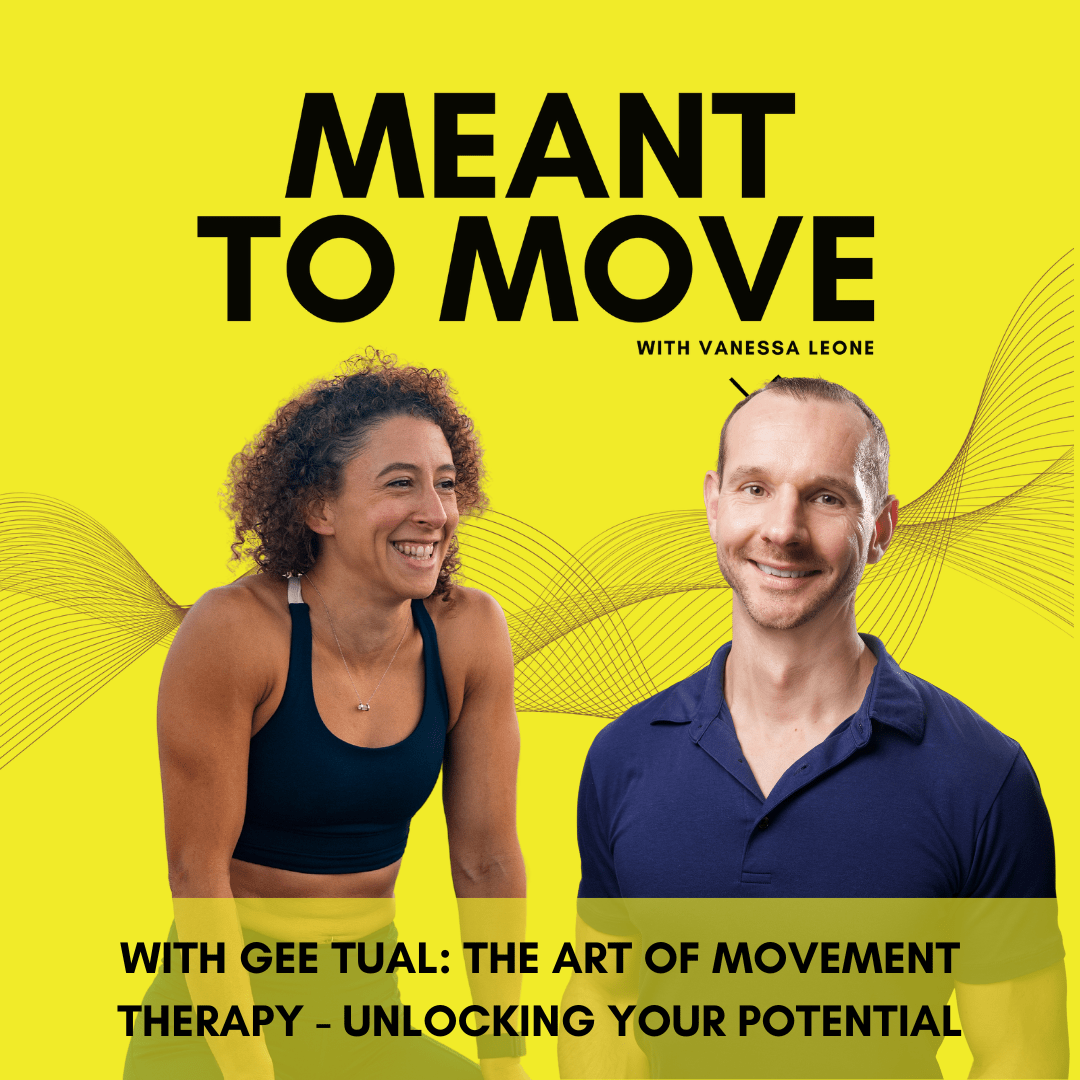
The Art of Movement Therapy: Unlocking Your Movement Potential – Episode 2
Vanessa interviews Gee Tual, a movement therapist and personal trainer, on redefining fitness through holistic approaches. Gee discusses blending manual therapy with movement techniques to alleviate pain and optimize mobility. He highlights innovative methods like Animal Flow, emphasizing its benefits for neuromuscular and cognitive function. Stressing the importance of flexibility in fitness, Gee shares his “Ask, Assess, Adapt” protocol to tailor sessions to clients’ evolving needs. The conversation underscores the value of open-mindedness, creativity, and individualized care in promoting long-term health and well-being. Gee’s insights inspire a shift from rigid programs to a more integrative, adaptive approach to movement.
Vanessa (00:00.917)
Hello and welcome to Meant To Move. My name is Vanessa, as you know, and today I have with me the wonderful G, G -Tual. Now, if I’m going to pronounce your name properly, Guillame am I doing it okay?
Gee Tual (00:15.825)
So far so good, you’re nailing it pretty well done.
Vanessa (00:19.559)
My favorite Frenchman I had to try. now, Gee, I have you on today because you’re one of the few people who I know who have the same work title as me. And it’s right there on your shirt. If you’re looking at us, which you might eventually says movement therapist, Gee, and that’s probably because no one in Australia can actually pronounce your name. I’m Yeah. So tell me what do you actually do? Like.
What do you do?
Gee Tual (00:50.73)
I like you, I think I do a few things. We just mix it up, sprinkle a bit of magic and just stir it a bit and something comes out of that. So yeah, my movement therapist and personal trainer based on the Gold Coast. I’ve been in the fitness industry for 14 years. I started as a personal trainer, but I think like you, we have a lot of things in common, you and I that…
I guess at one point I did not identify well with I guess the definition of the stigma or perception of what personal trainers were or came across like for the general population. I felt like I had a bit more to offer and I was maybe thinking about things and how to help my clients slightly differently. And I felt like when I was people were asking me what I did, I felt like personal saying that my personal trainer was not enough.
or was this actually different just by the way of thinking. I went into this rabbit hole of trying to figure out what else could I be that would actually describe myself more. we have a friend in common named Alicia Smith, who was my business coach for a couple of years, the wonderful Alicia Smith. And I give her all the credits for that. She kicked my butt for about a year to actually really figure out where I would fit the most.
And we came up with movement therapy simply because I help my clients and the people I work with to improve their movement potential and regaining control of their body and moving away from pain. After that, what I use for it to achieve this goal is up to what comes up in my brain. So I use the mix of little bit of manual therapy and as well as lots of movement stuff.
personal training exercises from the PT catalog. So it varies, but the approach I think is much broader than what most of the personal trainers learn to do. And hence for me, it was like different therapies to help people move better, which obviously came up as movement therapy. There you go.
Vanessa (03:00.789)
I love it. Excellent. love that you’re talking about manual therapies as well as physical therapies, because it’s an aspect of what I do as well. And we’ve both extensively, I think more even extensively than I have gone down the manual therapy route. So when you say manual therapy, what does that mean?
Gee Tual (03:21.97)
good question because there’s a big gray area for the fitness people that you can do this, you can’t do that. So I’m definitely respecting the scope of practice and I’m more than happy to refer to other health and allied health professionals. Absolutely. The one who I trust, the one who I believe are doing the right thing. But I’ve done probably the first course on putting the hands on
Vanessa (03:24.363)
You
Gee Tual (03:51.682)
the clients in a certain way as well to teach the client to do the techniques was a course by Douglas Hill called neuromuscular activation, be activated, is a form of applied kinesiology, neuro lymphatic points. And it really works on another system, to be honest. Like it comes across sometimes with some voodoo magical thing, but
Vanessa (03:55.403)
you
Gee Tual (04:21.348)
you’re looking at the stress response and how the autonomic nervous system of the person is working, whether it’s more on a fight or flight mode or more parasympathetic, more relaxed. So most of the people as we know these days find themselves in that fight, flight, freeze zone. And obviously from that, the movement is automatically going to be affected. If we can bring that level down through some neuromuscular points or neuro lymphatic points, which is pretty much muscle testing.
then we get to reestablish probably a zone that is workable for the client. So that was the first time that I was put in front of some sort of manual therapy that I felt I could do with my clients or eventually teach them the technique and then see the results. And of course, in our industry, as you know, your personal trainers, you can’t touch your client, can’t do a lot. You can’t do a lot of things. Yes, you’re expected to see some sort of results, but I was like, for me, it doesn’t work.
If someone wants, if their glutes is not working and you’re trying to improve their personal best in deadlifts or squats or simply, you know, maybe getting rid of, trying to help reduce some sort of injury or anything like that. But if the tissues in the ground are talking to each other, you can do as many deadlifts or leg extensions or kickbacks or whatever you want. When you integrate that to the whole system, it’s just not going to work. So as a…
fitness professional, I’m supposed to help my client move better and move forward into their goals and movement. But the actual physical and mechanical concept that we learn as personal trainers is just not enough. So you have to think outside the box and look at what could be the roadblocks in the way for the person to stop moving a certain way.
Vanessa (06:01.247)
Mm-hmm.
Gee Tual (06:08.502)
or with difficulties. that was the first course that I did, which was mind blowing. It took me a little while to get around it, to get to fine tune the techniques. That’s for sure. But I use it, I used it again this morning on a weekly basis, definitely several times. And I also did a rock type course on cupping for movements during COVID online, which is a very short course. what I kind of liked about it is that they’re teaching you the
They’re teaching you the philosophy of it, of when you go into gliding with the cups on the person, what actually happens. After that, the way you do it, the directions, if you understand the purpose of what you’re trying to achieve and then you understand the mechanic of a joint and the tissues, then you can try to play with it and go, let’s see if we can free something. And as you know, touch has such a massive impact on the body from a sensory point of view.
And therefore just doing that can have an implication on letting go of some tension, what I call unintentional tension, which is a math. I’m sorry, I’m that one, because I love it. And so, you know, how do you use that if I feel like it’s something that needs to be… If stuff are sticky, you know, the fascia, the skin, the soft tissues, they’re stickier because of lack of movement, dehydration, stress, know, X, Y, sometimes that can be something that help as well.
Vanessa (07:12.201)
I like it. like it.
Gee Tual (07:33.22)
So that I did a rock tape kinesio typing course as well. So I guess from an extensive like manual therapy That’s probably the three that I that I do and I did those. Yeah, Gary Ward’s finding center Flow motion course, which is more about the feet as well and how we can do some mobility and on the feet So yeah, that’s that’s pretty much it, but I don’t crack people’s necks and stuff like that. I don’t know
Vanessa (08:03.115)
That’s very cool. And like, love, I love the power of manual therapy with exercise, but for someone who has never experienced that before, so, you know, they, they come to you, they think they’re coming to you for personal training. Maybe they have pain. you know, what, like, what goes through the process? Like, do you see your clients be like, that’s weird. Like, why would I do that? And then all of a sudden have this.
like epiphany, like walk us through the process a little bit.
Gee Tual (08:38.823)
What goes on in my head is, I don’t even know sometimes. There is a show on Netflix, I don’t know you’ve ever seen it, called The Good Doctor. It’s like an autistic young doctor in a hospital and then there’s the scientific way to go and help someone on the hospital bed and then it’s not working and then the camera goes onto it and you can see it because it’s autistic. It’s got this look.
Vanessa (08:47.701)
Yes.
Gee Tual (09:01.828)
and he’s kind of looking in the void there and then he can see what’s happening in his head and then he says, oh, try this here. I have a client, her nme is felicity, she says to me every time, every week she goes, oh, here comes the good doctor. Because we work on something and I’m this is not working and I just kind of like glance somewhere and she goes, here we go, he’s gonna think of something else here. Like if it’s not working, I need to find a solution that whatever it is to change. And I forgot your question right now.
Vanessa (09:12.607)
Hahaha.
Gee Tual (09:29.38)
in the process. by the end of the year, I have a course to teach health fitness professionals more about how to work with clients in that more holistic way, like that you share obviously very well. But I have this sort of protocol called Ask, Assess and Adapt. So asking the questions, like you said, someone comes for training and I need to know a lot about
Vanessa (09:29.555)
No, no, it’s great.
Gee Tual (09:57.846)
everything happens in their life, know, the way they slept, the hydrates, eat, stress at work, stress in the family, like all those things. You show up to me today in a certain way and you are not a textbook. You are trillions of sales right in front of me and you want to achieve some sort of movement goal, whatever it is. And I need to know what I’m dealing with. Then from that, that will probably prompt me to assess some movements.
that I go, I probably need to check that and see what it is today. And if it’s someone who I’ve trained for a little bit, I never assume that they are the same person at every session. Because between the last session and this session today, something else would have happened in their life, whether it’s positive or negative. So I would have some sort of movement assessment that would eventually give me an idea of like, this needs to be freed, corrected, activated, released, or grounded.
whatever it is that I feel. And we do this adaptation of either mobility or activation of an area of the body just to make sure they are present now for the moment, especially if I’m going to load them with weights, barbells, dumbbells, kettlebells, whatever it is. So I think my brain’s always going like ask the right question, assess whatever movement I need to see.
for this particular session and then we adapt to whatever needs to be And sometimes I would have like, yeah, today we’re gonna do XYZ exercises and then turn up, I’m like, whoop, throw out the window and we’re going to do something completely different. So because you’re not turning up the way I expected, I’ve stopped expecting eventually over the years. It’s a blank canvass every time they walk in.
Vanessa (11:42.119)
Yeah, no, look, you make, you make a great point about showing up a certain way. And I think that this is super important point for people who have never potentially thought about it, who show up to the gym and they do the same program, you know, for X amount of weeks. And there’s nothing wrong with that. I’m not bagging that. It’s a great, it’s a great concept and it works. But what I want to talk about is what you said there with is adapt. Is it, I feel like in the industry.
both for professionals and for people who want to like just work, work out at the gym and people who just want to come and do a class is that there’s an expectation that they have to meet the standard of the program. And if I’m not meeting the standard of the program, then I’m not doing it good enough or I’m not, it’s not enough. I’m not going hard enough or a, you know, I’m not progressing. And I think that that stigma of having to stick to a program can be
detrimental to a lot of people because of what you’re saying is that we actually, you come to me tomorrow and then I go see you in three days. I could be completely different. and I will be because I’m a female as well. So I’ll be completely different two weeks from now, right? Depending on where I’m at. and we just don’t take that into consideration enough. And I love that you do. And I think that’s such an important factor for people at home and, like,
When you’re talking about adapting, you talked about, you know, weights and things like that, but what else might you adapt?
Gee Tual (13:12.238)
Well, to go back to your point, consistency is key. And that’s how, especially if you go into losing some weight or putting on some muscles, we know that the consistency overload and progressive overload will give you the results that you want eventually from a strength or power point of view. But it’s not just about contracting muscles more and more and more and more. You are your sum of systems. Like I love that.
Dr. Perry Nicholson, who I’m a big fan of. I you’re like, yeah, me too. That’s why we’re friends. Because we’re like, we just get on and know the same people. But Dr. Perry, and I always give credits to where it’s due. Like I would not be here today without the people that taught me so many things. But he says like, there’s no system fails alone, no system heals alone. And I love that because at the end of the day, it’s a reminder for us fitness professionals that
We are sums of the system. have a cardiovascular system. We have a musculoskeletal system. We have a lymphatic system. We have all sorts of systems, neurological system, and they all work together. So just thinking that you are going to the gym and you’re going to stick to a program, the intention behind it, it may be okay, but at the end of the day, you have other things to consider. And that’s not necessarily your job. That’s the personal trainer’s job to go.
If I understand who you are today, where your stress level is, how much tension you have, if you are dehydrated, like if you’re rushing here and your heartbeat is up, like what can I do to maximize what you’re going to do, what we want you to achieve through that session in terms of a programming point of view with what I’m dealing right now. And I think that new trainers don’t learn enough about that because they’re not exposed to this. It’s very much a…
Hey, here’s a bag of muscles and bone in front of you and you’re going to give them something heavy and they’re going to lift it several times. And then from there, you’re going to gain muscles and lose fat. And I’m like, I’ve done that at conventions. You’ve heard me saying it as personal trends. I tell you, you are way more than who you are told to be. And the system in Australia is very much pushing the PTs down.
Gee Tual (15:25.9)
And I think this is where people like you and I have had enough of this and go, can do more, we can offer more, we can educate ourselves more to help educate our clients that consistency with the program is going to be good, but I’m gonna tell you that you need to drink more water, you need to rest more. So next time you come to my session, you’ll be much more optimal to start with and we can go on with our program as it is.
Vanessa (15:52.171)
It’s super interesting because I feel like it would be the same for you. I often get clients, once they start working with me for a little while and you realize the scope of what we cover in terms of a programming and education and like looking into that holistic health side of things. It’s a completely different world. You can’t unsee that.
Once you’re exposed to it, you can’t unsee it. So it’s not like you can go back. And I, and it’s really interesting because I can’t, you know, I feel like you’d be the same. Sometimes clients can’t work with me one-on-one all the time and that’s fine. And that like, you know, I would love to have a personal trainer three times a week, but there’s no way I’m affording that and living in Sydney. so I get it. but part of what we do is help you become.
Gee Tual (16:22.945)
That
Vanessa (16:47.433)
a little bit more self aware and a little bit more self aware and a little bit more self aware and that little bit of education and that little bit of education so that you can understand what systems influence your body. I have a client who I’ve been working with her for years and years and I want to hear a client story after this, but we now know that in certain months of the year, her work stress is so intense that we call those like
maintenance slash just get through months. Right. That’s it. So the intensity of the sessions comes way down. It’s way more restorative. We sometimes barely move. There is movement in there, but we barely move. And this has been a pattern and we’ve noticed it because the first few years when we were working together, I would keep, you know, she’s fit. She swims, ocean swims. you know, goes to group exercise classes.
We’ve noticed a significant decrease in pain, huge increase in, in her capabilities. So it’s all going really well, but we’d have these moments, these months where it’s like, it all fell to pieces, pain increased, no energy. And we’re like, what, you know, what’s happening? And it’s all work. It’s like she, her body, her mind, nothing can, she can’t take anything else. She has to have that complete sole focus and it’s too busy. we.
We can’t load her in the gym. can’t do anything that’s going to progress her in those months. And that’s so important to take into consideration. And that’s a very obvious example in for a client of mine, you know, we can, we can plan that pretty well, but not everyone’s stresses or triggers are that obvious either. and so from that story, like what comes to mind for you of a client story or something similar like that.
Gee Tual (18:38.612)
So many. I’m going to circle back a little thing about that idea that makes you someone quite versatile with like a tool box that you just like open. I actually have a massive yellow bag in my car that looks like those magician bags. know, you just open and I’m like, what tool do I have? I’ve got bands, I’ve got rollers, I’ve got all sort of stuff when I train a couple of clients at home. But
Vanessa (18:53.867)
You
Gee Tual (19:03.3)
When I started my PT career, was working for a ski company, a snow skiing company. was making custom ski boots and orthotics. So guess for me the interest in the foot mechanic and the rest started then. But I was training clients for skiing before and after work. So I didn’t have a gym. At the time I didn’t have a car either. So was catching the bus, the train and the ferry to go from
North Shore, lower North Shore to Rush Cutters Bay, back to Circular Quay, and next to Tana Hall, that’s where the shop was, with my bag. But because I didn’t have access to gym equipment, I didn’t carry kettlebells, dumbbells with me. I think the heaviest thing I had was a bosu ball, and I was not taking it all the time. But you know, I did boxing and stuff like that. So I was forced to have this creative mind to go, I’m gonna train clients in small groups and had soccer moms as well.
Hello to them if you’re listening to this podcast. Remember those days 14, 15 years ago? But I had to think outside the box. And I think this may have, you some people have a more creative mind than others. Some were like more logical, more creative. think like naturally I’ve got more creative mind, but I guess I was kind of like thrown into the deep end to.
Vanessa (19:59.317)
Hahaha.
Gee Tual (20:21.326)
Gosh, if this is not working and I don’t have a foam roller and I don’t have this thing to release, what can I do to get the effect that I want? And eventually that translated to getting a bit more tools in my bag and then TRX bands and if it’s not working, if my client doesn’t get it, if they’re not responding to it, I’m starting to find other things and then social media as well when you get IDs and all that. So I think…
You have your ability with your clients to go through the month of the strong month. And then eventually you’ve got this period of like, she’s not herself. She’s completely different. And I can’t work with that technically, but you go in another space in your mind. Hello, good doctor. And how can I still make her benefit for coming to see me so she can go through those months here? And I think this is something that’s probably the major part that’s lacking in the fitness industry is that trainers get trained to do things a certain way without.
Vanessa (21:01.638)
Ha ha ha.
Gee Tual (21:17.546)
necessarily thinking that, they can do this, they can do that as well. That will actually build on to making their client progress eventually. I think for me, it’s always been like, if my client lives better than when they walked in, job done. What I do in the session, they probably don’t care.
They probably don’t care that I know all those things here that I use a former or a kettlebell or anything. They don’t care. They’re just here to feel certain way to get a certain results or puff or feel they got massive gains or whatever, which is fine. Um, I think probably one of the first time that I experienced this and go like, Oh, there’s something there. And I had, um, I had a client in Sydney. He’s
He’s 50s, early 50s and we were working, he had back pain and we were working on his lunges because he had the lazy hip, the girlfriend hip. So we’re working on, I heard this is something depending on the country, they have the lazy hip in America but they call it the girlfriend hip, like what’s up girlfriend?
Vanessa (22:23.016)
That’s so good.
Gee Tual (22:23.3)
Okay, so lazy him or girlfriend him, whatever tickles your fancy. But Steven, that’s his name, that’s my client, Steven. he, one day came to when I was working at Fitness First in Sydney. And he, that was a Friday morning, and he was completely, like he was stressed, completely drained. And he’s like, okay, let’s go through our session. And my first, and she’s like, no, we’re not. Like, what the hell are you, what is this in front of me?
And you kind of, I remember feeling that, oh, this is going to be such a setback because we’re progressing quite well. And right now I literally have like mashed potato in front of me, but, and he turned up, you know, to his credit. He could have definitely call and say at at six 30 session, I’m not in, but he turned up and I remember taking him to the yoga studio that was empty at the time. And I introduced him to Animal Flow.
because I was super excited about it. I was like, I think we can do something here. It was just quadruple movement training. It was body weight. And it was just teaching him to do like, know, beast activation, crab activation for traveling. And we were traveling beasts and we did some crab reaches. I think that’s pretty much, that’s pretty much it. Like it was very basic, but he left the session feeling like, I feel like I worked out without working out. I moved my butt. I feel so much more like.
awake in a sense. And he said to me for 45 minutes, I did not think at all about work, about my deadline and my meeting with my boss. Like that was a very stressful day for him. And he’s like, I literally for 45 minutes, I could not think about it because as you know, with Animal flow, you’re in the zone. You cannot think of anything else. So
That was very interesting that I kept him in a physical activity that was not what we usually do. I also ensured he seemed to something that’s challenging yet fun, but worked his body in the way that probably allowed him to get rid of that tension, that unintentional tension, not that physical tension from training, but that stress tension that gets loaded in the tissues through movement, through body weight movement and getting to all his mind out of it. And…
Gee Tual (24:40.968)
From then on, which was funny, he asked to do more of that and then fast forward six months later, all we’re doing was animal flow in Observatory Hill when we trained that side. So was hilarious. And it had told me it’s improving my running, my cycling and swimming because he was doing triathlons as well. So I’m like, okay, I found another tool that makes him move better.
Vanessa (25:03.411)
Yeah. Well, you’ve gone and done it and I knew you would at some stage. So I had this question planned, but you, you, you, went in a little earlier than I thought, but we’re going to go for Animal Flow. So for someone listening, I think I love Animal Flow. The one thing that I don’t like about Animal Flow is the name because I think it sounds scary to most people. I think it doesn’t describe.
Gee Tual (25:14.852)
Gee Tual (25:25.92)
you
Vanessa (25:32.501)
how incredibly awesome it is for the body. So what the hell is animal flow? What’s a crab reach? And what are you doing to the body when you’re participating in an animal flow?
Gee Tual (25:49.38)
Yeah, so I realized before I just talked about the beast crab and the listeners might be like, I don’t know, it’s like a menu from a restaurant, like I don’t know what’s going on here. It’s a very good part. Ness, I can’t agree with you with the name, but I think it’s way too late to change anything. And you know, it’s been 12 years and Mike Fitch can have a conversation about that.
Vanessa (25:57.323)
you
Vanessa (26:09.643)
No disrespect. No disrespect.
Gee Tual (26:13.25)
No, no, but I had that question before from myself and other people anyway, so it’s pretty cool. It’s pretty cool with that. But Animal Flow, first of all, you don’t have to have a pet and bring your pet to the session because I did have this question asked a few times. Do I need to bring my dog? You can if you want to, but it’s not going to help you.
But animal flow is a form of quadrupedal movement training, meaning that it’s going back down on the floor, connecting the hand and the feet with the ground and moving your body around the ground. So more so of a closed chain type of exercise, opposed to an open chain exercise that would be like lifting weights. The main, the concept and the idea behind animal flow is to simply improve the connection, communication and function of the human animal.
At the end of the day, we evolved crawling as babies. If some listeners can remember the early days. Or if you have a child, you would see that. And there’s a kind of reptilian dragging your belly on the floor that evolves into what we call baby crawl, which is six-spong contact, hand, knees, and feet before you start that squatting to standing process. And eventually evolves to walking.
running, jumping, what we do now here. And with that period of crawling, there are lot of discrepancies that can happen in the evolution of the human being, not only physical, like hand-eye coordination, for example, but cognitive as well. So we know that when we move the opposite limbs in the crawling pattern and load them a certain way, there is more communication between the left and the right hemisphere of the brain.
We know that the way to actually look at the ground close to us and in the distance, depending on the movements, that biocular motion improves something, that communication in the brain, and is very helpful for cognitive skills like reading, memory, communication, and so on. So this aspect of crawling from an infant point of view has all those benefits, are physical.
Gee Tual (28:28.908)
for the gait pattern of moving opposite legs. Like when we walk, we have the opposite arm swinging with the opposite leg, but also cognitive that helps the development of the brain as an infant. Now fast forward to an adult life, why is it still beneficial? Because we walk, we run, and then we can talk and read and write and all that. But if you think that we can improve those skills, or if we have that…
that decrease in mental capacities, we can re-implement that into the neuroplasticity and retrain the brain. I’ve implemented that with a client with Down syndrome, a client with cerebral palsy and Parkinson’s and there’s been some good results from that. So that’s been really cool. So for me, Animal Flow is a form of training, like you mentioned, it’s great for the body, it makes you move in so many different ways in three dimensions.
but there is this element where you can feel the connection between the brain and the body that is for me really hard to match from an other type of exercise system.
Vanessa (29:34.835)
You answered that question so perfectly. That was beautiful. Well, I think you talk about, I think this gets questioned a lot. People are like, why would you crawl as an adult? Right. But if we think about how disconnected we become from our natural body, our natural state, just because of the environment that we live in in society.
It makes sense that going back to something that you did when you were a child helps you reconnect with your body. helps you quite literally. You have to be present because there’s so much coordination that’s involved. So even if you just took it for that, you mindful the talk about mindfulness and mindful practices is huge. know the benefit of it. And that doesn’t mean just sitting there like with your legs crossed and like, you know,
in peace, right? I struggle with that kind of mindfulness because my body likes activity. So animal flow for me is like meditation. It’s just a way to connect completely with my body, be completely immersed in it. And you get to feel so much of what’s happening. Because your hands and your feet are the one of the most sensory rich points in your, in your body. that information that you feed to your brain is
Gee Tual (30:33.732)
to.
Vanessa (30:57.245)
Insane. It’s so cool. And you talked about open closed, open and closed chain skills or movements for someone who doesn’t know what that is. How would you like, how would you describe that? What are they doing in the gym? That’s open, closed or my God, open chain and closed chain.
Gee Tual (31:16.836)
Open the door, close the door. There you go. I think maybe one of the easiest way to explain that is that what is actually moving? Are you moving your body around a fixed object versus moving an object around your fixed body? So exercises that one would do at the gym would be, for example, a pull-up where the bar is fixed and then you’re moving your body around the fixed bar up.
Vanessa (31:20.821)
Yeah.
Gee Tual (31:45.22)
and versus a lat pull down where you are anchoring your body and you’re pulling the weights towards you. At the end of the day, the targeted muscles, the lats, as the primary mover for those two exercises would be the same. But one is you’re moving your body towards the activation would be coming from almost the ground up in a pull up as opposed to down from the top down on the lat pull down. Same thing with a squat or a leg press.
A squat will be a close-chain exercise where you are anchoring yourself on the ground and you’re your body on the fixed object of the ground versus a leg press where your body is the anchor and then you’re moving the weight in front of you. So in animal flow, the ground is obviously not moving and you’re manipulating and pretty much being a shape-shifter.
Vanessa (32:38.101)
changing shape. Yeah.
Gee Tual (32:42.338)
shape-shifter around the ground but also adding that load variability where because you’re moving your body in space the load on the tissues and the joints is constantly changing. It’s never the same repetition. It’s pretty much impossible to repeat the exact movement from a loading point of view at any given point. So think of that from a stimulation point of view of your nervous system and
probably I guess neuromuscular activation where your brain has to figure out where your body is in space at any given point and in return has to create some neuromuscular activation to stabilize and move your body to create the next movement.
Vanessa (33:25.909)
So it’s a very fancy way of saying lots of mindfulness, lots of coordination, and you get a really good amount of muscle work as well. So it’s not like, you you’re not doing weights or anything like that, which is where I think people get, you know, they look at animal flow and they don’t think that it’s going to be hard enough or they don’t think it’s resistance training, but 100 % is.
Gee Tual (33:50.948)
And that’s 100 % true, it’s underrated in that sense. Oh yeah, it looks cool. I remember I had some people coming and say, oh, you what is this? You know, it looks like capoeira because it does have movement from yoga, capoeira, break dancing, parkour, gymnastics and calisthenics in it with a twist, with much more of a science-based element of it, of why we want the intention, the sequence of each movement. There are more papers than one came out.
just before Christmas, I think one of the guys in the university in America used animal flow as a system to look at how much muscular activation in a push-up versus forms of movement in animal food that use the same muscle groups and see which one has more activation. And they found out that through like they had like captors and sensors on the body.
that there is actually more neuromuscular activation in the animo flow movement than there is in the body weight exercise. So they want to do more research about that, about other type of exercising and movement pattern to understand why the demand on the body when you position yourself with load variability in animal flow is greater than just doing a body weight exercise. I I love body weight exercising in general. I know you do too as well. Again, it’s underrated.
And it’s much more, I guess, from a longevity, from the human longevity point of view. I think it’s great to know how to just move your body in space before you start lifting the other weight. But yes, that aspect of animal flow is that workout that’s underrated. But I had people in Sydney going like, well, it looks like you need some coordination with that. I’m not going to do it because I don’t have coordination. And my response was like…
If you don’t have coordination, do something that requires coordination. How do you get better at something that you are bad at? You do more of it. Don’t be scared.
Vanessa (35:49.151)
Yep. It’s the same thing. I can’t go to yoga. I’m not flexible enough. Number one, yoga isn’t designed to make you more flexible potentially depending on the yoga that you go to, but like it is, that other side of the coin. Well, yeah, we don’t want to be bad at things, but to be better at something, you have to do the thing that you’re bad at, at least initially. And when you have a teacher as good as you, G, then you won’t be bad at it for very long.
Gee Tual (35:54.028)
Yeah!
Gee Tual (36:00.1)
Thank
Gee Tual (36:15.204)
Thank you love.
Vanessa (36:20.209)
Excellent, excellent. So here’s a personal question. What are you doing currently for yourself that you would call movement therapy? how are you helping yourself at the moment?
Gee Tual (36:36.226)
massage yesterday with our brilliant massage therapist here, Mickey, to start with. My style of training is probably not conventional in the sense that maybe like you, I get bored very easily. So I’m probably a personal trainer’s nightmare because that consistency in
put me in the gym to go into weight training. I’ve tried that and then at one point I’ll be like, okay, today I’m gonna work on my shoulders and do this and half-width row session. I’m like, I’m gonna do a cartwheel and a handstand. And it’s like, this is gone. Like the whole like strength training is gone because I just, I may have ADHD. I’m never gonna get tested for it because who cares? I don’t care. I don’t know. I’m just fine the way I am. But I think variability and I’ve noticed that when I’m going through phases of doing strength training,
I lose a lot of the mobility aspect, which I can’t afford with animal flow being a master instructor. I can’t afford to be bad at to teach people. So I’m always interested. Like if I go online on Instagram and I see an exercise that looks different and someone explaining it about, Hey, this is actually going to load the glutes a certain way or do this and that I’m going to try it. kind of like a bit of a scientist, scientists go like, Oh, I’m going to try this, this, this experiment here. And
and I guess make my own formula out of that. I’ve started to swim again when I can, early in the morning. If I start a little bit later, I’ll go for a walk. I’m very lucky to live on the beautiful Gold Coast and the weather has been quite good, not the last week, but overall it’s pretty good. So just go like a nice walk around the water and I applied the mobility stuff that I did in my client’s studio at home.
Vanessa (38:25.739)
you
Gee Tual (38:27.689)
I feel I have to do it to walk the walk, right?
Vanessa (38:31.731)
Yeah, the mechanics cars, no. look, I would say we’re pretty good at walking the walk most of the time. But that’s great. Like you mentioned a whole bunch of things there that could be used as movement therapy. And I don’t think you need ADHD to not want to do the same program again and again. so anyone who’s listening, you know, you don’t have ADHD if you don’t want to do the same program again. Like that’s not what we’re saying here. But what we’re saying is it’s okay to want that. Like not ADHD, but you it’s okay to want.
Gee Tual (38:46.884)
you
Gee Tual (38:54.091)
Thank
Vanessa (39:01.457)
not doing the same thing again and again. Because that was, think, you know, this is a good place to finish is I hate doing the same thing again and again. That’s what drew me to group exercise, because you go into a group exercise class and it’s always just a little bit different depending on the instructor and what you step into. I think that’s why people love Pilates reformer, right? Because it has the feel of
You know, doing things a little bit differently. It’s a little bit sensory, you know, your feet are on a bar, your hands are in straps or, know, doing something. So it’s sensory. so I get it and it feeds information to the brain. but I, I don’t know about you guys. I would get bored even just doing Pilates reformer three times a week. Like I need to have things that are even more variable than that to be able to stay like stimulated and entertained by my own movement and.
I see that in my clients, like a lot of my clients, they’ll do one type of group exercise class and then another, and then they’ll do a PT session and they’ll go into the gym. And I don’t think that, you know, you have to do the exact same program week in week out to find progression. And I think there’ll be a lot of people in the fitness industry who’ll scream at us for saying that. But I sit here have gotten stronger.
in my mid to late thirties by doing less and not doing the same thing in exactly the same way every week. It’s very similar, but it’s not the same thing. And by listening to my body, by taking it down when I, when I can’t and by pushing it up and I have energy and, and that in itself yields like no injuries. Like, I, like I can get up and do whatever I want to. And
It’s, I think it’s a very underrated way of moving because everybody wants a system. Everyone wants the answer, you know, he’s the answer, but we’re essentially saying is we like that. That’s, not the answer. There is no answer.
Gee Tual (41:12.452)
I’m about to turn 47 and I’m probably the healthiest in a way or the fittest that I’ve ever been and less injured. And I do have every now and then, you know, like a niggle somewhere, like I don’t understand why, but you know, like that’s my job to find out. I’m like, you can’t do it with yourself. But you’re absolutely right. The thing that I see is that we have the knowledge of
different systems, different physical activities, different options to move the body. And by design, humans are designed to move. Sports is a pure invention for entertainment. But way back, we climbed trees, we climbed on logs, we swung from ropes, we climbed rocks and mountains, we jumped, we crawled, we rolled.
Like all those things, like go to a kid’s playground. Those kids are like three, four, five years old kids, they’re on a monkey bars. No one has taught them how to hang, right? You take an adult in a gym, less than half of them will have the strength to hang, right? Because we lose that. Yet from an evolution, like cellular point of view, we are designed to do those things.
What I see probably is that in the industry, if with the general population, people don’t have the awareness of the benefits of the other things. And if you walk around, I don’t know much anymore, whether it’s like in Sydney, because the Gold Coast, every block has some sort of studio gym, like Fit Stop, F45, BFT and all that. And again, great, we have more places to exercise. Doesn’t mean we’re a healthier society with less chronic pain.
So I find that quite ironic, right? Hey, here are more opportunities out there for you to exercise and move, but you have more back pain, foot pain, knee pain, neck pain, and so on. again, I think for me, and it’s been like my big call the last couple of years is I think we need to change the conversation from the inside out, from the industry. As fitness professionals, we need to tell our clients that…
Gee Tual (43:23.126)
Like you said, if you feel like you want to go for a walk, you want to change to a different group exercise class and all that, there will be benefits. Children, tell them, like parents would say, no, my son is only going to play soccer. And it’s like, no, go and play other sports because you’re going to develop all those motor skills as a child. You need to experience. Why not with adults? You know, you’re only going to be a good swimmer if you just do swimming, but you can be a better, more complete human being that that function through life for longer.
in a better way if you are doing other things but you don’t necessarily know the benefits until you try something or someone tells you a trainer or a therapist to say, hey, go and try that, these activities. And if you don’t like it, that’s fine. But there’s a a chance that you’re going to like moving differently. And yes, it might be challenging but that’s where you’re gonna get growth. So I’m all pro like go and experiment as many different types of movement classes, sports, gyms and all that as you can.
Vanessa (44:22.847)
Yeah, yeah, I think, I think that’s where, you know, I, I want to be like a fitness acceptor. get really annoyed at, people in the industry, you know, picking apart everyone else going like, that’s a terrible thing to do. Why would you do that? You know, we don’t know that person’s story. I don’t know the context of why they’re doing what they’re doing. And it might look weird or strange or potentially maybe dangerous, but we have absolutely.
no other information other than what they’ve put in that post and you know, they or what their intention of that post is as well. So I just think there’s so much very quick to judge. And I love that a really whole part about how you describe movement therapy and, and one of my ethos is like open-mindedness, just learn and go and try things and experience things in a completely different way. And I like that is a, that’s, that’s huge for me.
Gee Tual (45:21.348)
I think our job as fitness professionals, you’re, know, however you want to classify yourself, know, PT, move therapists or anything else, is that we need to be educators and facilitators for movements and for bettering the humans are in front of us. Like that’s our job. Our job is not to just make someone do bicep curls. That’s part of it. But ultimately, if someone comes to a personal trainer, there’s an element that they want to get better at. They want to
They wanna feel better, they wanna move better, they wanna feel stronger, they wanna have a better image of themselves. Like something needs to change. You go to see a trainer or movement therapist because you feel like you need an improvement somewhere. And that’s our job to go and kind of like analyze it and go, good, this is what we see, this is what we’re going to do. And at end of the day, animal flow, a kettlebell, cupping,
beds, whatever, it’s just a tool. And us as professional, it’s our job to educate the client to say, this is what we’re going to use to get you to that betterness of yourself. But also we’re going to facilitate the process, but also tell you what you need to do to get more results. Because one session with me and then you take six days off and you come back, that’s kinda like, you’re not gonna get the changes you want. You need to take ownership.
of your life and on how your lifestyle changes. And that’s our job to do that more than just working on your deadlift PB.
Vanessa (46:59.797)
What a great place to finish. That was like, did you know you were going to end there? Like that was, that was.
Gee Tual (47:07.78)
No, it’s that inspiration through the screen. I he’s just like, I told you before, you and I, can just like see each other somewhere obviously at an airport and we’d probably miss our flights because we were talking at a table at the airport for hours. Yes.
Vanessa (47:21.955)
context for that, for you listening, and I have lived in the same state and not seen each other until we’ve had to go and present at an overseas conference at the same time. So, you know, it’s just the way of the world, but I’m always so glad to speak to you, always. And I will definitely be getting you back on. Thank you so much for your time. I appreciate you.
Gee Tual (47:44.204)
my pleasure, my honor to be on your podcast. I highly regard what you do and I’m very honored that you asked me to do that.
Vanessa (47:51.423)
Yeah, well, until next time.
Gee Tual (47:54.34)
Cheers.
 Vanessa Leone Movement Therapist