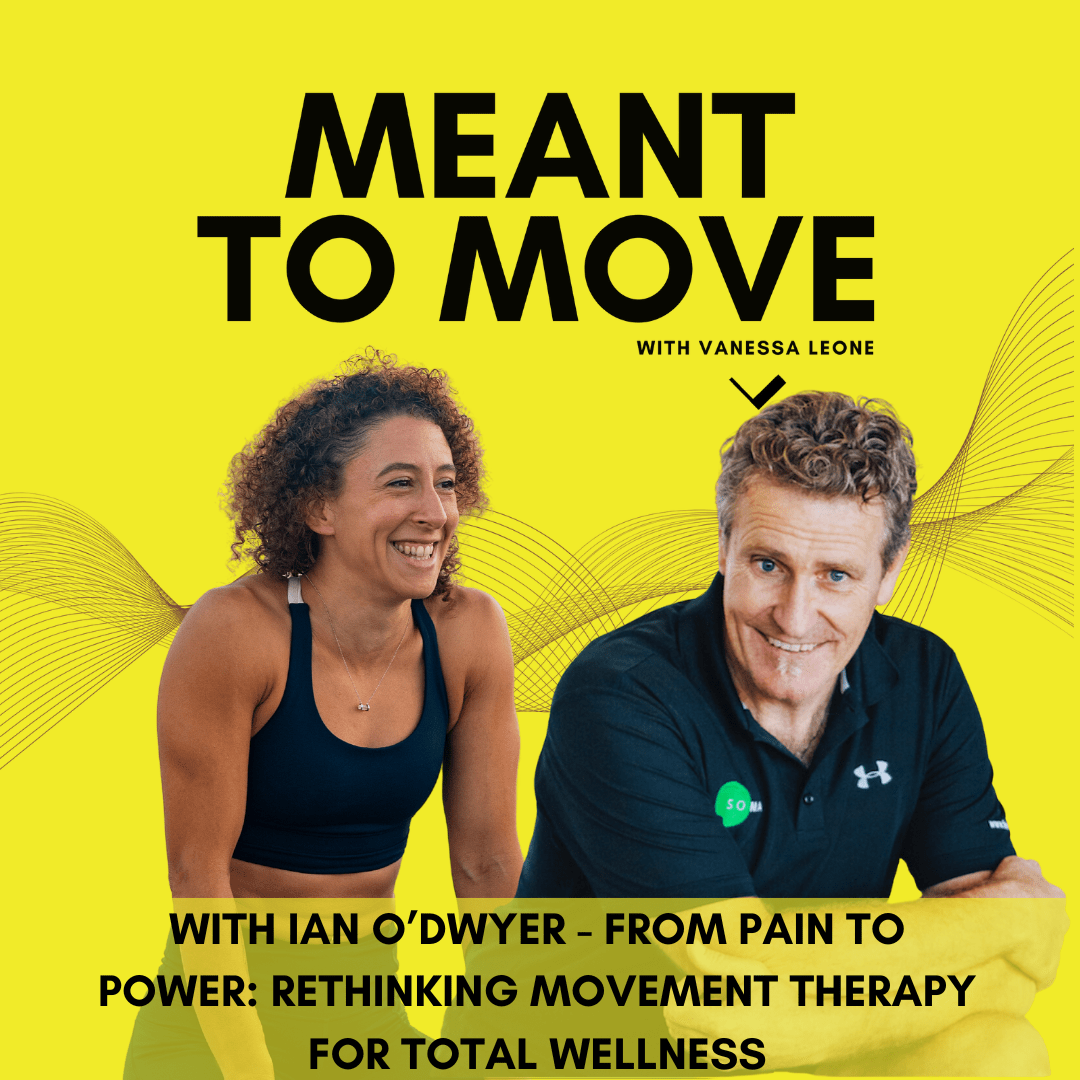
From Pain to Power: Rethinking Movement Therapy for Total Wellness with Ian O’Dwyer
Summary
In this episode of Meant to Move, Vanessa interviews Ian O’Dwyer (OD), a “movement coach” known for his holistic approach to movement therapy. OD shares his journey from semi-pro sports and plumbing to becoming a movement mentor. He emphasizes the importance of inclusivity, emotion, and interoception—listening to internal body signals. Through anecdotes, OD explains how tailored movement practices can prevent injuries and enhance joy. He advocates for intuitive, low-risk interventions like grounding and fluid flow exercises. This conversation underscores the connection between emotion, intuition, and physical well-being, offering a refreshing perspective on fitness and health.
Transcript
Vanessa (00:01)
Hello and welcome to Meant To Move podcast. I’m Vanessa. I am so happy to introduce you to Ian O’Dwyer. You’re gonna hear me calling him O D, but I have developed a new nickname for you O D called Movement Yoda. How you feeling about that?
OD (00:20)
Yes. Wow, I’m over the moon. I’ve been called many things. That’s quite pleasant, yes.
Vanessa (00:30)
Yeah, and it works really well, know, OD in the name Yoda. I just, I was like, this is perfect. I, you know, you have been my mentor for nearly my entire career in the fitness industry. is my 18th year. And, you know, we’ve known each other for quite a long time and been very lucky. And I suppose what I really want to talk about today is you.
and movement therapy. And so I think the first point of call is when someone asks you what you do, how on earth do you describe that to that person?
OD (01:15)
That’s a really funny question. I’ve got clients I’ve had for 20 plus years and they still struggle to define what I am. And I guess the interesting thing is, Ness, I probably struggled for a long period of time because we all came into this industry thinking we were going to be personal trainers, yet the industry’s very good at giving titles out but not having definitions of what those titles actually mean.
OD (01:44)
So was I a personal trainer? Well, when I actually went back and defined the word trainer, dogs and horses have trainers, so I didn’t actually consider myself to be a trainer. I considered myself to be a coach. Coaching is what I’ve always done. I’ve always been coached, so therefore it was just natural to go in and become a coach. And so when I looked at what I did, you know, really what I did was I, know, movement’s my gig, as you know, I just…
I see movement, I love movement, I love moving. So therefore, the word movement and the movement coach just sort of to me fell together. Now once again, that’s confusing for a lot of people because what is a movement coach? Well, if we clarify that, movement’s really simple, it’s everything. It’s everything. It’s everything from allowing people to sit into chairs and get out of chairs pain free to getting.
kids with learning disabilities to be able to have confidence enough to be able to speak up and to have confidence to have a thought and to be able to articulate that. And then throw the stuff in between, the mums and dads, the human beings like you and I, the elite athletes, know, everything in between. So a movement coach for me was understanding and being able to create movement inside a human being that is inclusive.
OD (03:07)
So we talk about mindset, we talk about breathing, we talk about function, we talk about isolation, we talk about loading, all of this stuff. Well, you’ve actually got to put that together. So when we’re talking about movement, I want to be talking about inclusivity. I want to talk toes to nose, I want to talk breath, I want to talk enjoyment, I want to talk about your heart, I want to talk about your gut, how does that feel? I want to talk about doing movement
that actually creates happiness and joy inside you, not that it’s a chore or that it’s something that you are not gonna do that’s hard. And coaching, know, coaching, listening, not telling, know, guiding, not showing, asking, asking what the person in front of you feels and listening, not just with your ears, but listening with your everything, with your interoception, right?
And that’s the biggest thing for you and I, Ness, where I’m excited where this is gonna go is this is a completely different perspective on what movement therapy is. It’s a key to unlocking the potential in the person within us and in front of us.
Vanessa (04:30)
Yeah. I always love the simplicity of the words that you use at the end because similar to you, I’ve struggled for so long to articulate what it is I do as a movement therapist or a movement coach, you know, that those words are kind of interchangeable. And I suppose I stumbled upon therapist for those reasons that you said in terms of inclusivity and emotion and actually asking.
my clients what they want to do and trying not to tell. the hard part is, you know, I always found this paradox really interesting is your clients will come to you asking you what they should do. I use the word should in inverted commas, but nobody likes being told what to do.
OD (05:17)
Thank no. And I think it’s interesting, Ness, how I have no problem suggesting opportunities or potential things that they can do. However, hasn’t that got to be congruent with what their likes are and what their needs are? So, you know, if they’re going to exercise, shouldn’t that show up in a manner in which it brings joy and happiness to them? And also, it mimics…
Vanessa (05:23)
No, and-
OD (05:48)
the movements, the challenges, the tasks that they have to do in that sport, in that daily activity, in that meeting, whatever.
Vanessa (05:59)
Wholeheartedly, wholeheartedly. That’s a great start. OD, Yoda, whatever I’m calling you these days.
OD (06:04)
Hahaha
It’s a smile,
we’re off, that’s the important thing.
Vanessa (06:12)
I would love it if you could give us this, what’s your movement story? How did you get into moving and movement?
OD (06:25)
Wow, that’s a great question. And then it’s a question I reckon we could talk about for two days because there’ll be many people listening to this that will have a similar parallel. Big family, we all had played sport. Mum was a good tennis player. Dad was a good footballer. Obviously big family, so therefore, mum kept playing tennis, but dad had his horses. So as a kid, always were running, cross-country running was my…
OD (06:54)
was what I loved because it just gave me freedom. was in a country town in Victoria where there was nothing there except tennis courts, squash courts, basketball courts, football oval, cricket oval. So, you know, played a bucket load of sport and I was your consummate under-recoverer. So I would run, I would stretch six days a week. I would do everything to the nth degree to be the best.
And that’s just, you know, I had a brother who was very, very good at Aussie rules. He was signed by Geelong at the age of 18. A week later, he broke his neck playing the same sport. So, you know, that was my aspiration to be, to reach his level, right? And I didn’t, didn’t quite get there. And I had a lot of injuries along the way, not anyone’s fault, more the fact of the way we looked at the body and conditioned the body. And once again, as I said, me being an underage,
Not an over trainer because we have to understand that over training you can only do once in a preparation under recover You can do regularly once you over train you have to take weeks off to get your body healed But under recovering you can train every day and not recover and of course that breaks you down anyway So yeah those experiences all those injuries those experiences actually added to my resume I’m not an academic as you well know
I’m a plumber by trade, ex-semi-professional sports person. But all of those things came together to give me the ability to create solutions for people because movement is what I saw coming from a horsing background and then a sporting background. Movement just made sense to me. But movement made sense to me in every direction, not some directions, Ness. You know, we lowered our athletes very linearly.
We do compound movements and think they’re functional movements. And some could argue that they are potentially. However, they don’t mimic three dimensionality and three dimensionality forces for loads. And that’s a very big area.
Vanessa (09:00)
When you’re talking about three dimensionality, could you give that like a, a really simple explanation for someone listening.
OD (09:07)
Yeah, sure. So think about, think about I’m standing in a room and I’ve got a piece of glad wrap over me and it’s all around me. And what I’m gonna do is I’m gonna take my hands and I’m gonna take my hips and I’m gonna push that glad wrap as far as I can away from me and I’m gonna call that my movement bubble. So anywhere that I can reach in any direction, that’s three dimensionality. That means there’s gravity coming down on me, there’s…
There’s ground force pushing back at me, there’s my momentum, and there’s my mass. And I’m using all of those to create this functional bubble of mine. Now, if I’m conditioning people well, if I’m conditioning myself well, that bubble should get bigger. And I should be able to accept more forces in that bubble, and I should be able to attenuate those forces to pass those forces on so I don’t break.
Vanessa (10:00)
like. So you’re, you’re a plumber, you’re a semi professional athlete.
How did you, like, where was that step into the fitness industry?
OD (10:11)
that transition?
Well, it was way back in 97, just, know, plumbing was going through some big changes. I loved using my hands. I really, really did love using my hands and solving problems. But it was just going through a big transition and I thought, well, why not follow my heart? Why not do something that I’m really passionate about? Once again, back in those days, what we thought, what I thought personal training was and what it was, was two different things. It was weight loss and it was hypertrophy. Well,
You know, we’ve done hypertrophy many times, and all I’ve seen is injuries. And weight loss wasn’t really my gig, because what I realized very early on is a lot of weight loss or weight gain is about the emotional anchor, not necessarily about food in mouth. So if I can get to the emotional reasoning, I can change the outcome of that person who has those eating challenges. So I didn’t really want to go down that path. Movement was my gig, where I just didn’t want people being like I was, being injured.
being unable to fulfill my dreams of doing what I wanted to do because I couldn’t train or I couldn’t move or when I did it was limited. So, you know, going into that personal training mode and then in a very short period of time realizing personal training really wasn’t what I was about. And then I met a guy called Richard Boyd who I bought his studio on Noosa which was the only personal training studio on the Sunshine Coast at that time.
And that was back in 1999. as I say, he took off overseas and started a company called Personal Training on the Net, which was basically then a very young company, but within a very few, very small amount of time, a few years, it became the largest educational website in the world. So I got to go overseas in 2002, so three years after I bought his studio, I went over to the States, met an amazing bunch of people.
started to work with them and learn from them and share with them and it was just amazing, was amazing, right? you know, I guess, Ness, if we think about the universe bringing positive people together with, you know, an eclectic idea, you know, all these guys come together, we got on so well, there was no ego, it was just easy.
Vanessa (12:26)
It’s really interesting to me hearing you talk about, know, really early on in your fitness career, coming from a background of professional athleticism, even semi-pro, and plumbing, which stereotypically you would call relatively ego-driven, male kind of macho, you know, realms.
And then the first thing that you say is that you realize that emotion is way bigger than, you know, weight loss or anything like that. I like for me, you putting that together then from those backgrounds, that’s incredible. that’s
The emotional intelligence of that is huge. And that was one of the biggest drivers for me and the biggest learning things for me coming from when we, when I started learning from you as, as a mentor. what do you, what were some of the challenges that you faced? If you think about early 2000s, you know, we’re not talking about mental health epidemic yet. There’s, there’s very little mind body kind of awareness. How on earth are you talking about how emotion affects your motion back then?
OD (13:47)
Well, I guess it was interesting. Some would say it was misfortune. I would say I’m one of the luckiest people in the world. I grew up with an amazing family. We didn’t have a lot, but we had each other. We had horses, which I idolized and loved. got to spend time with dad and my brothers, who were just amazing horse people. And still are. I’ve got two brothers who are still alive, who are still involved with horses indirectly. But just their knowledge is amazing.
And then, you know, I’ve got a brother who had a vaccination, you know, a million years ago, and it killed portion of his brain. So, you know, in very early days at the age of two, he’s gone from a normal child to a child who has a learning disability, you know, can’t read, can’t write, can’t look after himself. And of course, I cut my eye out with a knife when I’m three, go to school, two years later, take a footy with me.
I wouldn’t give the footy to the kid in Form 1, I’m in preps. And he burst my eye. So from the age of five, I’d never seen with two eyes. So I guess intuitively, and that was a word that scared the heck out of me as I got into personal training because you can’t talk about your gut feeling, especially back then when neuroscience hasn’t connected the vagal nerve yet. But intuitively I knew that when I was playing sport, I was playing with fear.
and not scared of being hurt, scared of failing. So just imagine that, you know, I had pelvic floor problems, I had chronic groin problems back in those days, that’s what they called them. I was soon to realise that the base of my pelvis was constantly locked on. And that’s your emotion, that’s your gut feeling, right? That’s your fear, your base, your foundation, your base chakra. So I guess, Ness, for me, I was always…
OD (15:43)
I had the courage, I had to have the courage, I didn’t have the courage, I probably had to have the courage firstly to grow up with a handicapped brother, and I couldn’t call him handicap, I know people will be upset for using that term, intellectually disabled, sorry, used to be a handicap term, and he taught me so much about appreciation, he taught me so much about, you know, just simple things, you know, just…
everything you did put a smile on his face. You made him a cup of tea for a smile on his face. You gave him a Christmas present, a little matchbox toy. He kept the matchbox box around that toy for years. It was just interesting. was just those little things that probably I was being, you know, that were being pushed into me that I probably didn’t really understand. I probably wasn’t aware of at the time. But, you know, then when I started to evolve,
emotionally, if I started to evolve on all levels, I started to really look inside me to see who I was. And I guess that’s just evolution, for all of us it’s evolution. We first learn something, we run down this pathway wanting to help everyone with this knowledge that we have and then we realise maybe the knowledge is only a very small part of actually how we help people. Yeah, it’s a very, very small part, but.
It’s our intention, right? Our intention to help. And that’s the one thing that I’m so fortunate that my family gave me was my courage, my intention, and my ability to create solutions.
Vanessa (17:23)
Thank you so much for sharing that. It’s, yeah, the deeper I have dived over the last few years into trauma, the emotional journey, and I suppose that side of it is becoming more sciencey, more prevalent. And I’ve dived into it for myself, I’ve dived into it for my partner who has complex trauma. And, you know,
Where I first learnt emotion is motion, how many years ago? 15 years ago, maybe 14 years ago. I, part of the description of what I do now is a huge amount of talking about the way that you feel is going to influence the way that you move and the chronic feelings that you get has.
chronic influence in the way that you move and what’s happening in your body and the fitness industry. I think that they’re starting to address it. But I still think that in terms of mainstream, if you’re just walking into a gym or if you’re just walking into a Pilates class or a HIIT class, it’s hard to address your emotions when you’re walking into a
into a, into a big class or into a big workout. And I feel like, you know, people are starting from a much, much lower base than what the entry level is in the fitness industry in terms of where everything starts in. And I mean, everything, yoga, Pilates, you know, interval training, like everything just starts at this mid to kind of even high level. Like I’ll jump into some of these.
these workouts and I’m like, man, this is like, this is a really hard workout. Like why we feel this need to consistently push ourselves. And over the last few years with all of the things that’s happening in the world, you’re looking at COVID and this kind of realization of my body and trauma. And I just, can’t move like that.
And don’t want to move like that anymore. Like I don’t, I don’t enjoy it. I’m not in a mainstream gym anymore. And you’ve, don’t know if you’ve ever been in a mainstream gym, other than when you come and talk to us in mainstream gyms and it feels completely different. It’s a, and there’s nothing wrong with a mainstream gym. worked in it for 10 years and I, and I think that there are great aspects about it. I’m not.
I don’t want to dis on any part of the industry. think every, every part of the industry has its benefits. but I would not, you know, I’m three weeks post, endometriosis surgery at four or six weeks. They say I can go back into doing a cycle class or a Pilates class. There’s no way that I would, I would be comfortable with how I’m feeling to, to walk into that knowing, knowing how I do it. And
OD (20:09)
Nice.
Vanessa (20:34)
And I think that your insights and the challenges that you’ve had along the way have been incredibly amazing to be able to help people shape this different view of movement in the industry and the way that I do things. And I think it’s incredible. One of the things that I would like to ask you if you’re okay with it is like, what are you feeling like some of your personal movement challenges are
at the moment or maybe what some of the bigger ones were you know you mentioned when you’re a kid but maybe as an adult.
OD (21:11)
think always the biggest problem that we have is finding enough time for us. We do what we do because we want to make this whole industry, this whole experience, I’m not even going to use the word industry, this whole experience a better experience. You and I, many of us have been down the path of having to go through allied health wellness, we’ve gone down through specialists, we’ve gone down through conditioning coaches, we’ve gone down through
OD (21:40)
We’ve been involved on the other side of the spectrum. We haven’t been the leaders in the field. We’ve been the person going there for the advice. Now, I had a lady in here yesterday who is 76. She’s an ex-nurse. She’s had chemotherapy. She’s now got neuropathy for bowel cancer. And it’s interesting she’s had a back operation. And we just talked about fluid flow. We talked about reconnection. We talked about…
the fascial tissue and how it can, you know, send messages to the brain and all that sort of stuff. A lot of things that she hadn’t been informed of.
Now I believe that what we’re trying to do through this podcast, through this team of people, is give people the best possible information for them to allow to make the best possible decision on their actions. So for me, you know, I’ve got a blood challenge from traveling way too much and not having enough recovery. So as we age down the…
pathway, you know, you’ve got certain things you’ve got to take and do and you know that when you’re taking those medications long term, then it’s never a good outcome. So I’m always searching for these opportunities to change, to challenge and you know, my specialist at time, he scratches his head and said, what are you doing? But it’s having good people around you that you can bounce your ideas off. It’s having the ability to be able to stop and feel that interoception really important.
But not judge it, just feel it, just be with it, just sit with it. And it’s having the permission to actually, I know me better than anyone knows me. So, you you’ve gotta have the courage to have a relationship with yourself and not judge yourself, just appreciate. know, I wouldn’t change my life. I’ve had the best life ever. You know, I’ve got an amazing family. I’ve had some amazing experiences, got great friends, got beautiful, beautiful children.
OD (23:46)
You know, the places that my job has taken me, would never go, would never have been to the people I’ve met, the people I’ve worked with, right? But it’s interesting because the people that I’ve met, the people that I deal with, like you, are people who want to change this society to become an even better society. To get back to doing what we used to do, to caring for each other, to caring for ourselves, to eating real food, to moving like we should move.
to sleeping, appreciating grandfather sky and mother earth, and just common sense stuff, right? Just common sense. And it’s interesting, once again, all this research comes out, watch a sunset, watch a sunrise, and there’s reasons why we do that. And you think, I wonder if this research didn’t come out, would people continue to do it or not continue to do it?
You know, it’s just interesting sometimes it’s just that piece, right? It’s just the piece of just being, being in that moment. And that’s, you know, what’s made it so hard now is that we haven’t got that piece of being. We are all programmed to have to go, to be, to have, to be seen, to wear, to drive, to live, whatever, in certain types of, you know, names. So it’s…
My challenge is to be the best me, being the best me, practising the best me.
Vanessa (25:16)
Yeah, that’s awesome. You’ve mentioned interoception a couple of times and I want to follow on with what you said with an interesting story, but could you explain interoception for someone listening who’s not really sure what that might be?
OD (25:32)
Well, we’ve got various types of septions, right? We’ve proprioception, which is nerve endings, there’s external feedback that come from various types of receptors in, there’s a vast array of receptors. mean, fascia has four mechano receptors, things that the fascia gathers information from, from some sort of action. So interoception is listening to the feedback, the biofeedback that you’re
body is giving you and I’m going to primarily say in the heart and the gut. Now it gives you feedback from everywhere but 100 million nerve endings in the gut, the heart’s eight times the electromagnetic is stronger than the brain. So those areas I believe that area, those regions are the regions we really need to focus on because they’re the areas that we disconnect from.
You know, I’m seeing a lot of people now with this position of, and you can call it round-shouldered, can call it poor posture. You know, I think posture gets blamed for a lot of things. It’s just body position. But when people are closing their sternum, closing the front of their body, they’re closing down their vulnerability. Their heart’s being protected because it’s been broken, it’s been hurt.
Vanessa (26:31)
Yeah.
OD (26:54)
So it’s interesting when you start looking at some of the studies and what they’re saying now from, you know, broken heart to breast cancer and, you know, all these things that go along with it, you know, gut health, you you look at, you know, all the stuff that we have this pelvic floor that people are exercising, but they’re not exercising in all the different directions that the pelvic floor can actually allow us to move. And we wonder why, but I am exercising, yeah, but you’re doing repetitive movement.
over and over over over and over. In fact, that would be potentially a stressor. Not a health stressor, but a negative stressor. So interoception is basically for me is the ability to connect to you from the inside and listen to what the biofeedback system is feeding you. How does that feel when you walk into a room? How do you feel with this person in front of you? What does this food
give to you in a feeling? When you walk into the sun, how does that feel? To me, that’s the simplest way to explain the interception of the understanding of listening to us from the inside on the deepest level.
Vanessa (28:09)
wholeheartedly agree and a lot of people, you know, go to professionals to be told, I suppose, what’s, I don’t want to say what’s wrong with them. I don’t think there’s anything inherently wrong with anyone. But you you might be in pain or you might have a problem or something like that. And we wait to be told and I,
I really like medical professionals, but at same time, they also hold a lot of people back with a lot of their medical gaslighting because they don’t validate what people are feeling. then they, people question themselves because if the professional doesn’t validate the way that I’m feeling or they don’t acknowledge that that’s real or that’s what’s happening, they start to question themselves. And so we have this, this doubt and, it’s so learned. It’s not.
That’s not ingrained, but we’re ingrained to listen to our bodies. We learn not to trust our bodies. so it’s this process of unlearning. I mentioned my endometriosis surgery. I was sitting there on the table just about to go in for surgery. And the surgeon, she came up to me and I said, look, it’s a gut feeling.
OD (29:04)
Yeah. Correct.
Vanessa (29:28)
But I feel like everything that’s happening in my body is all on the left. Like it’s just, I feel a pressure in my hip. just, there’s something there that doesn’t feel right. Guess where she took out a nice little sack of endometriosis from.
OD (29:47)
what better she did. And it’s funny, isn’t it, right? The left-hand side of our bodies, female side.
You know, so it’s, and I use that word before inclusiveness, you know, we’ve got to look at everything. We’ve got to look at everything from the physiological, we’ve got to look at everything to the emotional, we’ve got to look at the spiritual. I don’t mean, you know, woo woo stuff. mean, how do you treat people and hopefully the way you treat them is the way you would expect to be treated back. You know, it’s just the appreciation of everything and everything.
So yeah, your gut feeling, as I said before, I know my body better than anyone. You know your body better than anyone. And you know, as I said to this client who came in yesterday, she went to a specialist and the specialist didn’t want to listen to what she was saying. Now, once again, Ness, you and I both know the top 10%, the top 15 % across the board in any field are great because they use everything. They listen to everything and they have this
They have this uniqueness about them to be able to make a decision on a far broader aspect. But of course, you know, as you have very clearly stated, we are taught to think that the brain is the most important part of our body and that it controls everything when in fact in movement we scientifically know it doesn’t.
So, you I had a client years ago who, you know, she had transverse myelitis and she was paralysed from the neck down and, you know, after doing some work with her, I found out she was a doctor of neuroscience. She’d never heard of the brain not controlling the body. She’d never heard of fascia. Now, there’s more fascia in the brain than what there is grain matter and fat. How do you not hear about fascia?
Vanessa (31:43)
cut it all away.
OD (31:45)
And that’s but that’s the way she was taught so it’s I certainly don’t blame them but You know, it’s it’s like this. It’s like back in 2019 some science came out about how Osteokelcin which is produced. It’s a hormone produced by the bone is the reason we actually it’s it’s what creates the fight flight freeze or faint response in the body, right and You know all research amazing and I presented this in one of my workshops one day and
this person got really, really upset about it. she basically said, the adrenal system, the amygdala, there’s years and years of it. I said, look, do you know the body that well that you can stand here in front of me and tell me that you know every system in the body? And she said, but I don’t think anyone does. And I said, no. I said, I would doubt that there’s one system in the body for everything.
I would extremely doubt that the body’s not far smarter than having four or five systems that can take over, replace, kick in, whatever. So I said, I’m not saying the amygdala’s done and dusted. What I’m saying is, wow, you’ve got two systems now. How clever is that? And by the way, the bone, which everyone thinks is a waste of time, can actually now do some pretty cool stuff.
So it’s just interesting, isn’t it? What excites me, Vanessa, going forward now is we get a chance to share this with whoever wants to listen. We’re not telling people this is the way or this isn’t the way. We’re saying, right, this is what we’ve done. Has that worked for you? If it has, high five. If it hasn’t, okay, have some courage. Do something different. Because doing the same thing over and over and expecting change, that’s not real smart.
Vanessa (33:37)
And I think that this is the key element here when we’re talking about movement therapy and movement coaching. That’s very hard to articulate to people who are asking the question is the fact that we use our experiences and our knowledge and our continued desire to find knowledge and experiences that create a point of difference in the way that we treat every single person. It’s not like a cookie cutter.
this is the process. It’s not that if you’re seeing a med pro, they follow a process, they follow a set, because that’s the way that they’re taught and they have restrictions around what they can and can’t do. But a lot of what we do, and this is where I think people get really confused where they’ll throw up arguments about, there’s no science or there’s no this or there’s no research. And what I would say is, there’s also a lot of
There’s not a lot of risk in the movements that we do with someone very, very initially. There’s not a lot of risk if you decide to eat more vegetables. There’s not a lot of risk if you get up and see the sunrise. Do you know what I mean? But people are willing to listen to a doctor who says, this medication or these medications, and you open up the fucking packet of
OD (34:51)
you
Vanessa (35:02)
contraindications and potential side effects and they’re huge and you look at the risks and the risk profile is massive like it’s it’s actually insane and but people will have a go at us or have an argument about us because we can’t produce any scientific research that a a mobilizer will make you feel better but we have so much anecdotal evidence and you know what it’s not fucking risky it’s
Vanessa (35:30)
gentle and it feels good. Sorry about my rant.
OD (35:31)
Yeah, yeah, and that isn’t that funny when you
no no no no, but it’s funny though isn’t it? love it because what we do is we ask the client for feedback Do Health professionals
most people will take, maybe some, yeah, correct, maybe some. And that’s what I mean, like it’s, want the person in front of me and I tell them, if we don’t get instant change, don’t come back. Now, instant change doesn’t mean I fix anyone. I’ve never fixed anyone. But instant change might be, has there been a change in the way that tissue feels? And this is interesting, like foam rollers, we’ve been using them for years and we use them in a very different.
Vanessa (35:52)
Maybe some.
OD (36:17)
format as you well know and we get an amazing changes out of them because we look at them from a different perspective. Most papers I see about foam rollers are about range of motion. For God’s sake can we lose the question about range of motion? You know it’s just imagine if I’ve got someone who’s got an inflammation problem and all of a sudden their inflammation problem is because their fib head can’t move and their fib head can’t move because the fascial tissue is stuck.
and I happen to use a foam roller in a certain manner on the bone to create vasodilation and then on the muscle to create more fluid flow and all of sudden the fib head moves, the ankle moves and the back pain goes and the inflammation shifts. Wow, has anyone asked that question in a paper? No. Right?
Vanessa (37:05)
too hard to ask that question, there’s too many systems
OD (37:09)
That’s right, but just imagine we take something like fluid flow that we know we’ve got lots of fluid in the body because the scientists told us we’ve got blood and we’ve got lymph and we’ve got fluid inside all the tissues so we know there’s a lot of fluid in there but no one has the courage to ask that question because now they’ve got to change the narrative of where their direction goes and how it sits. So yeah, we are the bunnies that do get questioned.
But we are also the people who I can honestly say that can stand there and have a conversation with anyone and put into practice what we do and allow the people that we’re discussing with or them themselves to do what we’re doing and to feel what the outcome is. And that’s bloody powerful, I tell you, because when you feel the change, I don’t care what you know, what you feel can’t be challenged.
Vanessa (38:09)
100 % and I think you know that we come back it’s a bit of a full circle moment we come back to that describing movement therapy it’s it’s just so different for each person who comes in the door and it’s different
It’s different for me in different months. Like my movement therapy for me this month is completely different to what it looked like pre-surgery and it’ll probably continue to be different for the next few months until I sort things out again and I feel like I’ve got some semblance of what’s going on. But even the language that, well, you know, my surgeons used, they call this a standard minimal, what’s it called? Invasive procedure.
So, but you know, apologies if you’re not big into medical things, but like they go in there and they literally scramble my guts around trying to search for tissue that shouldn’t be there and take out a whole bunch of stuff that my body has gotten used to being in there. So that means all of my organs, all of that fluid that you talked about, all of that has to shift. Like my organs don’t sit on top of each other. If they did, I’d be in a black.
I have a lot of problems. have a lot of problems. Your organs don’t sit on top of each other. They have to float in this tension fluid. And it’s very delicate balance of tension and fluid that’s kind of you’re living with every day. And that’s what we’re talking about when we say when we look at someone, we’re not just looking at a muscle. You’re not just looking at their posture. You’re not just looking at their bones. There are so many other systems that we
OD (39:21)
Thank
Yeah.
Vanessa (39:51)
want to take into consideration as part of the movement practice.
OD (39:56)
Yeah, and probably, you know, I’m just sitting there in my little nerdy way there thinking, wow, isn’t that amazing? Because it’s true, every organ has to float this fluid. They move about 35 mil in different directions. Just imagine if I could get that fluid to move from my foot. It could pass through your pelvis, up through your viscera, up through your sternum, up through your lymphatic ducts. The blood comes back to your heart. Just imagine the oxygen content now because of the fluid intake.
and how now your brain is going to be flooded with oxygen and nutrients, your decision making is better, your body position is better, your healing is better, your waste disposal is better. my God, just amazing. We’re all better.
Vanessa (40:37)
It’s all better.
I’m so excited. I’m so excited. Okay. I had like a bunch of other questions that I’m not going to get to, but the cool thing is if you’re listening right now, you will get to listen to movement Yoda OD many more times this year. He is, he will be back and we will be talking case studies and very specific questions. So this is your chance. If you have a question, write your question down, hit us up.
Vanessa (41:12)
Instagram, Facebook, on the pod. We want to know. But I am going to have a little bit of fun with you. I’m going to ask this question to everyone who’s coming in. What are you currently doing at the moment for yourself that you would consider to be movement therapy?
OD (41:23)
Yes.
At the moment, I’m doing a lot of grounding. So I’ve got some people that I work with who are very intuitive and I’m just playing with some stuff and it’s been interesting. It’s been really, really interesting because it’s, you know, when we talk about intuition, it’s not as though these people are telling you things and you follow it. It’s stuff that your gut’s already telling you. We’re just having a conversation with someone. It’s just confirmation.
OD (42:00)
But it’s interesting with the grounding in the fact of what do you feel? Like 70,000 nerve endings in the feet, right? Most of those nerve endings love vibration. So what’s the earth? Nothing more than vibration, right? But what do we do as an exercise person? We put shoes on and then we go and run on the roads. No vibration there, there’s no connection, right? So it’s just interesting, you know, even going for walks in the park, doing stuff that’s just reconnecting me now and it’s…
just to feel my energy levels, just to feel how my healing process is going, the improvement, the ease, the more peacefulness of it is just amazing. that’s my movement therapy. And you know what, it’s kind of funny because it doesn’t take much to step outside, take your shoes off, stand on the grass, stand on dirt, do some nasal breathing, get some vasodilation, feel what your feet are doing, just pay some, you know, just.
gratitude to know Grandfather Sky or Mother Earth for the beauty joy love and happiness that it brings to us.
Vanessa (43:03)
that. That’s excellent. And funnily enough, I’m also playing with some grounding in a different way. I’ve been playing around with a grounding sheet and a grounding mat. Because of what you said, you you want to step outside and put your feet on the earth. Well, some days that’s just really challenging. And I’ve found a grounding sheet. We can talk about this in a little bit more detail in an upcoming pod.
Vanessa (43:32)
but you can make a Google. Exactly. But you know what, since I’ve been like, so I’ve been using it a couple of nights before surgery and then since the surgery, when I wake up, I don’t feel any pain. And the pain that I got from my surgery came more like throughout the day and it got worse, particularly at night. And then for one night, I forgot to.
OD (43:33)
We talk about lots of things in detail.
Vanessa (43:58)
plug in my grounding mat because it sits into the grounding socket of an outlet. And I woke up, sore. I woke up, sore. And I was like, like what’s happening? And then it wasn’t like, it wasn’t until later even. So I woke up and I noticed it. And then I later I realized, I didn’t plug it in. Isn’t that weird? I’m like, very cool.
OD (44:25)
And it’s kind of exciting, right? Because once again, it’s just, we say this all the time, you it’s not about having the fancy gadgets. I don’t have infrared here and I love infrared, right? I don’t have infrared at home. I’ve got whole body vibration, I’ve got cycloid vibration, I’ve got the sun, I’ve got beautiful backyard here that I can actually go onto and stand on the sand and the dirt. Whatever’s in your environment, just use it.
So if it’s a matter of having to have a grounding mat, perfect. Because what it shows us is we have this piezoelectric, that was our 45 minutes, I set an alarm to make sure we didn’t go over. We have this piezoelectric parent that runs through our fascial system. So it’s interesting because you just go, really all it is is just energy. Is it energy, is it chi, is it fluid flow? Does it matter?
OD (45:21)
No, all we’ve got to know is can we keep stuff moving? Because if we do and everything flows, everyone’s
Vanessa (45:30)
Yeah, if it makes you feel better, it’s working. That’s a good way to end.
OD (45:34)
Perfect. Perfect. I love that.
I love that.
Vanessa (45:40)
O de, I’m very excited to continue these conversations with you. Thank you so much for your time and your, always your energy. have much appreciation for you.
OD (45:50)
Pleasure, Vanessa, thank you. And thank you for everything you’re doing. This as I said, this is gonna be lots and lots of fun. There’ll be lots and lots of avenues and tangents we’ll get off. Guys, if you’ve got questions, please send them in because it gives you a chance now to get some answers. Potentially, you may get no answers because you just may get more questions. I always say to people, I don’t give you many answers. But you may get a solution. You may get the opportunity to work your own solution out through our experiences, through our…
Vanessa (46:08)
Ha ha.
OD (46:19)
relationships. I just love this opportunity.
Vanessa (46:25)
Yay! All right, have an excellent day. Thank you.
OD (46:28)
You too, bye bye.
 Vanessa Leone Movement Therapist