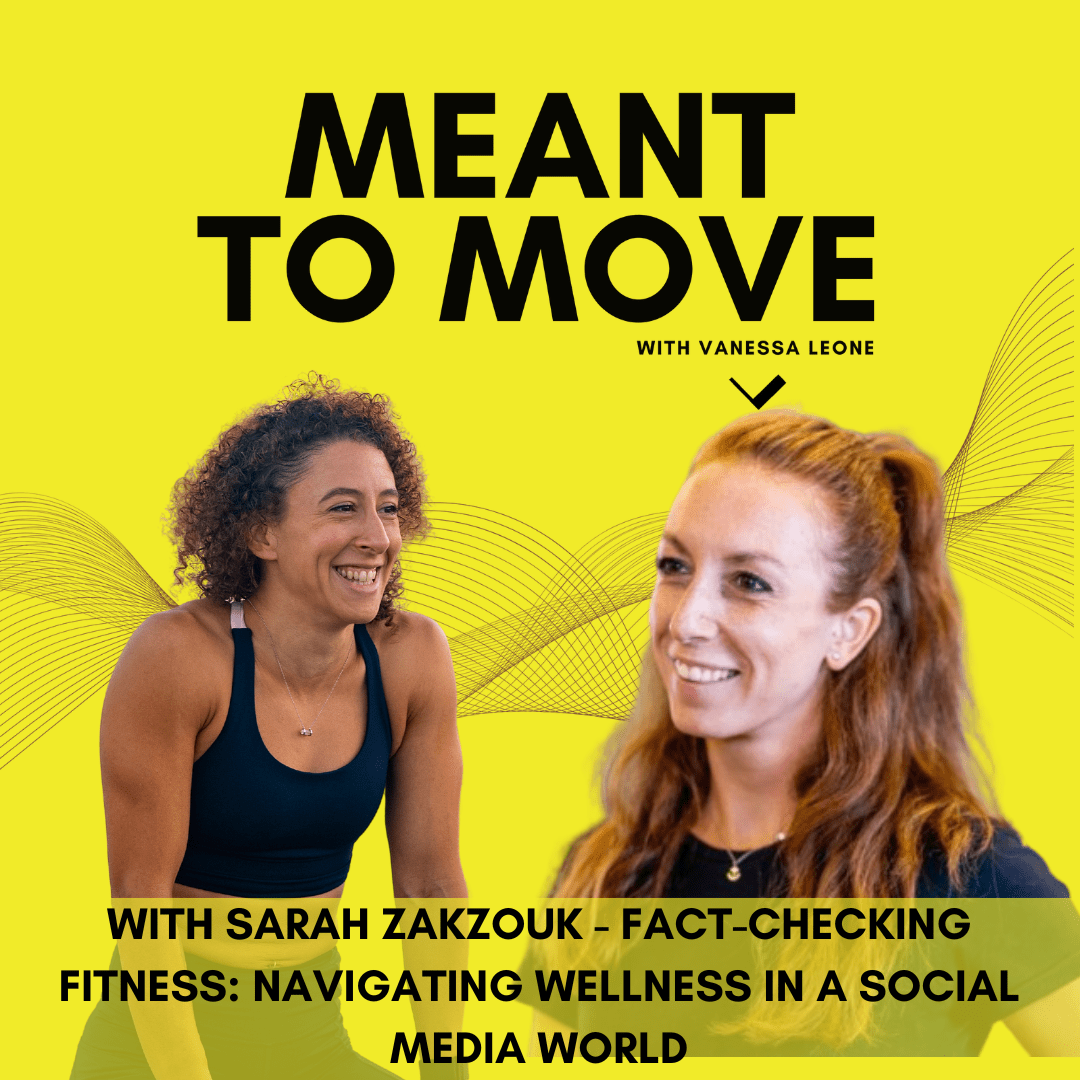
Meant to Move Episode #8 – Fact-Checking Fitness: Navigating Wellness in a Social Media World with Sarah Zakzouk.
Summary
Host Vanessa Leone welcomes wellness consultant and journalist Sarah Zakzouk. Sarah shares her journey from publishing to fitness, specializing in Pilates, personal training, and wellness consulting. She discusses her passion for writing, contributing to Vogue Arabia, and launching Wellness Division. The conversation explores fitness media, social media influence, and the importance of fact-checking health information. Sarah emphasizes the need for balanced fitness goals beyond aesthetics, advocating for mindful movement and individualized progress tracking. She highlights her movement therapy practices, including strength training, Pilates, swimming, and beach walks. The episode closes with an invitation for listener engagement and further discussions.
Transcript
Vanessa Leone (00:01)
Hello, hello. This is exciting. This is my first segment with my friend Sarah. Hi Sarah, how are you?
Sarah (00:09)
Hi Vanessa,
nice to see you.
Vanessa Leone (00:12)
Yeah, I know. for context, this segment is called Foreign Correspondent, and you’ll understand that a little bit more as we come through this episode. But my dear friend Sarah lives in Dubai, so we have a bit of a time zone issue. But our relationship is voice memos, essentially.
Sarah (00:26)
you
Yeah,
we make it work. We make it work.
Vanessa Leone (00:34)
And so I’m really excited about this chat because I think that there are so many amazing, interesting stories and amazing, interesting people in fitness and in health and wellness. And I think you’re one of those people, Sarah. That’s okay. So just tell us who are you? What are you currently doing in the fitness industry?
Sarah (00:47)
So my name’s Sarah. I am under an umbrella term a wellness consultant. I think that’s the easiest way to put it because I do a lot of different things. My background is actually more corporate from the publishing industry. And then I got into fitness and in a big way it just became like it sort of spiralled but in a really good way. So I’m a Pilates trainer. I’m a fitness PT, so gym PT work as well. And I do, I’m a consultant.
So I’ll work with different businesses on their wellness packages, however that may work, and just to put things together for their space, really.
Vanessa Leone (01:35)
succinct, I really like that. You’re straight to the point. This is perfect because I knew this is what I was going to get with you and I’m so excited. you said you started in kind of publishing, we’re going to go into that a little bit in a second. What sparked your love of fitness and movement and Pilates?
Sarah (01:37)
Good question. I’ve always been into fitness and sport. So when I grew up in Saudi Arabia and when I was there at school, I was into team sports. So netball, swimming, whether that’s a team sport or not, but swimming and a lot of outdoor activities. So I lived on a compound and a very outdoorsy lifestyle. So after school, you’d sort of hang out with your friends on the compound. There was no social media, good and bad things.
And that’s a whole other discussion to have at some point. And we went rollerblading, played basketball. And so that was kind of my, sort of just gravitated to it very naturally in that way. And then later in life, I actually came to Pilates when I was doing my masters in London. And I think I was just going through quite a stressful phase of it and head down in a book, literally.
Sarah (02:53)
and came to a Pilates class in the Student Union. And I just remember it very vividly in just terms of the space. And there was just some connection made there. It didn’t become like a really specific fitness routine for me at the time. But I remember thinking, this is new, this is really interesting. It was that kind of mind, body, but in a different way. And I kind of got a bit hooked on it from there. As well as that, when you’re living in the UK especially London, you’re walking all the time. So just very active, active in general, but nothing super specific.
Vanessa Leone (03:30)
cool. I love the moment, like you still remember your first class and as a fitness instructor now you’d probably see the other side of that, right? You see, and I’ve seen it before when people come in for their first class and they just, something clicks, doesn’t it? It’s really cool to watch.
Sarah (03:51)
You know what I was thinking when I was thinking about this podcast and I was like, I would love to go back and chat to the trainer who was in my, who taught the first class. I don’t know them because I didn’t follow them and I didn’t go to their class religiously for whatever reason. Maybe I got caught up with coursework. I don’t remember, but that would be so cool to be like, you’re the reason I do this now or one, you know, one of the reasons. So yeah, yeah, for sure.
Vanessa Leone (04:15)
That’s cool. think that that, for me as a, you know, and I would say for you, that’s, that’s the best thing to hear is knowing that some moment like that, you’re really not even sure what you did as an instructor, but that, transformed your life. And I think that we both know the power of that. And that’s what we’re both excited to really talk about in this podcast and upcoming as well as that. This there’s so much space. So like we’re both consultants and we.
You know, we have a lot of things that we like to do. Let’s talk about the expansiveness and the transformation that fitness can make. Now, one really cool thing that the listeners might not know is that you are also a journalist. You write currently for a publication. Can you tell us a little bit about that as well?
Sarah (04:45)
Yeah, so since I can remember, I’ve always enjoyed writing. It’s just been an outlet for me. And now I think now that I’m in the wellness industry, we see that writing is an actual outlet as well, journaling and that sort of, maybe that’s why I was drawn to it, I don’t know. Storytelling, something I’ve always loved doing. I try to, as I progress with this career in fitness, to incorporate the publishing side and the writing elements so that it doesn’t necessarily mean that just because you go one direction that what you learn
previously or were passionate about needs to get lost. So now I write for Vogue Arabia here and there, and the topics can be quite varied as well. There’s nothing super specific that I would write. I get commissioned every now and then to write a piece. I also write for my own website, Wellness Division, which essentially is about bringing lots of different narratives together under one umbrella. It’s still in its infancy phase.
But that’s something I really want to grow as an editorial page, online magazine, if you like, just to bring in different ways of looking at topics, talking about them, not necessarily talking like we’re talking now through the written word. I really want to bring that back because I think through the written word, there’s a whole sort of dimension in terms of what benefits that has to the person writing it, to the person reading it, to how you hear the person who is speaking in that feature.
The journalism side is something that I’m very passionate about that I love that I can incorporate now into what I do as well and make it relevant. So that’s going to continue and it’s going to grow and there’s going to be a community of writers. I started a mentorship scheme recently as well, which was super cool. We finished four weeks and we got to the point where we’ve gone through different sort of case studies, different ways of approaching content, written content.
And so the next stage of that will be building core structure off the back of the mentorship scheme.
Vanessa Leone (07:10)
I think you and I are both fans of the written word and anyone who watches this podcast will always see my bookshelf right behind me and I think that’s why we became instant friends. And what I… I find this topic super fascinating because media and journalism and social media really influence fitness and wellness and like this whole thing that we talk about, our career, you know.
I’m doing the spoken word, you’re doing written word. media has a huge influence on what we believe, how we feel about ourselves, all of these things. What’s it like for you on both sides of that? Kind of, you know, in the middle of both, like how do you see fitness in the media that might be different to someone who’s not involved with media at all?
Sarah (07:42)
That’s a good question. I think, look, with social media, it’s such an amazing, well, there’s many platforms, but let’s say as an all encompassing platform of content, you can literally access information whenever you want, from wherever you want, from whomever you want. There are so many different voices, which I think is great. It’s accessible, open access information. The problem being is that we have to consider how much of this is fact checked.
When I go on social media, I’m like, wow, I learned so much today about something, you or I can take that and I can go and implement it with my clients. And I didn’t know that about, you know, something related to hormones or a fitness style. The problem being is that when we consume this information, depending on where it’s coming from and how well sourced it is, or if it’s evidence based, we kind of take that information for granted, for gospel, for fact, for, you know, and implement it.
This is the issue. So when I say to clients and they say, I listened to this podcast or I saw this on social media and this person was talking about X, Y, Z. Now I’m going to just follow this strictly. I’m going to now eat like this. I’m going to train like this. I’m going to just do exactly what this person, this influencer has told me to do because they look amazing. They look fit. They look composed. They generally looks as well. A lot of it is what we see. So that’s also problematic. And I just say to clients, I’m like, we’ll just.
try and do a little bit more research around this specific topic, try and understand it a little bit further. If you’re really gonna take it and go and cook like that and train like that and live like that, then just make sure it’s the right thing for you, not just that it’s the right topic and the right thing for a general public, because what works for you might not work for me, what might not work for that other client. So that’s really important when taking and digesting information that it comes from a credible source and that you also have kind of…
looked into different approaches to that argument as well.
Vanessa Leone (10:10)
the soapbox. This is the, you know, we can all be a little bit blinkered at times and, you know, I don’t think any of us are saying that we’re like, I’m definitely putting my hands up and I’m like, yeah, for sure I have blinkers on certain things and when I follow certain people, it’s a great confirmation bias, right? Like you just, you get that validation. So for
someone who has to fact check as part of what you would do for your role, what are some tips that you could give someone so if they’re consuming information on social media or perhaps in a magazine and they read an article, like in a fitness magazine, what’s a really good approach for them to like look at that information and go, oh okay, how do I know, how do I start to pull that apart?
Sarah (10:43)
Yeah, and that could be tricky because say for example, this happened to me recently, I read a book and very credible book, it’s backed by evidence, it’s about sleep. And I read this book and I was like, yeah, this is all like super informative. I’m going to take that and apply it. And then I listened to a podcast literally the other day and they mentioned this book and they went that book in the podcast. It was a Huberman Lab. In that podcast, they mentioned the book.
and that it was full of amazing information. They learnt loads from it. However, then they just debunked loads of what was kind of the approaches there and said, but hang on, let’s just take it from this perspective. And then they made a very credible argument as well. And I was like, hang on. Now I’m like, well, I totally believe what the book said, but I totally believe what you said because that makes sense. And it has to make sense. If it doesn’t, I’m like, okay, I have to look into that further. So for me, this happens all the time. And I’m like, well,
I wanted to talk about that book or I wanted to write a review about that podcast or my blog or whatever. But now I need to go back and think about it because there’s a valid argument to the flip side of that. And look, you’re never going to, that’s the reason someone’s published a book. It’s literally right next to me here. Someone’s published a book. It’s not that they can go and retract and take away all of that information because they published it that’s what they believe and that’s what they research. So it’s also not to say that
what argument you make is never going to be credible, but science is always evolving, people are always researching, there’s always a new way of approaching something, so it’s likely that there’s going to be a new way of looking at it. My advice to people is literally to be like, if you’re reading something, what publication is it in? Who’s writing it? Are you familiar with their work? Do you really think they have a valid argument here? Is there somewhere else you can
find out a bit more information about it or ask your, if it’s related to fitness, for example, come and chat to your, to me, chat to your PT, chat to your health professional. This is really important because also I find that a lot of health professionals, they’re very good at being doctors, for example, or surgeons, and they’re great at prescribing medication. And that’s what they learned in, I don’t know, the seventies. The amount of…
Sarah (13:23)
research that’s been done on whatever they are skilled at, whatever might have changed, whatever different approaches are available now that maybe don’t rely on medication, maybe they rely on fitness instead, you kind of have to take people out of their boxes a little bit as well. And I think this is the issue we sometimes face in these industries. So I would always go back to the skilled professionals, get a second opinion on things, and then implement it into your lifestyle if you’re not the skilled profession in that topic.
Vanessa Leone (13:56)
Mm, yeah, I have this issue as well. You listen to a podcast, you read a book, you get both sides of the coin and both sides of the coin are valid. And I think the purpose of this podcast isn’t necessarily to, you know, fact check or tell people that they’re right or wrong or whatever. And I always love dispelling myths and potential misconceptions that people have in the fitness industry. But
I think we also have to look at misconceptions and take them with a grain of salt because they were there for a reason as well. Like people like, why would, why did we believe that in the first place? And what has changed, you know, while we have known that for it to change as well. So there’s, there’s usually so much context. And I find that the, the biggest challenge is that we almost form like an identity to.
these beliefs, these systems, these things that we hold onto, particularly in the fitness industry. And, and I think a lot of social media influencers like this, you know what I mean? You were talking about it as kind of like, I’m the, I used to watch this one, we’ll see this one, she was the banana girl. And she literally, I think she literally just ate bananas. Or very close to just eating bananas. And then, you know, you’ve got like your carnivores and then you’ve got like a
It’s very interesting, isn’t it, how all of a sudden the whole persona is just around this one thing. And that to me is an alarm bell. What do you think about that?
Sarah (15:36)
It’s of course, it’s massive alarm bell. It’s a red flag. Also another topic. But basically what I find when that happens and someone is literally like, this is the only way to do life. And you’re like, no, it’s not because everything is about balance. But let’s go with that for now as an argument. I’m not gonna throw names. I can’t even think right now, people, know, everything just flies out the window. But when it’s like,
the carnivore diet, for example. Someone comes to mind, I’ve just forgotten his name. But often that extreme behaviour, kind of polar opposites, this is the only way to do it, and this is the only right way to do it, it’s nothing else. It’s also just great as a marketing strategy. So basically if you’re on social media, which everyone is, and you’re like, well, I do eat bananas all day. I don’t know this banana person, but I’d love to meet her.
This is kind of another thing that it’s like, yeah, but everyone knows her who wants to know about the benefits of bananas or whatever it might be. And that then makes you your, that’s your niche. I believe in niche, working in a niche topic, I do, because you can’t be great at everything. And this is something that a lot of trainers also try to do. They try to be really good at everything, be the physio, be the trainer, be the nutritionist.
So I think honing in on something is really important and being really good at it, but I don’t believe in extremes and not being open to other forms of methodology or just being open to different discussions of how to achieve results in another way.
Vanessa Leone (17:14)
Yeah, for sure. Yeah, I think we can definitely land on that one as a red flag. It’s like a dating red flag, I like it. Yeah. Yeah. I think this leads me onto this question and just for context, for those of who are listening, I’m throwing this one out to Sarah just to see what she will think.
Sarah (17:26)
It’s a red flag.
I swear. Yeah, yeah. If we’re go there, that’s another podcast day.
Vanessa Leone (17:49)
I hear this a lot in terms of maybe perhaps more mainstream media, let’s, you know, forget about politics. Let’s just think about fitness magazines or fitness media, wellness media. A lot of people bag media outlets. A lot of people are like, why are they publishing that? Or why would they say such outlandish things? Or, you know, why are they still talking about weight loss and looking skinny on XYZ magazine?
And I sometimes wonder, like, obviously they’re doing it to gather or to, you know, to get a reaction. But I also still think that you’re the one, we’re the ones consuming it. Like we’re the ones who look at that outrageous headline and go, my God, and open it up in like an outrage and read it and then get outraged by it. And I feel like that’s half the problem is because we’re actually allowing ourselves to react to these insanely clickbaity headlines.
What do you think?
Sarah (18:59)
I think just in the media in general, there’s a lot of, it’s very saturated, obviously with social media as well, there’s a lot of competition to get your story out there. Whereas before, there’s always been sensationalism in the media, to be fair. I’m thinking of like tabloids and whatever. It’s not something new. But I think now it’s more like, can I get my story to be seen? Which obviously everyone’s trying to do on social media platforms.
Clickbait is something I can’t stand because it always gets me and I probably click on it, but, and I’m just like, it just gets that, it just drives something in you, makes your blood boil or just makes you, it’s just a shock factor. It’s a shock value. And that’s how you play on human emotion. You play on human intrigue. People want to know what you’re talking about, especially if you leave it, know, dot, dot, dot unannounced. So, or unanswered, let’s say. But clickbait, just think is very dangerous because
The person who’s written that article, who has hopefully done a good job of it and done their fact checking and whatever else, taken time to write something credible, you can literally just destroy that by putting a headline that doesn’t really match to what the story is about. And this happens all the time. So people will go and click on it, or maybe they won’t. Often what I do on Instagram, for example, I will…
kind of scroll through stories and I’ll see something that’s maybe of interest or something that’s click-baity and I’m like, ooh, that’s a controversial way of saying it or something. I go to the comments because now everyone just says summarizing the feature, here you go. And I’m like, well, thank you for doing that. I didn’t click on their page. I didn’t go to their whatever. I’ll only go to your website if I believe in your journalism and I want to support your publication and probably subscribe to it as well. You know what I mean? So,
Clickbait is part of this fast consumption culture, fast commenting culture, and also it just can misalign entirely with what the story aimed to achieve. So who in the comments is giving you the information? Are they journalists? Are they people writing for the publication? Are they random people who are sat on their sofa just going, let’s put some random comments on here and see what people do? It’s just like, it’s just a very open forum to be saying whatever you want.
Vanessa Leone (21:03)
Yeah, yeah. I just, find this, this like topic endlessly fascinating because I don’t think we realize how much of an impact, even the things that we don’t think that we click into affect us. So Emma, my other segment host, well one of my other segment hosts on here, she posted a reel about a magazine article talking about
how many calories were burned in a Pilates class versus another Pilates class or something or other. And she’s very frustrated by this because she’s sick of the calorie thing, because that’s the only way that we can define or measure success supposedly in a class is by how hard we worked. And as…
this topic for this month, we’re talking about measurements, we’re talking about, you know, how do we define what we measure in fitness. But I think the question before we ask ourselves, what do we measure, is how are we influenced by what to measure and by who’s telling us to measure what? I find that so fascinating. I don’t know if you wanted to add to that.
Sarah (22:25)
That is, that’s something also that I’ve been hearing on a fair, I think it’s the same podcast. I’ll have to share it with you after, anyway, it was basically saying all of the rules, regulations, standardization that we live by is based on a set number of metrics that someone has determined. I’m all for standardization because I, to a certain degree, because also everything would just be unruly in everything. But who is deciding?
Sarah (23:13)
what the metrics are, who is deciding what is healthy, what’s unhealthy, what is good for you, what’s bad for you, just everything basically. You could pinpoint anything, go into politics, but we’re not gonna go into politics. basically, this is something really interesting because also, I, and Pilates, if you’re going for an example with Pilates, that’s also measurable in so many ways.
and not measurable in so many ways by the same token. So this is the thing, it’s like, A, do we have to measure everything? We’ve got our Apple watches, we’ve got our whoop trackers, we’ve got our aura rings. Yeah, I mean, yeah, I’m not against it. Our CGM continuous glucose monitor trackers as well, which a lot of people are doing now. I’ve done personally for a lot of testing purposes to see what it’s all about and how it works. So tracking is, yes, important, motivating.
it helps us create more awareness about ourselves and our bodies and how we live and what we want to achieve. But for example, Pilates coming back around to that, you can track calories for sure, especially now that Pilates is such a booming trend, like they’re doing all sorts of iterations. So you’ve got your classical Pilates, you’ve got your athletic Pilates, you’ve got your, type of Pilates you can think of, your strength training, probably your calorie burning Pilates, whatever name they want to put to it.
It’s great that it’s accessible and that it’s out there for everyone. It’s not great that it’s kind of becoming a little bit mushy in terms of what Pilates is, but that’s a whole other argument that’s on fire on social media as well at the moment. tracking, say for example, I’m tracking a client who does Pilates.
All clients want to feel a burn. They want to feel that they worked hard. They don’t want to go away from your class really like, you know, I feel like that was just something very basic and I didn’t feel much. However, what if your client has a spine injury? So some of my clients are coming out of spine surgery. Our measurements, our tracking is more about your articulation, your range of motion. Are you able to move without pain? Have we achieved strength in the muscle groups around your affected area?
to make you move and perform better in daily life. So for me, that’s a measurement of progress. A measurement of progress in Pilates could be are you breathing effectively? Because Pilates is really all about breath work, right? And how you activate your muscles, how you breathe in conjunction with all of that. So over the time that you’ve spent with me in my PTs or classes, do you feel like you breathe more effectively?
Are you able to breathe and calm your nervous system? Are you able to breathe and contract specific muscle groups? So it’s a very fluid concept. It’s definitely, you can definitely hone it into specific metrics, of course, but then let’s also be mindful that you can also attribute measuring and tracking to something a little bit more qualitative. It doesn’t always have to be quantitative.
And that’s something I just feel that needs to be expressed a little bit more because not everyone
is going to classes to be super fit, super buff, super toned, super everything, super strong. They might also just want to feel like less in pain every day or feel like their mental health is better because they’ve gone through whatever, you know, like it’s, it’s, it’s, it’s a lot. It’s a minefield.
Vanessa Leone (26:44)
It is a lot, it is. And you said something really interesting there about people coming to Pilates and they kind of generally, they want to feel that burn. They want to feel like they’ve done something. I actually think that that is an influence of, you know, whether it be media or whether it be like an expectation that we have somehow developed in the fitness industry, that for people to come to a class,
If they don’t feel like they’re getting a burn, that means that they’re not doing something worthwhile. And I find that absolutely baffling, absolutely baffling, number one, because you rocked up and you’ve just done a 45 minute or a 30 minute or an hour worth of movement. And there are so many factors that will influence whether you’re feeling a burn or not.
regardless of how hard the teacher is pushing you. I just like that in itself is a metric that you talked about that I think is something that we have to question. Why do I feel like I need to have that every single time I go into a class?
Sarah (27:49)
Yeah, and I think that’s kind of dividing the industry a little bit, to be honest. But also, if you look at it from two perspectives, you look at it from our perspective as the trainer, as the coach, but then you look at it from the business perspective. So the business perspective is I’ve just spent X, Y, Z million dirhams on this Pilates studio. I’m paying your wage. I need clients to come in the door so we can start turning a profit. These machines are very expensive.
If these clients don’t feel a burn, our Google star review will not be positive. So there’s always, and I do this because I’ve done both sides. I’ve been the trainer, I’ve been the business manager. So you have to look at the KPIs from both sides. As the trainer, which we are, it’s kind of an education piece, I think, to be like, okay, not everything is about weight loss.
Because, God, the amount of times people are just like, I want to lose weight. And they don’t need to, especially when they don’t need to. I’m like, are there any other things that we’re looking for? I have a wellness planner that I give my clients, my PT clients. It’s a little bit of homework for them. So I print out some sheets for them. It’s very old school. I don’t do it online either. I want them to write it. It’s all part of this, sorry about the other elements of paper and all the rest of it. But it’s more like, I want you to write down your goals each week.
I want you to write down your progress. I want us to discuss it if you want to discuss it. Just so you look at then maybe what your goals were when you first met me. Most likely for women that I see. Weight loss, toning, build strength. I’d say those are the main ones I see. But then I also have women who have had difficulties with their pregnancy. Difficulties post pregnancy, postpartum issues. have spine surgery issues. have…
Just all sorts just so many different factors and then when you start to see people who come in with life issues Like I’m not saying that losing weight is not a life issue is if you’re really overweight But you have stuff that’s maybe a little bit more important to fix to get to get through in order to get back to daily functioning you know and so when we look then at these cases people are really like they see the benefits they come to me they’re like my god I couldn’t do a forward fold when I first met you now
I’m touching my toes, I feel like my spine is articulating, I feel strong, but also fear. When you have an injury, for example, there’s this element of fear, not being able to do anything, and maybe technically you can, but there’s just this anxiety about going back into pain. So when we kind of take, I’m not saying everyone needs to be injured to understand the different elements of wellness, but when you have an injury, even myself, my approach to it is so different. I’m just like, well, I can’t train the way I did before.
I can’t be as physically fit looking as before because I can’t do all of that. I have to now focus on my mobility. I have to really, you know, slow it all down. I focus on my breathing, how I connect my body and slow down my movement pattern. So I think it’s just getting, it’s an awareness piece and it’s trying to make people, trying to help people understand the benefits of their fitness practice from like a foundation aspect before you then build it layer by layer into your.
aesthetic goals, your strength goals, because you’re building strength in different ways from the base up.
Vanessa Leone (31:27)
That’s such a great answer. Such a great addition. And I absolutely love that you have a paper version of a wellness planner. Funnily enough, there, well, here we go. There is science to back the physical writing of goals of progress that actually fires your brain up and changes the neuroplasticity around what’s happening. So I think that that’s super valid. It’s beautiful. Yeah, I just, I love that.
This is what I’m really excited about because for someone listening who, you know, feels guilty if they don’t do a really hard exercise class or if they haven’t burnt X amount of calories or for someone who doesn’t like exercise because they’re scared to push, to go too hard. Like I think what we’re trying to say is that there are so many other factors of moving, the benefits of moving and
other ways that you can measure your progress without actually having to measure anything specifically. Yeah, I think that’s cool. Could you tell us one of your Favorite questions in your wellness planner, wellness questionnaire?
Sarah (32:41)
It’s not a questionnaire. It’s literally like a I’m looking at it right now behind here. It’s just like a what does your week look like? So it’s daily. It’s your weekly goals. It’s your motivation I think if I’m thinking off the top of my head my my question would be kind of like How do you feel like Specify one of these how do you feel like it’s improved you maybe physically and mentally so we incorporate the mental health element as well as the physical
attributes because that seems to be what most people are looking for. I think I just question that because it kind of just gives you a little bit more introspection as to why you’re doing things rather than I have a wedding to attend in six weeks. I need to look really hot. And I’m like, OK, great. This is also possible, but let’s think lifestyle. And I think also the people who come to me, who know me, who often come to my classes first and then they get to know me and
ask me to do PT work, they kind of know what I’m about. So they know that if they’re going to work with me, I am going to sort of push them in a different way. And I’m going to try and incorporate different ways of finding wellness. It’s not just going to be, I’m not your transformation coach, for example. So they’re different things as well, right? So when people go to a transformation coach, they’re like, okay, I need to look like this in, in two months or less.
So it’s also who you’re going to and what that person is marketed as and what they promise you, you know? And so I think it’s really important as well as a coach to be very clear about what you’re about and how you work with your clients, why you do, and what you aim to achieve with them. know, that’s also, it’s a two-way thing. It’s a communication thing because if you’re a PT, you see someone on Instagram, they just, you know, in their bio, they’re a PT, they’re pilates, whatever, gym.
and they look great because they train a lot, they train themselves, then yeah, fair enough. You’re marketing someone who is physically fit. And if I go to you, I wanna be physically fit too. So, you know, it’s kind of a two-way thing, I think.
Vanessa Leone (34:50)
Mm, yeah, I wholeheartedly agree. I highly encourage people who are engaging with gyms and who potentially want a trainer or want a coach to almost interview that coach. I have several times throughout my career been interviewed by someone and I actually, I love it. Like, I love that someone is taking the time.
to question me and my methods and how I’m going to approach the challenges that they might face because it’s so important. Like it’s so important to understand that, you know? It’s like dating.
Sarah (35:23)
Yeah, yeah, it’s like a relationship basically, if you’re going to spend that much time with this person, especially if they want to train like three to four times a week with you, their first session of the day, they’ve just woken up, you know, you become it becomes a part of thing. It’s like, wow, you know, I see this person often. So, so for me, for me, what I do is the initial consultation that we have, it’s a consultation to see to do, I mean, I have like a park you in a form that I go through with questions about their health.
goals and all the rest of it. But it’s also to see how you move, how my client moves, how I can help them if I can genuinely help them. Because sometimes you’ll see a case and maybe you’re like, actually, this isn’t something I can help you with or, you know. But also I say to them, you have to enjoy working with me. It’s not just I’m in control as the coach and you will do as I say. It’s like, do we get on? Yeah, I know, make things a lot easier. But no.
It’s like, it’s a, need your energy and you need mine. So by the same token, if I’m going to invest, because I invest a lot of energy into my sessions, into my people, and because I’m very passionate about it. So if I’m going to be there, I need you to be there and meet me there. Not every day. Sometimes people are tired. They’ve had a tough week and whatever life gets in the way. But the coach really, their job is very much to be
the person that helps their client in that moment to achieve what they need to achieve in that hour or however long the session is, you know, so there’s also a lot of pressure when it comes to being in the right zone, to being present, to being the right energy for the person and to know when to back off and when to push. That’s also something you learn with experience. You can’t always push them like a bootcamp, you know, like a drill sergeant, but
Also, you can’t always be like their mum and just very mothering in. There has to be a balance and you have to learn to read the room and the person.
Vanessa Leone (37:27)
Yeah, I would agree with that. And I think that that is such a nuance of face-to-face coaching and that face-to-face interaction. And actually you segue brilliantly into this next question. There’s a couple left, so we’re nearly there. But I look at online training and online training programs and I’m not that I’m sceptical of them. I have dabbled in many an online training program.
And I think that they’re useful because for me, I kind of know how to train. know what to do. I know where my body should kind of be. I can guesstimate the weight that I need to use pretty, pretty efficiently, pretty well. But I look at these, at these online programs sometimes, and then I, and then I, I see the clients who I work with and I’m like, this isn’t for you.
this, this, the, the, the gap between where people are starting. If you’ve, if you’re not engaging with fitness, if at all, or, you know, maybe you’re very yo-yo, I feel like almost these online programs in itself are like a measurement. Like they, they’re setting you up to be like, you’re not quite good enough yet. Whereas I think when you’re one-on-one,
you read the person, what’s really important initially is success. Because like when was the last time you did something that you were bad at just to do like twice a week? Yeah, three times a week. I don’t remember the last time I would do something that I’m bad at. Exactly. Do you know what I mean? And so I look at online programs and I wonder
Sarah (39:03)
Mm-hmm.
for the sake of it.
Mm.
No, you probably wouldn’t keep doing it. Yeah. Yeah.
Vanessa Leone (39:27)
Who would, who’s doing them and like what, where do they fit? Like where do they fit in our industry? I don’t know. Do you have anything to add to that?
Sarah (39:31)
I think a lot of PTs do go online to do their programs online or on an app or whatever it might be, because obviously it’s numbers. You get much mass interest there and it’s easy to just be like, this is my plan. Maybe they do online check-ins. I don’t know. It depends. I’ve never done actually an online. I’m thinking now when you were saying that I’ve never done an online sort of over time consistently structured workout routine. I’ve done like YouTube videos back in the day or DVDs, but
that was just for me to move. I think it’s problematic. Look, if I were to do online, I think I’ve done online a few times during COVID, I did online classes for obvious reasons, but if I do anything online, I’ll have met the person before, I will have done a consultation with them. There’s the face-to-face element is, in my opinion, like imperative at the beginning, because you can’t see how they move their body. can’t see if they have, maybe they don’t know they have.
Scoliosis, for example. So anything then you apply on an online program and you can’t really see their spine or, you know, whatever it might be. It’s just not, I just don’t see how it’s going to benefit them in the way they need it. Because just working with clients, it’s just very specific, it’s specificity according to their body, according to their requirements. And sometimes like my program that I would normally use with someone face to face doesn’t really show the results I want. It worked for someone else. I’m like, you know, they were fine. So it’s like,
then I have to regroup and find out what works for this person. And personally, I find that I need to be with them. I need to read their energy. You can’t read someone’s energy online unless they’re just really loud and excitable, which happens. So I think I have a problem with online, yeah, to a certain degree, unless people move very well, very effectively, you know how they move. But they have to have a very good body awareness to be able to just get on with it themselves and follow you on a screen.
Vanessa Leone (41:34)
Yeah, it’s a tricky one, isn’t it? I can see where some of the benefits are for it, but I think that there’s an over-reliance on the convenience factor of having this online check-in with a coach. And I would say that there would be some excellent online coaches, for sure. Not bagging anyone, but it’s like you said.
)
It’s so hard to tell how someone’s moving, even from a video. Like you said, you read it in their energy.
Sarah (42:05)
I’m not against it because I’m just thinking now I had a client who used to train with me and then for whatever reason What’s the word convenience? She went online with a coach, but she’d already created a really strong foundation in person with a PT who had You know discussed various she had loads of questions, which I loved always questioning. What should I feel? Is this the right position should but you know, and it’s good because When you’re working with someone, I don’t think pts are for life. I think
You work with a personal trainer to understand yourself enough to go and do it yourself safely, you know, in the gym or in classes or online. So if you build a foundation, I’m all for it because sometimes it’s hard to go to the gym or maybe someone has a change of career or they travel or they have a child or whatever it might be. There’s life situations, but I don’t really believe if you’re brand new to fitness that going to an online coach is the way forward. I think you have to really build a foundation there first. It’s like classes.
Some studios won’t let you progress to the intermediate class or even just the normal class before you’ve done your five beginner sessions. It’s the same thing. It’s just to avoid injury, to make sure that you’re moving effectively, especially if it’s a results-driven format. How are you going to see the results? You’ll just say, well, that coach is not very good because I didn’t get to where I needed to. So you have to start.
a little bit slower, I think, and under some form of, there needs to be some metrics, maybe, measurement.
Vanessa Leone (43:36)
Just a few, just a couple of questions for yourself. Like I said, we’re not against measurements, you just have to ask the right questions.
Sarah (43:43)
Just a few. Now,
yeah, I’d be open to all of the different types of measurements.
Vanessa Leone (43:53)
Yes, I like it. like it. My last question for you is, I mean, you’ve known me for a couple of years now, we talk about this concept of movement therapy. What are you currently doing for yourself that you would say is your movement therapy at the moment?
Sarah (44:03)
And by movement therapy, like movement that really sort of benefits me, you mean like in terms of my therapeutic or just in general? Okay.
Vanessa Leone (44:16)
movement, practices, wellness
practice, whatever you would like to do.
Sarah (44:21)
Okay, just getting caught on semantics there, you know, like.
So my movement therapy, I’d say I’ve always done a bit of a mix. For me, I have to be doing strength training to some degree because it just makes me feel strong. It makes me feel, it just makes me feel really good. And it’s also a great outlet for me when I need to just, you know, get out, get out of my head for a little bit and train.
headphones on. But I also obviously do a lot of pilates. Pilates, I do a mix of mats, reformer and chair. Love the chair. I love that they’re all within the same discipline, but also very different as well. So they work really nicely together because they give you variety and they challenge you in different ways. For my kind of more therapeutic, if that’s the right word, it’s swimming and walking on the beach. Those are my two like meditative
places, you know, in the water, sound, sound, what’s the word, is muted, and noise cancelling headphones sort of vibe. And then walking on the beach, I try and do that like even in between sessions, like today I went this morning, and it’s just, it’s just the being in nature kind of thing, moving your body, it’s nothing excessive. And personally, I think if I can’t, if I don’t have one of those in the in the sort of routine, I feel it, I feel when something’s missing.
So when I’ve been injured, for whatever reason, I can’t do a certain training practice. I definitely feel the difference and it helps me work towards getting better, doing all my physio exercises and getting through that pain so that I can get back to a routine that really, you know, feels like movement therapy for me, you know?
Vanessa Leone (46:10)
Yes. I think that’s why I love movement therapy, because everyone gives me such interesting answers to that question. It’s beautiful. Thank you. Now, I want to thank you so much for your time and your energy. I appreciate you.
We’re going to get into some interesting topics and I would say that if anyone has any questions, whether they’re from, you know, wellness division, they’ve seen your work there or from our side of it, and you’re interested in perspective from Sarah, please hit us up. This is super important to us. And if you’re interested in writing or if you’re interested in reading Sarah’s blogs and all of her articles, they’re fantastic. I highly recommend everything’s in the show notes. So please check her out.
Thank you for your time.
Sarah (46:56)
Thank you so much
for having me, Vanessa. I’m so happy that you’re doing this podcast. And I think there’s going to be some amazing episodes. And I’m really happy to be here. So thank you very much.
Vanessa Leone (47:08)
Yay, I’ll speak to you soon.
Sarah (47:10)
Yes, you will.
Vanessa Leone (47:14)
Love it.
 Vanessa Leone Movement Therapist