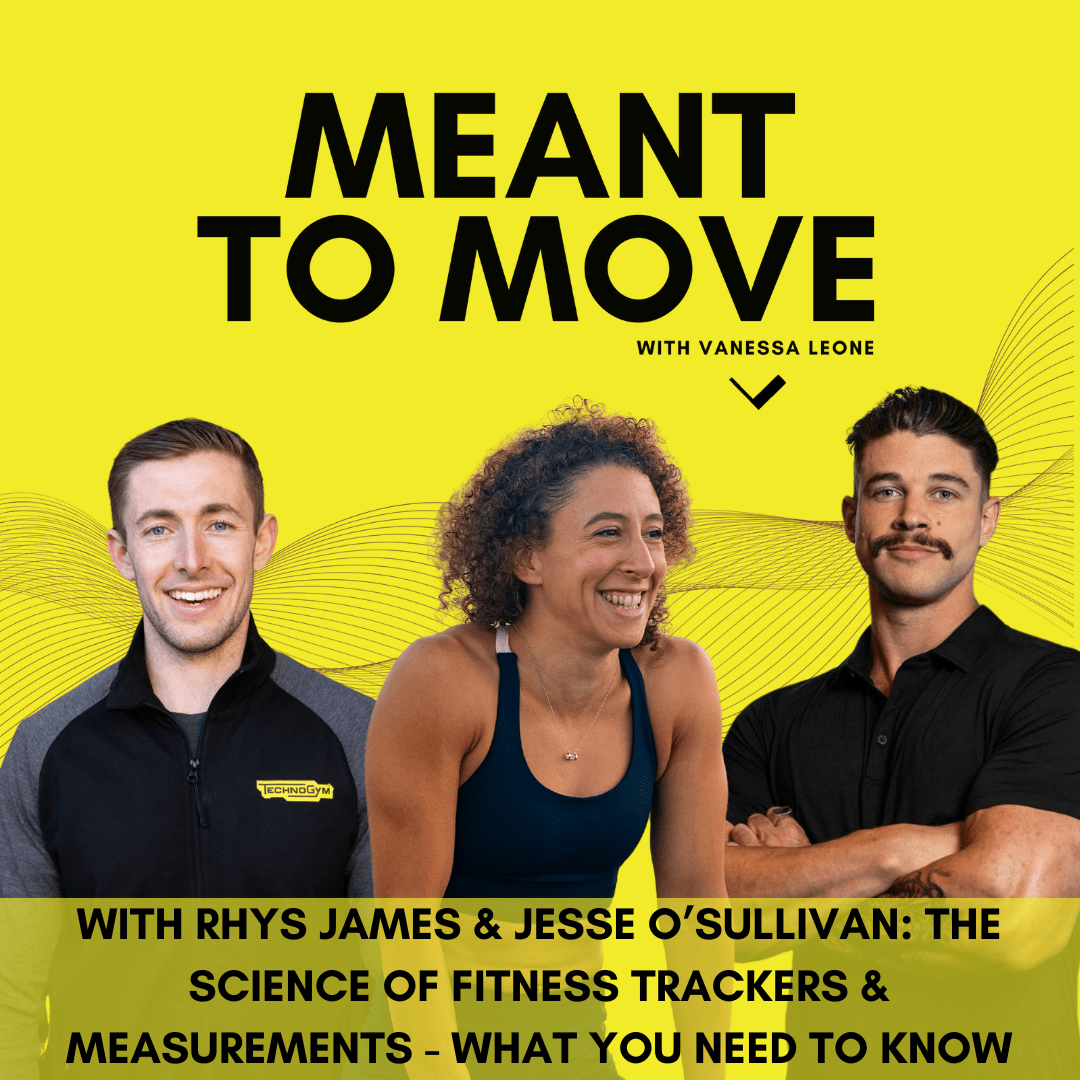
Meant to Move Episode 8: The Science of Fitness Trackers & Measurements – What You Need to Know with Rhys James & Jesse O’Sullivan
Summary
Host Vanessa Leone speaks with fitness experts Rhys James and Jesse O’Sullivan about tracking performance and wellness metrics. Jesse, an online coach, tracks body composition, strength, sleep, and stress markers. Rhys, training for an Ironman, measures power, heart rate variability, and swim speed. They discuss the role of data in setting goals, motivation, and avoiding overtracking. Jesse highlights sleep as a key wellness metric, while Rhys emphasizes cognitive testing for future fitness trends. The episode explores the importance of individualized assessments and balancing data-driven training with movement enjoyment. They close with a call for listener engagement and future testing events.
Transcript
Vanessa Leone (00:01)
Here we go. Double trouble today, everybody. Exactly, they know. I have Jesse and Rhys. I’m really lucky to be able to work with these guys. I’m a contractor and educator for Techno Gym Australia. Jesse’s in the same boat as me. And Rhys, he’s the boss man in charge of us at least. As the educators. And this month on Meant to Move, we’re talking about all things measuring. Measuring measurement.
And I thought that these two would be excellent to speak to about this topic because you both have really personal experiences in this, I would say, as well as like good client experiences. So, you know, rock, paper, scissors, who wants to go first? But measurements in fitness, let’s fitness, let’s talk about what do you actually measure for yourself? So, Jesse, you were on first, you’re gonna, you’re gonna go first.
Jesse O’Sullivan (00:59)
First of all, thanks for having me on the podcast. And then also when it comes to measurements, probably the first one, like I, a lot of my goals that I’ve, achieved in my past have been around body composition. So, always was the skinny kid at school and struggled to put on weight. So obviously measuring my weight was the very first measurement that I learned. but then diving into a bachelor’s degree in exercise physiology and working with clinical people and all that kind of stuff. And I realized how much more
is beyond that number. So, diving into, you know, even DEXA scans rather than just looking at body weight or, you know, quarterly I’ll go get my bloods checked. So, test for all of, you know, blood cell count and where my hormone profiles are at and all of those aspects around stress. And then I guess on a daily basis, there’s also, I wear a Whoop band and normally I also wear an Apple watch, but I’m not wearing that today. Just broken the strap on it. But,
The Whoop Band really, really good for measuring sleep. So that’s probably the main tool that I use the WootBand for. I will say that it’s not very accurate at tracking steps. It’s a new feature that I’ve just implemented and it’s not that great yet. It reckons I do like 40,000 steps a day and that’s completely incorrect.
Vanessa Leone (02:17)
Yeah, I was gonna say it definitely overestimates my steps for sure.
Jesse O’Sullivan (02:21)
Yeah.
but then probably the last other measurement I use is obviously tracking my workouts and my training and things like that. whether it’s I’m lifting heavier or running further or running faster, those are the kind of metrics I track.
Vanessa Leone (02:36)
That’s cool. Let’s just go a little bit of detail into that then. So do you track like through an app? you like a old school? Do you just write it down? How are you tracking? And is it like all of the workouts that you do?
Jesse O’Sullivan (02:49)
Uh, yeah, I, I’m just a data nerd. So I track everything when it comes to my workouts. Like if it didn’t get tracked, it can get done, which can be good and bad at the same time. But, um, with my own online coaching, uh, with my clients, I’ve, uh, built an app with, it’s, it’s a fully personalized app for my clients. And yeah, so I’ve created myself a program on that. And then I also work with a coach and, he has another app that he uses. So.
Jesse O’Sullivan (03:18)
Whether it gets recorded on his coach on his app or my app or whether it’s on Strava Yeah, I usually stick to the phone measurements and try and automate as much as I can So even down to I bought like a withing scale so I have to manually input my weight I just stand on the scales and it automatically uploads to the app for me because I always forget to do that But that allows me to graph it all and make it look pretty and yeah
Vanessa Leone (03:36)
Wow.
Okay, so we’re talking some next level measuring, and this is exactly why I brought you both on. I’m going to follow up with a question, but let’s hear from Rhys. I know you measure a lot as well. What are you currently measuring for yourself?
Rhys (03:55)
Yeah, thanks, Ness. Thanks for having me. It’s great to jump on your podcast with you again. Yeah, just to add a bit more on what Jesse is measuring, I guess I measure some similar stuff, but if I break it down a bit more, so maybe acutely, I would measure in my training. I’m currently training for an Ironman and I focus a lot on power, whether it be on the bike or even relating that to running in terms of pace. So acutely, I’ll be measuring that on a day-to-day basis. And actually this morning, did a bit of a swim test to get my critical swim speed, which is quite useful then for me to pace myself in the pool. In terms of more wellness markers, I would also say sleep and heart rate variability is something I keep an eye on as well, because obviously there’s quite a high…
In terms of more wellness markers, I would also say sleep and heart rate variability is something I keep an eye on as well because obviously there’s quite a high training load demand at the moment and I’m definitely feeling that right now. I’m definitely over training and I’ve noticed actually my heart rate variability is massively dropping off over the last couple of weeks, especially traveling to Italy last week.
yeah, heart rate variability and sleep, two of the metrics that I get from my Polar watch, which unfortunately isn’t as detailed as what Jesse mentioned in his Woot band, but it gives me enough, I think.
Longer term, guess I’m on a test in week as well. So like I said, the critical swim speed, but also FTP, which is essentially my average power I can hold on a bike for an hour. So that again, that’s then used for programming my bike sessions, which hopefully will help me in the long term. And I’m excited to get into, I guess, a few more measurements that we’ll talk about a bit later on with some of the stuff we’ve got access to at TechnoGym.
Vanessa Leone (05:49)
Yeah, that’s cool. So I like the new one that you’ve mentioned there, critical swim rate, stroke rate.
Rhys (05:59)
speed. Yeah.
Vanessa Leone (05:59)
Speed. Okay,
so I kind of have a vague awareness. Let’s talk through this one. This is cool.
Rhys (06:08)
Yeah, so I’m following a program on training peaks, which part of that asks me to complete a critical swim test. It sounds quite scary, but essentially it’s 400 meters as fast as you can go, and then you rest for five minutes, and then you complete 200 meters. Now, I don’t know what the algorithm is to predict that speed.
but it gives me a speed that I should be able to hold for my event, but also then it breaks down the speeds at different zones. So it’ll tell me a speed for zone one, zone two, zone three, zone four, because obviously when you’re in the pool, you haven’t got access to a power reader and heart rate. You can use heart rate, but when you’re underwater, obviously it’s impacted by the water, right? So measuring time, going old school is probably the best bet, I think, for swimming.
Vanessa Leone (07:04)
cool. Yeah, I was very curious as to how that was measured as a swimmer. I actually hadn’t done that test. It’s probably not one I want to do, it sounds horrible. That’s cool. That’s really interesting and I love… We’re obviously looking at quite a few performance tests for the both of you. I’ll get into what I did on the weekend. I actually did some performance tests. I think you guys would like it. A little different.
But let’s ask this question, Jesse, you’re up first. What do those measurements, what value does that bring to you?
Jesse O’Sullivan (07:42)
I would definitely say the measurements all align with goals. So like the way I see it, there’s not much point measuring something if it has nothing to do with your goals. So there’s a lot of measurements out there that mean absolutely nothing to a lot of people. But if you set a goal and say that is a body composition goal, well, you better test your body composition. And if you’re testing your strength, then you better do your one RM testing or something, a predictive test. So that’s where I’d say is
Yeah, the testing is dependent on whatever my goals are.
Rhys (08:20)
Yeah, I mean, there’s so many things you can track and measure these days, which, you know, can get like the Netflix paradox where you don’t know where to start. But yeah, definitely. I completely agree. And since starting this new goal of completing the Iron Man, I’ve definitely got more specific goals and therefore have more specific measurement tools or data that I want to use. Before having a goal, I was just training to train, I guess, and didn’t really, apart from maybe
trying to up the weight or change, I don’t know, tempo, or even just going off session feeling like RPE. You know, I wasn’t really tracking much, but definitely having this new goal, I have more specific metrics that I want to measure.
Vanessa Leone (09:07)
Yeah, for sure. And for someone like yourself who kind of was training to train, have these metrics provided motivation or sometimes a motivation? What has that done for your headspace?
Rhys (09:20)
I mean, you both know how competitive I am, so I can now compete against myself.
Vanessa Leone (09:26)
To the nth degree
Rhys (09:29)
Yes, so definitely it’s given me a lot of motivation to improve and actually seeing my improvements over time is a motivator in itself. So yeah, that’s I think so important obviously to set your goals. No matter, it doesn’t have to be an Ironman. It could be anything. Set your goals and then work backwards and see what you can measure because seeing those improvements will motivate you to keep going.
Vanessa Leone (09:52)
Mm, yeah. It’s an interesting paradox. Because I, on one hand, love measurements and measuring, they’re totally valid. I come from a science background, the same as you guys. It was ingrained. If you’re not measuring it, what are you even doing? For the last few years, I haven’t measured anything, essentially, except for health markers. So, Jesse, you mentioned health markers. That’s been a big focus for me, because with autoimmune…
trying to sort out my own health has been the marker has been the measure for how I’ve wanted to get better. And so now that I feel like I have that management, my health management back under control, I have more energy, my endometriosis is under control. This year, I’ve actually started implementing some measurements back in. And it’s super interesting because I think that you
I mean, we’ll talk about training periodization, which is essentially like, you know, peaks and troughs of when you can train hard and when you train less. But I almost think that sometimes goals for people can and maybe should be like this. I can see the value in having something to measure and a goal that you’re really working towards. But then I also see the paradox of what that can do for someone’s mental state if
they then get an injury or if they over track and they over train, they over analyze everything and they get so into it that then when they don’t reach said goal or something like that, it becomes like a complete failure and a huge blow up about something like that. Have either of you had an experience like that where your measurements have been on the other end of the spectrum, like demotivating or kind of challenged you in a way that you weren’t expecting?
I love the pensive faces. This is excellent.
Rhys (11:43)
I’ll jump in. think just sticking to something that is, you know, latest. This morning, my swim time was actually a lot slower, but I didn’t get demotivated because I realized when I first tested out, the pool wasn’t quite the distance it needed to be. So I’m actually more confident now because what was prescribed for me in my swimming was way too hard.
which was actually starting to demotivate me. But now, actually implementing the correct times, I’ve got more realistic goals to hit in more realistic times. But still, doing that test when I did it, was whilst I was away in Singapore, so I only had access to a 40 meter pool. So then I had to kind of try and figure out how I could add on a bit at the end to make up the distance I needed to hit.
So, yes, that’s on the flip side. Yeah.
Vanessa Leone (12:48)
That’s cool. Because I think, you know, I have seen instances of…
people over training or overworking, I’ve had clients who they get to the goal or they get close to the goal and might be training for a run or they might be pushing for a personal best time. And when that goal is either done, they’ve completed it or maybe they just fell short or maybe they actually did really, really well. There’s this period post achievement of measurement that becomes this kind of lull. I don’t know what to
do with myself anymore or what’s happening. And so that’s where I think talking about measuring is important. Obviously tracking things is great. We’ll talk specifically a little bit more about some of these measurements, but I love the mental and emotional side of this because I think that that’s where there’s not a lot of discussion surrounding these measurements. And have you ever had a client or an instance yourself where you’ve been like, you’ve hit the thing, you’ve done it and you’ve gone,
what was that?
Rhys (14:23)
Yeah, well,
I guess it goes back to the Olympics, right? And when people go to the Olympics and they win a medal, there’s some post Olympic depression, you know, there’s a lot of athletes that suffer with this because they they’re going through the journey of training and achieving their goals and hitting their PBs. But then at the end, it’s like, boom, I’m done. What next? So I guess it’s you can relate that to what you just mentioned there, Ness.
Vanessa Leone (14:49)
Yeah, yeah for sure. That’s exactly right.
Jesse O’Sullivan (14:54)
And I think to jump on that question and the previous one, for myself, my own testing, I’ve always taken every measurement I take in terms of its accuracy and its validity and kind of take it with a grain of salt because at end of the day, there’s a lot of measurements that are purely predictive. Unless you’re really going into clinical labs and getting hooked up to oxygen and all the rest of it, a lot of these things are done through equations, which
aren’t always super accurate. that’s the same goes for, you know, body composition assessments and things like that. There’s so much variability in there. But I’ve definitely seen it in some of my clients where it just requires that little bit of extra education. When they receive that bit of data being like, it’s not what I wanted it to be, or I’m a bit upset that it’s not where I want it to be. But it might not be for starters, that measurement might not be aligned with what they were working on. Like they were measuring
their body composition when they were worrying about their strength and their endurance and all these other aspects. And so of course, they’re not really going to be, you know, primo the best in the world in body composition because they’ve been focused elsewhere. And same goes for, let’s say during my bodybuilding prep that I did a few years ago, that like my strength just bottomed out like a lot of my metrics just completely disappeared, but I will shred it. And it’s kind of like, you can’t be wanting everything all at once and to focus on one thing, you kind of have to sometimes say goodbye to the other thing.
Vanessa Leone (16:25)
Yeah, that’s a really valid point. That’s excellent. That’s actually a really good segue into my next question, which is specifically directed at you, Jessie. Sorry, you’re an online coach. You have a lot of clients. You’ve done face to face as well. You’ve done face to face coaching. What are some of the measurements that you are taking with your clients? Like, what are you looking at for your clients?
Jesse O’Sullivan (16:47)
Well, it was, we’ll just go for the full journey, right? So when they first sign on, I’ll work through just a general questionnaire that’ll ask them all their lifestyle aspects and where their stress is at, pretty much like a lifestyle report card. And we kind of use that as a subjective measure that we can compare to subjectively later down the track. So more on that mental side and things like that. But then when it comes to the physical side, obviously, you know, taking their height, taking their…
their weight, all those kinds of things. If they do have a more specific conditioning or body composition goal, then I will often refer them to get a DEXA scan, which as far as I’m aware is the most kind of accurate measurement of body composition. And there’s so many variables that affect that. So obviously I recommend them go do it first thing in morning and those kinds of things. And then when it comes to the fitness testing, once again, it depends on their goals. If their goal is
Like I work with lot of individuals that have injuries or just come out of surgery of, you know, reconstruction, like knee reconstructions or a shoulder surgery. So the first measure is pain. Like, can we get you out of pain? And so obviously recording that and taking notes of that pain and obviously their range of motion and things like that as well. But then if you got, you know, a client that’s their goal is to get stronger. It’s like, right, well, we’ll do a baseline measurement of strength. And usually like
You got to test them in the strength that they want to improve on. There’s no point doing a bench press test if you’re trying to improve their leg strength. Like there’s very little correlation there. So there’s a lot of particular it’s the answer is it depends when it comes to the exact tests I use with each client. But the main ones are those just the more subjective lifestyle assessments just so because I think those lifestyle factors one helps me coach them.
but also is extremely important for them to even just reflect on to see, or maybe they haven’t achieved their goal because of something else that’s going on in their lifestyle. It’s not, you know, they could be going to the gym five days a week, but if something’s going on at home or they’re not sleeping enough or they’re not eating enough, then those factors are gonna implement, will affect their progression towards their goal.
Vanessa Leone (19:00)
Mm, yeah, that’s a super valid point. And I like that even as an online coach, you still have relatively individualized standardizations, I suppose, or like tests for your client. I think that that’s really important because I think that kind of cookie cutter approach can be, like you said, you know, you’re a
square trying to go through a round hole and you’re trying to test leg strength but all of a sudden someone’s made you do a bench press and you’re like well I don’t really need that what’s that for? I think it’s really important to question your own measurements as well and why you’re doing them and why you want to be doing them so that’s really valid. Myself, we got tested on the weekend we teamed up with some physios close to my gym and they brought in their force
plates. Sorry, for anyone who doesn’t know what a force plate is, is it measures the force pressing into the plate and it gives you a huge amount of data and a lot of information about certain things. So we did some jump tests, which is called a counter movement jump and a rebound. We were testing our elastic ability as well as our muscular ability. And then we also did some plyometric pushups. And it was super interesting because
this type of testing and this kind of movement, this kind of power-based movement was my bread and butter. Like totally my bread and butter. I I would eat it up. I would be, I actually remember at uni, I think I had the biggest, if not one of the biggest counter movement jumps, just as a gymnast and a dancer and being a short ass, I was always having to jump and reach for things. So it was one of those ones for me that was really cool. But even just the test itself, like it’s amazing when you’re
actually testing something, like, Rhys, I want to talk to this about you in a second. You get a bit sweaty, you get a bit nervous, you’re like, this is cool, like, this is interesting. And I think that sometimes it’s a really useful response because it can drive you to obviously do a little bit more, but then it can also backfire and you can completely become all in your head and go completely too far and not succeed because you’re too busy thinking about your own performance.
so I’m really interested to see, I’ve done recently power testing with my small muscle groups, with my pelvic physio. So she’s got a little dynamometer and put my hip in different positions and measured my force through that. So that’ll be really cool. So that is post endosurgery recovery, making sure that all of my core and pelvic muscles are actually functioning the way that they should. When I did the test initially, all my big global muscles were, you know, spot on, super strong. And then.
all of the little stabilizer muscles were like terrible. They were so bad. So that’s been a nice focus for me for my training. But the plyometric push-up, that got me. Like, I used to be able to rep plyometric push-ups and now I’m like, okay, I’m going to find a way to put this back in my program. Just because I don’t know, it was like a point of pride. So measurements are cool because they can definitely, like I said, motivate you and go through that. Now, Rhys…
You talked about some very specific measurements. Obviously you’ve got your swimming one, running and cycling at the moment for your triathlon. But there’s a lot of people who would jump on a bike or who would go for a run who like to measure things. So what are some things that you’ve used in the past? What are some measures that you think are like really applicable for people who are doing some running and cycling?
Rhys (22:39)
It’s a good question. I think when you are starting out, I think you just go with the feeling. know, when you’re a beginner, it takes a while for you to start to learn a certain speed or a certain pace or a technique. So I think just to get started for people, for people starting out is just have fun and enjoy it. Because once you get the rhythm and you get comfortable, it becomes enjoyable and you actually want to improve.
And those people then who understand maybe why they’re doing something and why such data is showing on their phone after they finish tracking, then they become motivated to sustain their journey, I guess. So just going out and having fun. If you don’t have anything to track, then something simple like RPE, which is obviously a perceived exertion. But you’ve got to take that with a pinch of salt because…
quite often when you’ve got someone new to exercise and they start sweating, they say, I’m an RPE of 10, when really they’re probably at five. So that’s why I think having someone as skilled as Jesse or yourself, Vanessa, to coach them through that and actually educate them around how they can use RPE in a better way. It actually is very, it’s a very good reliable score when you are tracking intensity over time, obviously with more experienced people.
So I would say RPE is a good one to get your head around. But it was interesting what you were talking about there, Ness, about your testing. Did you actually do any…
You did the plyo push-up tests. Did you do any, like, strength tests, like isometric work or in your push-ups?
Vanessa Leone (24:12)
It was interesting. The reason why we did plyo pushups is because these physios, they use it more for jump testing. They coach a lot of basketballers and a lot of basketball young athletes, but we’re bringing it into a calisthenics gym. so while counter movement jump is useful, it’s not necessarily the most useful in terms of measuring strength. so power, upper body power, that
that’s relatively applicable because we definitely need that in calisthenics. But we were talking about how to measure the force you could produce in a pull-up and just the setup that you need for that kind of measurement. It’s like you said, Jessie, you have to go through like this huge rigmarole in terms of setup and complete position. And then you’re like, you have to wear a harness and then you’re hooked into the ground. You’ve got this big giant like coil and that’s measuring your force and all of this. Like, so it’s just this huge….thing.
It can be done and it’s super interesting, but then that kind of almost not de-qualifies that test, but because you would never really potentially set it up like that in real life, you have to wonder if it’s actually worth doing.
Rhys (25:51)
It’s like who’s got access to that equipment where really you could just start someone out, just measure time, just time someone holding a static push-up or even mid-squat. Using time and just measuring isometrics is a good measure, I think, for the everyday user. And isometric training then has a lot of application to pretty much everything. So I would say RPE and time.
are two basic ones that are great for people to start out with. And then obviously when you start integrating your wearables, which can track your heart rate, your power, whatever it may be, then you can start diving into the specifics a bit more.
Vanessa Leone (26:30)
That’s such a great answer, I really love that answer. I thought that was spot on, especially about the having fun thing. I think that’s where a lot of people, you know, they do the couch to 5k or something like that and like you said, they’re tracking straight away, they’ve got like these goals that they want to hit and they’re thinking too much about the end result before they actually feel like they can enjoy what it is they’re doing and that’s so important. Have you ever used a…
like an enjoyment or motivation tracker before either of you.
Rhys (27:08)
Not me. It’s a good one. Why not? Why can’t we start integrating something?
Jesse O’Sullivan (27:08)
No,
Vanessa Leone (27:10)
Yeah, I
used to use a motivation one for my clients, so I would get them to rate their motivation out of three before they came in for the session, then I would get them to re-rate their motivation after we did the warm-up. And it was really interesting because often the hardest thing that you can do is get to the gym, right? That’s the hardest step, is just getting out of the door, off the couch and onto whatever thing that you’re doing, out for a run or whatever.
So that motivation questionnaire, I think is a really, really interesting one because if you can, if your three is the best score, I’m a three out of three, I’m good to go. One, I’m shit. Don’t want to get out of bed. But if by starting to move, that dial shifts, then you know automatically that the movement is going to help your motivation. It’s going to make you feel better. It’s a really nice barometer to be able to then look in in your body and be like, okay, maybe I can.
I can do my run a little bit more intensely or I could do my strength training or whatever today. But then if that barometer, you know, stays the same or even decreases, that’s a, that’s a warning sign, right? That’s a red flag. That’s you potentially race over training or doing too much there at the moment, or someone who maybe is maybe even a bit sick or just really actually needs that day off. so I highly rate like a motivation tracker for sure.
Rhys (28:33)
Just to jump in quick, you’ve actually sparked a memory. We used to test this when I had an internship in a sports science department for a professional football team and they would track this every day. I think it was, is it the POM scale? Profiling of mood state or something like that. Not a POM like me, but yes, we used to track that and actually linking to one of your previous guests on the podcast talking about then how just starting moving creates that.
motion right emotion to motion.
Vanessa Leone (29:07)
OD will be so glad that you quoted him.
Rhys (29:09)
Yeah, I’m a listener, Ness.
So yeah, O’Dwyer. O’Dwyer? O’Dwyer. There you go.
Vanessa Leone (29:13)
Adwyer, yeah, yeah, really cool.
Okay, alright, so let’s… If I had to ask you specifically one measurement that you think is maybe not a gold standard, but like something that you have gone back to again and again for your clients, for yourself, what is it, how do you set it up, how do you test it, what’s it good for? Go.
That’s you, Jessie. He’s giving you the sign.
Jesse O’Sullivan (29:45)
All right,
do we have to pick one?
Vanessa Leone (29:49)
Pick one to start, see how we go for time, alright?
Jesse O’Sullivan (29:53)
For me personally and also for a lot of my clients, being of the busy type, the very kind of entrepreneurial and CEO executives, all that kind of stuff, I always find that sleep is one of the best things to measure. Because I find if you can fix sleep, you can fix so much. But if you’re not measuring your sleep or if you don’t even know, like you’ve…
Um, like the aspects around sleep, whether it’s the, not just the quantity of time, but the quality of time in bed, the routine beforehand, the routine, the morning, all of these aspects that can affect your sleep, like measuring those, I feel has the best bang for buck for all of my clients because everyone knows how to track their weights. Everyone at the gym, everyone knows how to, you know, progressively overload at an extra kilo extra rep, whatever it might be. But when it comes to, know, when they hit these plateaus and they’re like, Oh, but I’m training five days a week. And, know, I thought my nutrition is good and
And, then, you know, they’re only sleeping six hours a night. And so like, there’s some critical things that happen during our sleep. And then I think if you’re, if you’re not measuring sleep, then you’re probably rubbing yourself off a lot of potential progress.
Vanessa Leone (31:01)
So talk us through then, if you’re coaching someone through a sleep questionnaire, they don’t track it, but you’re wanting to know more information, what kind of questions are you asking?
Jesse O’Sullivan (31:12)
first of all, I just asked like their daily routine. So what an average day looks like to them. so what time they usually wake up, whether they’re waking up to an alarm or before their alarm or after their alarm or with no alarm at all. and then when it comes to the evening, like their evening routines, like once they finish work is, is I pretty much try and, get a metric of most things after that. because some people will finish work and then go and do a whole bunch of things that, you know, stimulate them even more than work.
And then they’re wondering why when they hit it hits the pillow, like they’re struggling to fall asleep for the next two hours or three hours. because it’s the first time their brain is finally switched off. So I’ll try and measure the things pretty much from the time they finish work till their head hits the pillow. and then just some subjective measurements of like, you know, when you wake up in the morning, do you feel well, well rested? are you waking up throughout the night? If so, are you able to fall back to sleep. just those kinds of metrics would be the main ones that I assess and then.
I can always dive deeper and recommend they get a watch of some kind to track sleep or an app on their phone just to get bit more a more accurate measurement.
Vanessa Leone (32:22)
Very cool. It’s not what I expected, but I really like it. No, is, honestly, it’s such a great thing. And I know you and I both use these. Like, are you asking people about how they breathe during sleep? This is definitely, this is a little bit of sponsored content here, team. Jessie and I are both affiliated with these nose strips, but can you talk us through how this has helped your sleep and what it does for you?
Jesse O’Sullivan (32:35)
yeah. So because I was measuring my sleep, and measuring my energy levels in the morning, I was able to figure out that I, was something going wrong. Cause like, I was getting, you know, eight to nine hours of sleep. I was going to bed at the same time. I wasn’t waking up throughout the night or that I was aware of, and my energy in the morning was just trash. And I was like, at first I thought it was because of bodybuilding. was like, I’m just chronically fatigued from, you know, being in such a heavy deficit and training so much. but then,
after months after the bodybuilding show, was still in that kind of really high fatigue level. Despite how much sleep I got, I even like cut out alcohol and stimulants after midday and all this kind of stuff and still no energy. So I went to the doctor and got assessed for sleep apnoea. So did a sleep study. And yeah, they found out that I was pretty much suffocating multiple times per hour, like nine times per hour, something ridiculous. And it’s just obviously
When you think, well, when I first thought about sleep apnoea, I thought I had like, you if you’re overweight, that’s a big factor. And if you’re, you know, drinking a lot and smoking, those kinds of things are all risk factors. But then for me, who was quite healthy and, know, didn’t drink that much and all, all those kinds of things, I was like, well, I can’t lose more weight. So, that’s where I looked into the fact that it might be a structural issue. So, that’s once, once again, I got the Whoop band, to start measuring my sleep, as a baseline. And then I started using.
different protocols and different things like the tape and mouth tape and nose tape and all that kind of stuff. I find for me, the nose tape definitely helps my sleep. The mouth tape not so much because the issue is actually happening through my nasal passage and through the back of my throat. So it’s not actually the fact that I’m breathing through my mouth at night time. So even if I do breathe through my nose, it’s the lack of air that’s going through my nose, but also the lack of air that’s passing through the back of my throat. So
That’s where I hopefully, well not hopefully, I am booked in for surgery to get it all fixed and yeah, hopefully open up all the airways. But that’s the main reason I use the tape is it really helps the airways and like usually I’d be wearing it right now, but just forgot.
Vanessa Leone (35:04)
You would, I didn’t recognize you without your nose strip on. This is a really interesting one because I think a lot more of the younger generation are having trouble with nasal passage. I actually have a really interesting guest that I want to interview who talks about how your mouth and your nose influence your complete throat structure and how you breathe. It’s super fascinating. So without going into a lot of detail, this is also
like really helped my sleep as well. I don’t mouth tape, I feel like I’m suffocating. I definitely nose tape. And it’s incredible. When we release this, I think what we should do is we’ll take a little video of the before and after of the sound of our breath. And that’s really powerful for sleep, I think. personally, I have definitely passed this information onto clients and it has helped sleep so much. It’s really cool. Yeah. Thanks for sharing. All right.
Rhys what, is your go-to gold standard measure for people?
Rhys (36:10)
I wouldn’t say go to because I don’t have access to it every day, although I could if I used some of our Technogym equipment in the showroom more often. But one I would go back to just from my uni days that I really, really liked because of the prescription you could get from it afterwards was something quite complicated and is probably more towards the sport realm was something called dynamic strength index, which
is quite a good test because there’s a lot of different types of strength. You can have the speed, can have max strength, you can have power, blah, blah. But essentially, dynamic strength index is a measure of your ability to generate force relative and speed, relative to your max strength. So kind of measuring like explosive power.
So how you would measure it would be to do a maximal strength test, which could be like an isometric mid-thigh pull or an isometric squat where you’re pushing against maximal resistance. So the bar essentially isn’t moving. And from that, you would get your max force that you can generate. But then you’d also test your ballistic strength, so like a counter movement jump. And what you do there is an equation which gives you your dynamic strength index.
which if I’m correct, it’s something, I think it’s your ballistic peak force over your isometric max force, your ballistic over your max force. And it gives you this score called dynamic strength index. And what you get from that is if you’ve got a low dynamic strength index score, which means essentially you are force deficient. So that means you need to train more strength, like heavy strength. Whereas if you’ve got high,
dynamic strength index, means you might need a bit more power or speed training. So the reason why I like this is because you are able then to prescribe appropriate protocols off the back of it for individuals who may be a bit more strength or speed dominant. That’s one I used to love when we used to test for that in uni because everyone was different. You Jesse’s, I don’t know, you’d probably be in the middle, mate. You’re pretty strong, you’re pretty powerful, so you’d probably be quite neutral. But Ness, I would say maybe
definitely more ballistic. So maybe we need to get you on the heavier strength training to at least even that out a bit. So yeah, it’s individualized, that approach. That’s the one that I used to love when we used to test for that in uni.
Vanessa Leone (38:30)
For sure. That’s very cool. Actually, again, you guys are really like onto this today because it’s the next question. So we’re talking about lots of different ways to measure as well. you know, we’ve touched on WOOP. WOOP gives a lot of data, a lot of information. I would say it’s probably more of a health indicator that’s aligned to fitness and maybe performance goals that kind of goes in with that. What are some other really cool tests or measurements that you know of? Again, it can be Technogym related, it might not be Technogym related, that you think could…
know, maybe they’re not fully out there yet but have the ability to really transform someone’s health.
and fitness.
Rhys (39:31)
I think with the emergence of wellness these days, think cognitive testing is the next big thing because obviously there’s a decline in mental health these days. And whilst we know that exercise is proven to support this, I think people need to be shown data before they might start their exercise journey. So I think cognitive testing is something that is going to emerge.
I believe, I can’t quote the study, I don’t remember what it is, but there’s a high percentage of people that now suggest that mental fitness is just as important as physical fitness. So for me, I would say cognitive health and cognitive fitness is, yeah, the big one.
Jesse O’Sullivan (40:22)
What was
the question again?
Vanessa Leone (40:23)
So just a measurement or a tool or a tracker that might already exist or maybe it’s coming in the future that you think could really benefit people to transform their health, their wellness, their fitness, something that’s already here. Yeah.
Jesse O’Sullivan (40:41)
stick with sleep, like the
the measurement or sleep like Rhys mentioned cognitive performance and you know, sleep is a massive predictor of cognitive performance. It’s also a massive predictor of how insulin sensitive you are. if you’re trying to lose weight, like there comes a massive factor of your sleep, then how well you’re covering from your workouts is affected by your sleep. I know for myself, with ADHD, as well as, you know, I’ve, you know, dealt with
mental health issues in the past, it’s like when my sleep’s not good, guess what else is not good? So there’s so many factors when it comes to the sleep that I think if you can measure one thing, it’s definitely measuring that whether it be through a Whoop band or there’s one I’ve always wanted and I never tried it myself, but it’s the eight sleep mattress. It’s meant to be like it’s a smart mattress and it regulates, it measures your body temperature.
and regulates you to be in the correct temperatures for sleep. So obviously in Australia, it gets very hot and you pump the air con on, but then you breathe in through very dry air and things like that. But then also, you know, it might get too cold or it might get too hot. Whereas this eight sleep mattress, this is not sponsored I wish it was. But yeah, this is actually sounds really, cool. Obviously it’s a bit more of one of those extra level kind of luxury items, but yeah, one day.
Vanessa Leone (42:02)
Yeah.
Very cool. Okay, I like it. Second last question. Let’s do a quick couple of quick fire ones here. If we’re testing for longevity and wellness, you said sleep, you’re not allowed to say sleep anymore, Jessie. I’m vetoing it. What’s another measurement that comes to mind as a good measure of if you’re aging well? Go, Jessie.
Jesse O’Sullivan (42:31)
Just I guess from my knowledge in you know, working as an exercise physiologist and in gyms grip strength is a massive one. So You know even looking at elderly individuals, but also It’s a massive indicator of your nervous system. So they’ll use it with athletes to check how prime they are and whether they’re newly fatigued or not before they send them out in the field and things like that, so grip strength, I think would be Definitely one of the the best measurements
Vanessa Leone (43:01)
Those dynamometers are really not that expensive either. they’re yeah, they’re really they’re really accessible. Yeah. Nice. Yeah, Rhys.
Rhys (43:11)
Yeah, so Jesse stole mine. I was going to say strength. Strength is so important as we age. yeah, grip strength is one easy tool to be able to measure your strength, which is essentially your neural strength there. So that’s a great one. But then also VO2 max is the next one. So obviously strength being your force production capabilities, I guess. VO2 is essentially then how your body is able to
take in transport and use oxygen. So if you have inefficiencies in either your respiratory tract, your vasculature, or even your muscles to take in that oxygen and use it, then that would be an issue, right? So having a high VO2 is based on some of the research out there. think Dr. Peter Atti is big on this. VO2 is the best predictor of longevity
beyond medicine. So exercise is medicine.
Vanessa Leone (44:07)
Yeah, agree, agree. The cool thing about this, I think this is a really important point to make is that VO2 max testing was essentially completely inaccessible for most people until pretty recently, to be fair. And I will credit Techno Gym with giving this accessibility to these testing methods with some pretty spot on algorithms.
which I definitely think are much more spot on than your trackables, like your wearables, actually being able to test and do the test, even if you’re not measuring through the face mask in terms of your oxygen and your CO2 and other factors, the ability to actually complete a maximal test is something that I don’t think a lot of people have ever really done. And I’m pretty sure all of us have done a maximal test and
I think the benefit of doing a maximal test, even if you’re only doing it when you’re younger, or I mean, I think that they’re great potentially long-term as well, but you don’t really know what your max is until you put yourself in the scenario where you really have to push it and you really are pushing it. I think that that’s really important for a number of reasons. Obviously it’s really great for your resilience, but then every other workout that you do before that does not, does not.
come close to feeling the way that you do when you do a max test. So, credit to Techno Gym for creating accessibility in those types of tests. And you can do it on a bike, you can do it on a treadmill. It’s like, I think that’s super smart. I think that’s amazing. Mine would be, there’s a test called the Brazilian sit to stand test. So it’s a, like, measure of your mobility and, and, and strength, I suppose.
Rhys (45:58)
Sounds interesting, that one.
Vanessa Leone (46:02)
And so you have to sit on the floor cross-legged and essentially you just have to try and stand up without using your arms. Yeah. So if you can stand up without using your arms, you score the highest. But if you need to, you know, shuffle your legs underneath you and then put a hand down or then like roll onto a different limb, then you get each point of contact is another point on the score. So this is one of those kinds of reverse tests. The higher you score, the worse, not the other way around.
it’s super fascinating because it can also form a part of your training. So I also think that, you know, tests like VO2Max or this sit to stand test is super useful because it, the sit to stand one particularly, cause you could just do it anywhere. and, and it is accessible for everyone as well. So I would chuck that one in there for sure.
Rhys (46:52)
If there was a perfect test for you, Ness, it would be that, for sure.
Vanessa Leone (46:55)
Yeah,
I mean, I’m partial to a mobility test, that’s neither here nor there. But I do want to finish. We’re talking about testing and everything today. So with that lens on, what are you both doing at the moment that you would classify movement therapy that gets you closer to your goals or helps you
You know, become better on these tests. Rhys you’re up.
Rhys (47:30)
Cool, that’s a good one, that. I would say I’ve built exercise into my lifestyle over, what, 15 years now, maybe even a bit more. So for me, it’s normal. And people quite often say, why do you train so much? And I don’t see it as training anymore. It’s my lifestyle. So for me, it’s a form of therapy in itself. Whereas to most people, it seems like a chore.
So yeah, for me that’s my release, I guess.
Vanessa Leone (48:01)
Yeah, that was much quicker answer than I anticipated. I was waiting for a story here, but thank you. That was a one. Jessie.
Jesse O’Sullivan (48:12)
I’ve been very kind of data. You’d probably call it data obsessed. but what I love most about movement, is actually the moments when I’m not assessing. So, you know, when I grabbed my skateboard and go for a skate along the river or, know, down by the beach or, every Friday morning, I play soccer with a bunch of lads down the Gold Coast and we just kick a ball around, barefoot on the grass. And it’s just like,
It’s like 90 minutes of high intensity cardio, but you don’t even think a second of it being like, this is, this is really hard. hate this. Like every moment is like you’re laughing, you’re slipping over and sliding everywhere and just having a lot of fun. And I think that’s probably one of the best met like, movement therapy is, is just find what you actually enjoy and do as much of that as you can.
Vanessa Leone (49:10)
That is an excellent point to finish on. Yes. Thank you for sharing that. absolutely love that. Gents, I appreciate your time. I appreciate everything that you’ve said today. People can contact you from all of the information in the show notes. I’m going to put this out there. I want to run an event where we can do this testing for a bunch of people. I know, right? Like, and just like, you know what we talked about today? Like,
all of these different tests. I’m to put out in the universe. know, Rhys, you want to do this. So if you’re interested in this, you need to get in contact with us so we can set up these events. Definitely keen. I know you are, Rhys. What are you going to say?
Rhys (49:52)
I’m trying to hold back. I’ve got too many things to say. I’m so excited. It’s another chance for me to get competitive, isn’t it?
Vanessa Leone (49:59)
Yes, for sure, absolutely. But yeah, guys, I appreciate you, thank you for your time, and I’ll definitely be having you back. I’ll see you soon.
Rhys (50:08)
Thanks, Ness. Cheers,
Jesse O’Sullivan (50:08)
Thank very much. Cheers, guys.
 Vanessa Leone Movement Therapist