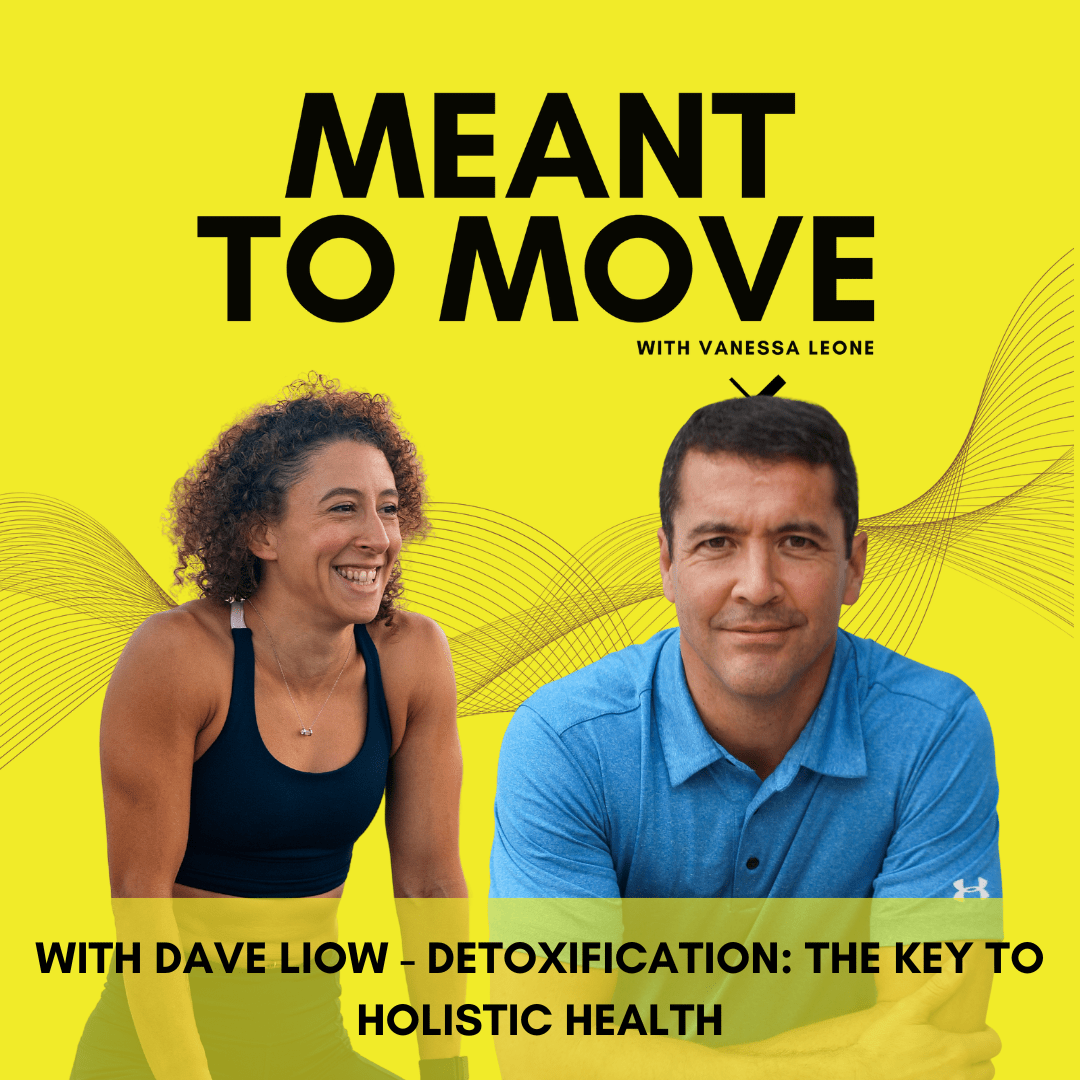
With Dave Liow
Summary
Host Vanessa Leone speaks with holistic health expert Dave Liow about movement, detoxification, and well-being. Dave shares insights from his background in physiology and discusses the importance of sleep, diet, movement, and mindset in holistic health. He explains how toxins from food, water, and the environment impact the body, emphasizing the need for detoxification through proper nutrition, hydration, exercise, and gut health. He debunks myths around detox programs and highlights sustainable habits over quick fixes. The episode concludes with Dave’s philosophy on movement as a key to happiness and longevity, encouraging listeners to take responsibility for their health.
Transcript
Vanessa Leone (00:01)
Hello everybody, here we are. I have with me a friend of mine and someone who I’ve known in the industry for like a little seems like a long time now, but welcome Dave. How are you?
Dave Liow (00:14)
Hey there, I think that’s your way of saying I’m old, but no problems.
Vanessa Leone (00:18)
Me too, don’t worry.
I love it. I think we definitely met over the pond where we were presenting at conference together. And I have to say that you are just one of the most open and forthcoming educators and presenters who I’ve met. And so I’m really happy to have you on the podcast today. Thank you so much for your time. Yeah. So we were chatting a little bit beforehand.
Dave Liow (00:39)
Thank you for having me.
Vanessa Leone (00:44)
before we came on about what you wanted to talk about today. And I think the first question that I have for you before we dive into our actual topic today, because you are a holistic health background, when we talk about holistic health, what are the parameters for you that come into defining holistic health?
Dave Liow (01:06)
That’s a great question. I guess from a background point of view, which may kind of help answer that and I guess show my background is I’m a bit of a movement geek. So I went through the whole university side of stuff and I was a physiology guy and then I did a masters and then I taught at universities, I lectured for probably another decade after that. So I got stuck right into that academic life and I love the movement side of it.
I soon found out, and that’s what I got excited about your podcast, is it’s about foundations of health, that that wasn’t enough. So if you’ve got a great program and you’re moving well, that’s just a small part of it. And I soon found out that unless you have the health foundations going, it doesn’t work out. So what I started seeing in my journey was people who were quite unwell.
and that included some athletes. I was working with whole lot of high-performance athletes as well that were missing a lot of the health elements. And I started seeing that that had a huge impact on the outcomes. So I got very interested in, boy, in sleep, in diet, in digs, optification pathways, in gut health, you name it. If it was something to do with health and performance and movement, I started following the rabbit hole. And there’s a lot to learn.
So yeah, all those things interest me.
Vanessa Leone (03:32)
So you’re into holistic health. You’ve learned so much. You dive down the rabbit hole. What, what do you consider some of the most important parameters of holistic health?
Dave Liow (04:02)
Okay, there’s, if I go back to one of my, I guess, early mentors, which was Paul Chek, he’s really the guy that I guess started bringing this whole, this idea of holistic health in front of me. And this was back in the 90s. And when I first saw that, I went, wow, that’s really interesting. And I love that he had a very early book, which I still think is an amazing book where he had different doctors, had doctor movement. So he had a doctor
quiet, you had a doctor happy as well and and a doctor diet so you know it’s what you eat it’s that that regeneration and sleep there’s that mindset part of it and there’s a movement part and I think those are I guess if I had four pillars or foundations I guess I could roughly organize some of my work into that and I still think that’s a neat way of looking at the body.
Vanessa Leone (04:57)
So ahead of his time then as well if you think about what he was talking about and where we kind of are now 30 years later or something. It’s pretty incredible.
Dave Liow (05:04)
Yeah, it was a while back, wasn’t it? Come to think about it. Lord.
Vanessa Leone (05:10)
that’s really cool. So you talked about regenerative practices or things that happen within your diet and diets really interesting because we have this regeneration, but we also have this detoxification. And at the moment you’ve said to me that you are super into detoxification. So for people who hear these words, what on earth do they mean when it comes to our overall health?
Dave Liow (05:39)
So de-toxification is something that’s happening all the time. So we’re exposed to an amazing amount of toxins and in this developed world, even more so. But one of the studies I was reading not so long ago, they were looking at animals as far away from mankind as possible. And they were still finding a lot of contaminants in the water in there and in those animals that were as far away from man as possibly could be.
And in new babies now, they’re finding pesticides that hadn’t been around for 25 years. I still find them in umbilical cords. So this stuff is in our environment floating around on a regular basis. So if you’re a human, you’re exposed to toxins, if you’re on this planet. And if you’re on this planet, you’re probably just exposed to a different amount of toxins. Some of the most toxic person I’ve ever seen, we have a toxic kind of checklist where we look at exposure to toxins, was actually a pilot. And he had the highest score I’ve ever seen.
Vanessa Leone (06:36)
Wow.
Dave Liow (06:38)
But saying that second one I’ve ever seen was the lawyer. So we often think this is people who work in industry. And I had a spell where I was working with guys who were welders, painters, fabricators. And you’d think their toxic scores would be very high from their exposure. But some of the most toxic scores I’ve ever seen or exposure toxins have been people who have been in, I guess, in city jobs. Yeah.
I’ve seen some farmers as well who’ve been farmers and growers who’ve been very exposed to pesticides and toxins. So the idea is we’re exposed to these toxins, there’s nowhere around that. But we want to be able to get those toxins and get rid of them out of our body. Because if they’re in us, they can damage us. They can damage our immune system, they can directly damage our cells, they can damage our hormones.
And certainly one of the theories, and again it’s hard to put, you can’t say that this toxic load is killing us, but when we look at the exposure we have to toxins and what’s happening to our health, there’s some pretty reasonable relationships there I think which no one can deny. And that’s the World Health Organization, that’s the Endocrine Society, they’re all saying that this exposure we get into these toxins now is a problem for our health and our children’s health.
Vanessa Leone (08:02)
Yeah. I I’ve been diving down this rabbit hole personally, like as a personal, not quite vendetta, but really trying to figure it out autoimmune for me. So that’s the, you know, that plays a huge role in me trying to figure out my health and longevity. But you talked about a detoxification kind of checklist. Is this something that people can assess, you know, maybe not.
fully in detail but can assess themselves to understand what kind of toxins they might be exposed to and what kind of stress that places on their body.
Dave Liow (08:33)
Absolutely. the first step of our, we run an actual detox program, but the first step there is you’ve got to stop your exposure to toxins. mean, you know, if I want to clean myself, there’s no point me doing that in the mud, rolling around the mud with a hose trying to clean myself. I’m just going to get dirty again. So if you can identify those toxins in your environment.
Vanessa Leone (08:41)
You
Dave Liow (08:53)
and remove yourself from them, well, that’s a great place to start. And in the Show Nights here, I’ll make sure you guys get a copy of the toxic checklist. And it’s really easy. You can just go down and look what you’re exposed to. And some things are really simple. There’s some very simple ones to deal with, like what kind of water you’re using, do you have a filter, plastic bottles, what kind of underarm you’re using, the perfumes you’re using, the cleaning products. So there’s some really simple things that you can do to reduce your
at low and they’re happy to give people a heads up on that so you can start reducing that. The less toxins you have exposed to the better.
Vanessa Leone (09:33)
Mm, yes. I have thrown out a lot of things recently. I’m not going to lie. Going natural, everything. Yeah. And I think, I think the challenging thing is it does get a little bit overwhelming when you think about how much is in your environment that can actually be causing this. But I suppose what I think is important for people who, who are kind of sitting on the fence who are like, this is too hard. Could you describe?
what a high toxic load does internally to someone who might not even realize that they have a high toxic load.
Hello? Can you hear me? I’ll ask that question again. Goodness gracious, this is going to be one of those days, isn’t it? I’ll ask that question again. Here we go.
Dave Liow (10:29)
we’re back again. Yep. Cool.
Vanessa Leone (10:40)
So for someone who is a bit on the fence about detoxification and what to change in their environment and what they might be exposed to, without them going into the checklist, could you describe for someone who might think toxins, it can’t really do that much to me, like what’s happening internally when you have a high toxic load?
Dave Liow (11:04)
So one of the things that I often quote is, what goes on you, goes in you. So I say that again, what goes on you, goes in you. So if you’re looking at your underarm and you wouldn’t want to spray that in your mouth because you don’t think it’s good for you, you shouldn’t be putting that on your skin. If you’re using perfumes again, which you wouldn’t squirt in your mouth because you think, oh, that’s not going to be good for me, you shouldn’t be putting that on your skin. What goes on you, goes in you. So that goes with any of the other cosmetics you have.
Now I’d say that you can put that with your cleaning products too. If you’re cleaning products, if you’re looking at the back of the ingredients here and it’s a chemical shit storm and you’re going, boy, and it’s got toxic written all over it. And you’re putting that on your eating surfaces, on your dishes, in your dishwasher, on your benches that you prepare food on, that’s getting in you. So if we go back to your grandparents, grandparents time, that’s probably about where you’d want to be.
So there’s the, there’s in your house, there’s the food you eat. If you’re looking at a packet of food there and you’re looking at the ingredients on the back and there’s 16 syllables and 14 numbers after it, that’s not food. That’s something else. So our human gut hasn’t evolved for the last hundred thousand years. So our grandparents, grandparents, grandparents, that’s the same gut that they had. But if you look at how our food chain has changed since then, it’s astronomical.
So generally the rule of thumb, and this is one from one of Paul Chek’s ones again, which if you can’t bang it on the head and skin it, pluck it out of the ground and rinse it off or pluck it off a tree, you shouldn’t be eating it, is the general rule of thumb. So the closer you can get to the natural source, the way to go, the less human interference, the better.
Vanessa Leone (12:54)
Yeah, yeah. And so those things that, you know, those chemicals, what, like, what are those internal systems? Is it like liver? Is it like what, how do they break down or maybe not break down in our system?
Dave Liow (13:11)
So that’s great. So I think most people have an idea that the liver is really important for filtering out all those baddies and a lot of them will get in through your mouth. So particularly if you look at some of the most common
There’s a whole range of different toxins, but probably some of the most common ones you’ll actually eat. They’ll get in your water and they’ll get in your food from your plastic containers, from in your food chain. So your gut has to deal with those. And when your gut to digest food, the first place it sends all that stuff it digests is to your liver to deal with.
So the liver is really important for that, but so is the kidney. But I would probably circle back to the gut again, because one of the first principles we have and in our program is we got to get the gut moving. So you want to sweat, want to wee, and you want to poop out a lot of those toxins. So if you’ve got a gut that’s not working well,
you’ve got problems because it’s just going to back up your liver. There’s nowhere for that liver to detoxify stuff too. So just backs up the whole process. So gut health is integral to having a good detox system. If you’re constipated or you suffer from constipation, that’s real issue because again, if it doesn’t go out, it goes in. So you end up getting a toxic buildup from that. We want that liver function to be decent. So
by not bombarding your liver with a chemical shit storm three times a day and plus snacks, that’s really gonna help your liver do its job. Plus we want, and I just saw you took a big swig of water there, which is amazing because we need that fluid too. The kidneys filter blood, that’s their job. And they will take a lot of toxins from there. But.
If you’re not well hydrated, you can actually reuptake some of those toxins back into the bloodstream. So having that water running through, again, think of a pond. If you have a stagnant pond with no water going in it or out of it, you’ve got a problem. So we need that flow, just like all tissue needs flow. And that’s definitely the gut, the liver, and the kidneys as well. So those are some key ones to start with.
Vanessa Leone (15:21)
great. I think you’ve actually come up to a really good point here, which I think is super important because a lot of people when they think detoxification, they go straight to food and obviously that’s super important, right? So you mentioned the food that you eat, all of that is key. But exercise influences this fluid flow, doesn’t it? And it can have an impact on your detoxification. So could you describe and explain how that works?
Dave Liow (15:47)
Yep, so exercise helps you sweat for a start, which is useful because that’s another way of detoxifying. And that’s where antiperspirants, I’m not a big fan of. If you don’t want to stink, that’s fine. Put some deodorant on it. And hopefully again, it’s one that you’d roll on your tongue because if you don’t want to eat it, you shouldn’t be putting it on your skin. So I’ve got two daughters and they had those…
spray cans and I walk into a room where someone’s been spraying that and my spider senses go off, I’m on no way. So I bought them.
15 different types. And I said, you try all these, you just tell me the ones you want. And that’s the one we’re going to give you. having that stuff in your armpits by breast tissue as well, that’s not a great thing to be doing. So we want that sweat. But also that exercise also tends to boost a lot of those detoxification enzymes. Because what we’re to do in the detox pathways is we’re often taking toxins that are fat soluble. And those are the problem children.
the fat soluble toxins. And there’s a lot of those around which are an issue. And converting those into water soluble ones so you can wee sweat and poop them out is what we want to do. So detoxification, the biochemistry behind it, is pretty intense, but I looked into that very…
a very in-depth looking at what we can do to boost those different pathways in each step of those pathways and also what blocks some of those pathways too so that we can detoxify really well. Yeah, so we want those pathways to be running well. So actually one little tip here for the listeners at home is…
Yeah, multi minerals and vitamins are really useful. So a lot of those biochemical pathways require trace minerals and also vitamins. So if you’ve got deficiencies in those, you can’t detox very well. So certainly having a decent multi vitamin mineral is really useful.
I don’t believe you can do that particularly well even with a decent farmed diet. You need to get something. You probably need one those in your diet, you do.
Vanessa Leone (18:16)
Interesting. There’s a lot of interesting, conflictions on these, right? And I suppose it’s just one of those things. It’s, it’s very unlikely to harm you by taking a multivitamin. And I often try to look at these things as like risk versus reward. people have like these huge, you know, debates about multivitamins, but there’s no debate about your deodorant, which has got butane and propellant in it. And that you’re
putting on your skin, right? So I think that that’s a really interesting contrast when people start to go down, but my supplements, then they’re really expensive, all this and that. What you’re basically saying is, you know, we don’t, we haven’t looked at all of these other household items that we just take for granted completely. And those are the things that are doing the harm, but you you take a multivitamin a day and you’re gonna, you’re gonna get hung up on that for some
reason because the media has sensationalised its potential negativeness or something.
Dave Liow (19:23)
Well, thank you.
If we look at farming practice today, again, what they were hundreds of years ago now, there’s no doubt that there’s deficiencies in soil. And if you’ve got deficient soils, there’s no way you can have crops or animals that are healthy. Australia and also New Zealand, and I’m not sure where everyone else is listening from, but there is a range of deficiencies in those soils. So I often think that a multi-vitamin mineral is, it’s like an insurance policy to make sure you’ve got that covered off.
And really an analogy that I stole from someone, I’m trying to remember who, never mind. Imagine you’re building a house and you’ve got your weatherboards and you’ve got your nails to hold the weatherboards in. Think of your macros like your weatherboards. So that’s your protein, your fats and carbs. You’ve got to have those, but you also want nails, which are your minerals and your vitamins to hold them in.
So there’s no point having gold plated nails if you’ve got shitty weatherboards. But again, if you’ve got weatherboards and you’re not securing them to your house, you’re going to have problems too. they kind of work together. I’m not saying that a multi-vitamin mineral is the big on an end all. It’s just a part of the whole thing. But I love that analogy. I think it really worked for me anyway.
Vanessa Leone (20:36)
great. I like that as well. That’s really nice. Would you have some similar tips for our listener about what movement or movement practices are useful to help boost these detoxification pathways in the system?
Dave Liow (20:52)
Yep, get sweaty would be my advice for that one there. And what we often do in our programs too is we even get people to sauna after that too to get more sweat. Different toxins are removed different ways and particularly heavy metals are quite useful to get them out and sweat. So you’ll get a lot of your cadmiums, your mercuries, your lids out with sweat. So that’s a really effective way of doing that. In terms of what type of exercise,
I like them all. I’m not one of these people that say you should only weight train cardio. Cardio will slow down your jazm. I don’t believe that for a second. Yeah, I think if you’re moving and you’re enjoying it and you’ve got some variety, all power to you, I do think it’s useful to move different ways and in different angles.
and just have fun doing it. If you can do some outside, that’s great too. You should lift some heavy shit as well though, because you should keep some muscle mass along your journey. But yeah, I’m not, I’m not precious. want the outcome. How you get there is up to you.
Vanessa Leone (21:58)
That’s really cool. I didn’t prompt that answer at all if you’re a listener. I’m all about moving how you like and movement variability, so that answered that question beautifully.
Dave Liow (22:05)
Cool. Look, I
think if you’ve been around for a while, like perhaps we have, you kind of come to that conclusion. And we all have our things. Some people love CrossFit. Some people love Olympic lifting. Some people love kettlebells. You know, they’re all methods of achieving a goal. And if that’s your method and it works for you, that’s all cool. But different strokes for different folks is what it comes down to.
Vanessa Leone (22:31)
I wholeheartedly agree. Let’s come back to sweating. This is cool because I think at the moment, the debate’s raging about cold plunge and saunas and all of this kind of bits and pieces in terms of recovery. And you’re talking about sweating as a vehicle for detoxification. Do you think that sauna has almost been…
to say removed from its original purpose as a detoxer, but it’s kind clouded in this recovery zone now. It obviously also promotes recovery, but can you talk a little bit about how it works and maybe why there’s a little bit of confusion in this space?
Dave Liow (23:18)
I don’t know if there’s confusion. think we’ve got that, there’s a real shift towards that whole recovery, know, contrast, ice bath, infrared, all that stuff. And I don’t think there’s a conflict there. I think they all have a place to play in there. And certainly I’ve got…
do think they are useful for that. Man, if you’re sitting in a sauna and you love the heat and you’re relaxing and you’ve got some music on, I think that’s fabulous for you. Likewise, if you love sitting in an ice bath and it feels fabulous for you, you should do it. If you hate sitting in an ice bath because you hate the cold, you shouldn’t do it. I think that has more harm than good associated with it. So, I’d still work with some athletes. It’s not my main thing anymore, but…
Vanessa Leone (23:58)
Hahaha.
Dave Liow (24:08)
I’ll tell them, if you hate the ice bath, you shouldn’t go near it. If you love it, you should use it. Is there evidence that it works? For sure. But there’s other ways that you could be doing this, which you probably don’t hate as much and don’t send you into such a stress state.
Vanessa Leone (24:12)
Hmm.
Dave Liow (24:25)
Yeah, just coming back to a point, I like what you said before about, you know, people just getting overwhelmed by all this information out there. I think it’s really important if you can just take a couple of points that you kind of think, yeah, that could be that makes some sense to me. I think that’s useful. You don’t have to do everything at once. you don’t have to be saying, OK, I’ve got to start exercising now. I’d better get in a sauna. I’d better change all my cosmetics from my products in my house. Just pick a couple of things that sit
Vanessa Leone (24:25)
Mmm.
Mm-hmm.
Dave Liow (24:55)
with you really well and just start somewhere and if that makes you a little bit healthier and you get a couple of points that’s kind of cool I kind of feel like I’ve done something but yeah you don’t have to do it all because that stress response I think that creates a lot more problems than the benefits of probably detox make which is yeah
Vanessa Leone (25:07)
Mmm.
Yeah, for sure. Sorry, I’d
love to you to perhaps to share a story about a client, maybe their journey through this. Like I’ll just give you some context. Sorry. I’ve done, I’m doing the deep dive, like you perhaps not as deep as you because it’s not as necessarily my wheelhouse and more of the movement side, but you know, the cosmetics, the Teflon pans, the fragrances, the
the cleaning products, all of that is kind of right where my partner and I are really looking at everything in our house at the moment. And I think that initially we were both a little bit overwhelmed because when you start to look at it, you’re like, holy shit, like everything in my kitchen is geared towards either giving me microplastics or some kind of like exposure to something. But we did, we actually started.
nice and slow. it was one pot at a time. It wasn’t like, rid of every Teflon thing as quick as possible, because number one, that’s expensive as well. And a lot of people can’t afford that. And it was, okay, let’s have a look. If we change our Teflon fry pan, which we know to use, and we move to stainless steel, how do we cook on it? I think that there’s practicalities that people in these swaps, because we’re so used to the ease of
of certain things, spraying your underarms because the products just, they’re available at the supermarket rather than having to go to the health food store and the tiny little pocket. He’ll sell, they have a whole bunch of natural ones, mind you, and they actually smell really good. So do you have like a client story that comes to mind of someone who you’ve kind of coached through taking through these steps?
Dave Liow (27:07)
Yeah, absolutely. So we have a process that we do with this and we usually do it at the start of the year. So I’ve actually got a detox running now with probably maybe 20 people that are running one at the moment. And we often do them at the start of the year and near the end of the year. We normally have bunches, but then we have people who tick through throughout the year as well. One guy, think, in particular, who had some of the better results that I’ve seen. And here’s one for you.
The hardest thing we do in our first week of detox is to cut caffeine. And man, and I always say to people, when you’re cutting caffeine, cut it by half each day. So if you have three cups coffee a day, go to one and a half. Next day you’ll go three quarters, next day…
Half and three quarters, whatever that is. Then down we go. Mass is getting hard here. So, and people go, yeah, yeah, yeah, yeah. I’ve had some people try and go cold turkey and man, they could not function.
So caffeine, it masks your tiredness, is effectively what it does. So it blocks adenosine receptors in the brain, which give you signals for tiredness. So it boosts your cortisol, gives you a cortisol miss, which is your stress hormone. So you take that away, all of a sudden, that tiredness creeps in very quickly, and you don’t get that boost, that stress boost from cortisol. So I’ve had some people absolutely self-destruct in that first week from trying to go cold turkey.
So, but you know, we want that hormonal system coming back online too. So cutting that, I had a guy who was, he was on 12 coffees a day. He was in marketing. So he’d be having all these marketing meetings and he was, he’s very overweight. Now the older you are, the more body fat you have, the more toxins you’ll have.
So if you’re 18, listen to this, and you’ve got 5 % body fat, you you haven’t got a problem just yet. But if you’re in your 50s and above, and you’ve got a bit of excess body fat there,
Yeah, odds are you are carrying more toxins. You just had more exposure over time. That’s just the way it rolls. And a of those toxins are stored in body fat as well. This guy was very overweight as well. So he started off on the process there. And particularly, he was quite into cooking, which was a bit of a bonus. So he just started tidying up his food. And all we say on that first week there is, know, cut the caffeine, cut the alcohol, but also just start moving your food towards real foods.
And that made a massive change for a start. In our second week, we start adding in some intermittent fasting. And we tailor that differently for different people, particularly for females versus males. Males and females have quite a different response to intermittent fasting. So we tailor it that way a bit.
Then we start off, we actually start reducing calories because we actually need to have some exercise and calorie reduction because we need to get the fats that we need to mobilize the toxins out of the fat. But not only once we mobilize those toxins out of the fat, we need to bind them and get rid of them. So if you’re losing weight, but you’re not binding those toxins,
All that happens is you get those toxins in the bloodstream, they go around the bloodstream and they settle somewhere else. So getting rid of those toxins is a key step that we have in our detox program. That’s we’ve got to have the gut moving because your gut’s not moving. Well, now you’ve got all these circulating toxins, your gut’s not moving, you can’t get rid of them. If you’re not sweating on top of that, you can’t sweat them out. If you’re dehydrated, you can’t weed them out. So we have all sorts of problems with that. So we have a whole lot of binding toxins. We use a lot of fibre to get the gut moving. We use a lot of
robotics as well. We’ll use some other binding.
We have some particular teas that we use which produce bile and also help with bile excretion. So bile is produced in the liver and what it does is it helps break down fat and it gets the fat so you can excrete the fat. And bile is normally recirculated. When your liver produces it, it recirculates around and around the body kind of 14 to 17 times is the magic number. But we don’t want that. We actually want the bile to get out of there. We want to actually poop it out so that we can actually get rid of those toxins there. So we do a lot.
of around around binding that with there’s been a lot of binding agents we use we get them from around the world specific ones that I’ve researched finding that I know that they’ll bind all those different toxins that come through so you can get rid of them out of your system and I guess that’s the the key thing if you you if you are losing weight
if you’re trying to detox is just make sure your gut’s moving and that you’re staying very well hydrated for a start. You can go down the fancy supplement route and if you want but I’d say just that would be a great start even if you don’t want to go in your rest. Make sure your gut’s moving. Fiber is wonderful stuff. for that and it is. You know we’re very deficient in fibre in our Western diet.
Vanessa Leone (31:52)
Mm.
and cheap.
Dave Liow (32:10)
So I have a range of fibres sitting in my cupboard there and I’ll often add them to foods just so can increase my fibre intake. In fact, the only people that I’ve seen with reasonable fibre intakes have been vegans that I’ve worked with. I look at their fibre intake, that’s actually pretty decent, damn good. But if you look at other traditional diets compared to Western diet, our fibre’s just about non-existent. It’s poor.
Vanessa Leone (32:34)
It’s incredible that you’re talking about this because literally this is part of what we’re talking about over the next few weeks. Fiber is a huge component of it. Cause we’re getting into a little bit more diet and it’s so underrated and it’s so easy. It’s so easy. Yeah. It’s such an easy thing. And I think, you know, we talked before about adding in that multivitamin, but adding in a fibre supplement is usually way cheaper.
Dave Liow (32:51)
It’s that simple.
Vanessa Leone (33:03)
way easier and obviously than just adding vegetables, veggies are nature’s fibre, but if you still need to supplement, they’re actually really good.
Dave Liow (33:13)
Yep.
Yeah, absolutely. I could frame some of my poos, I could make statues out of them, they’re that good.
Vanessa Leone (33:17)
Love that.
If I had a name we were going to go down there, I would have invited my partner
in, but we’re not going to go down there. It’s men. No, we’re not going to. It’s, it’s a very important part. Love that. So, okay. This, this is bringing us to, a really interesting part because what you’re talking about is I think a kin or similar sounding to what people would do as like a cleanse or like a detox.
Dave Liow (33:28)
Okay, cut that bit out if you need.
Yeah.
Vanessa Leone (33:53)
So when people are looking at these kinds of buzzwords on the internet, or these buzz diets, what’s actually happening when they go through these detoxes?
Dave Liow (34:05)
Okay, so I’ve looked at a fair few of them, particularly lot of the popular ones out there and gone through their ingredients. Now, if your ingredients, if they’re not boosting the detox pathways, so helping you break down those toxins, making them water soluble so you can get rid of them, if they’re not binding supplements, binding toxins, I don’t know what they’re doing.
So lot of the common ones that I see in detox programs, so turmeric is a good example. So turmeric is anti-inflammatory and I’ve got no problem with turmeric, but it actually blocks some of the important detox pathways. So if I see a detox program and it’s got curcumin in it or turmeric in it, I go, no, that’s not good investment. Milk thistle is another one, which is a really common one. And that’s a common liver one. Everyone goes, you need milk thistle to calm a liver.
Vanessa Leone (34:40)
Mmm.
very interesting.
Dave Liow (34:56)
And milk thistle does help with liver health, but it blocks detox. So it’s useful sometimes, but it’s not useful in detox program. So if I see that in the ingredients here, going, no, that’s not useful. Green tea is another, I love a good green tea and I’ve got a, I have a massive green tea collection, but.
That’s off the table as well. Green tea, some of the wonderful things in green tea, which are great other times, aren’t good for detox in that specific time. and then other ones I look at, they just make no sense whatsoever. You know, I’m very science driven. I use that as a starting block and then…
I try and add something practical to it to make sure it works into real life. But I look at some of the structure of some of these, I look at the ingredients and I have absolutely no idea what those substances are supposed to do. They make no sense to me whatsoever. Yeah, but maybe they know something I don’t know, but I don’t know what they’ve been reading.
Vanessa Leone (35:54)
Yeah,
okay. And do you have any kind of practical advice for people who are, you know, looking at these cleanses and, you know, detoxes? Like, are there things that we need to like watch out for, or is it just kind of like, hey, if you saw it on the internet, don’t buy it without giving it a little bit of like research, even just like Googling some of the ingredients. Is that a good place to start?
Dave Liow (36:21)
Yeah,
I think that’s reasonable. Yeah, that would be a neat thing to put down a little checklist on what to check in for a detox. Look, I think the other thing too is if it is really just a, you know, take this and that’s you done, or if it’s a do this and just drink juice for the next two weeks, I mean, that’s not sustainable. That’s not creating habits.
And I see a detox program. My philosophy is it’s like spring cleaning your house. You certainly want that. But while you’re spring cleaning your house too, why don’t you teach people how to put stuff away and tidy as they go? So it’s not going to get so messy afterwards. So that’s where a lot of the stuff we do is about building habits, about looking at labels, about how you eat, when you eat, what you eat.
So if can get those habits established, then add spring clean on top of it, your house is going to go cleaner later on. So that’s the kind of process we have. if the detox sounds like, you look at it and you go, man, I could do this for a week, but I’m going to hate this so much, or I’m weak and then I’m out. And then it’s picture in champagne. To me, that’s not useful. Let’s just clean the house, then trash it with a party the day after it’s finished. Why bother?
Vanessa Leone (37:41)
Yeah. No, those are perfect analogies and I like how you create those analogies because it’s very clear in my mind that picture now and we all see them. They’re so heavily advertised and they kind of just sneak in in your algorithms, I reckon. Especially when…
Dave Liow (38:03)
The ones that just have like the juice stuff there, I just sit there going, what the hell is going on here? I mean, I guess if you’re eating KFC and pizzas all day and you just drink juice for a week, it probably is gonna make some positive changes or it’s gonna make some changes. But again, not sustainable. No lessons, no lessons, no life lessons, no habits formed. Yeah.
I mean, you don’t brush your teeth once and say, my teeth are brushed. You don’t exercise once and say, I’m fit now. You know, we want habits, good eating habits. We want good habits to keep these toxins from getting us on a regular basis. And that’s what we want to build with detox programs.
Vanessa Leone (38:41)
Mmm, yeah.
So let’s finish with a couple of key questions then.
What, it’s hard to give people advice, like, you know, we don’t want to give unsolicited advice, but if someone is looking to decrease their toxic load, is someone’s looking to eat better, move more, all of that kind of stuff, what are the three things that you would recommend that they might start with or that they might keep in mind for their journey?
Dave Liow (39:14)
Yep. So I always think exercise is great gateway drug. Yeah. So it makes you feel good and it makes you do other healthy behaviours. So I think if you can find some sort of movement that you enjoy, I think that’s going to be great. And I don’t care if it’s throwing a frisbee around with your dog.
Vanessa Leone (39:20)
Hahaha!
Dave Liow (39:36)
I don’t care if it’s going for a run or a walk or going to the gym or Zumba or whatever that might be. Find something you enjoy doing movement wise would be a great one. I do a lot of work in the sleep arena and I’d be…
I would tell myself off if I didn’t say something about the importance of sleep because there’s a lot of detoxification happening in your sleep as well. And sleep is not a, it’s not like a sleep on your computer where things go quiet. It’s a very active process. Your organs are getting health cleaning, your brain’s getting housekeeping, your psyche, your emotional psyche is getting cleaned there as well. So sleep is massive on that one as well. So I’d be.
I’d say that would be wrong if I didn’t say something there. Now that leaves me unfortunately crossroads because I see there’s three and I’d love four. There’s got to be something around what you put in your mouth and that’s a must.
Vanessa Leone (40:30)
We can do four. You can do four. I’ll give it you. I’ll give it to you.
Dave Liow (40:42)
You you’ve probably heard that saying you can’t outrun a bad diet. You certainly can’t. you know, a diet has a huge impact on your health. So there’s got to be something around food quality. So don’t just look at carbs, fats and whatever else. Think about what the ingredients are. The quality of that food is massive. If you can’t bang it on the head, skin it and you can’t pluck it off a tree or pull it out of the ground and wash the dirt off it.
it’s probably not food you should be eating a lot of. So there’s got to be something around there. And probably the last thing I’d say is a purpose, a mindset for it. If you’ve got no reason to be healthy, if it’s just too easy for you to eat pizzas 24-7, because there’s a bakery, a pizza place right next to your work, because you’ve got no other reason to want to be healthy, you’ll just go with whatever’s easiest. So…
If you want to be there for your kids, if you want to travel to your old age, if you want to feel great, if you want to operate as a better human being, you need a purpose, a drive or some reason to make you want to make these changes. So find out what that is. because otherwise when things get a bit tough, I’ll just go back to my pizzas. So, you know, what’s your reason for wanting to make these changes? Is it? What is it? Is it you?
Vanessa Leone (42:07)
Hmm.
Dave Liow (42:08)
And for me, I probably should share this story. I should have done the start. It would be a better story to start. the reason I got really interested in this whole detox process is on my mum’s side of my family, my grandfather was a nursery man. He’s in New Zealand in a place called Waikato. And he bought a lot of plants into New Zealand and started a lot of the nurseries in New Zealand.
And he was told back then that DDT wasn’t a problem. You could spray that shit anywhere, it’s safe. Okay, so my granddad’s out there spraying DDT out in the fields all day. The stuff’s going all over him. He no protective equipment whatsoever because he didn’t need to because DDT was totally safe. That’s what the government told us. And he got that gone to his nervous system. He got very, very ill, so did my grandmother. And I watched him suffer with that poisoning my whole childhood.
So I’ve seen firsthand how toxic these things can be. And I’ll often say if you think the government’s looking after your health or your wealth into your old age, you’re kidding yourself. So self-responsibility has got to be huge. And if you want to be aging well, and if you want to look after yourself, you have to take that responsibility because the government won’t do it for you. And it’s not their responsibility, it’s yours. So take responsibility for your health and wealth and you’ll…
Vanessa Leone (43:31)
a great story, it’s a great ending and I think we can all see.
how quickly the world changed in our grandparents, great grandparents era, to the acceptance of so much of this chemical modification aspect of our food and our environment. Yeah.
Dave Liow (43:53)
So, yeah, World War II was a turning point for that.
A lot of those pesticides that were generated from World War II, that was a chemical boom. And that was, yeah, that was war related. That’s where a lot of these things came from. And the number of these products that are coming out there is ridiculous. And I know this may sound like conspiracy theory to some of you out there, but the science is really hard.
There’s the World Health Organization, the Inacron Society, are all saying that we’ve got a problem on our hands. And you can bury your head in the sand if you want, but it’s likely to come back and bite you in the ass. And if you look at the neurological diseases we’re getting these days, the cancers we’re getting, absolutely, there’s no doubt that our environment has a trigger to play in there. So if we can control that for your own health, you know.
Vanessa Leone (44:29)
Hmm.
What do mean?
Dave Liow (44:45)
huge impact on not only your own health but all those people you interact with. get motivated before you need it.
Vanessa Leone (44:49)
That’s a great message. Yeah, it’s
a great message. And it’s definitely not a conspiracy theory. I hope that there’s a growing awareness around it. And that’s why we’re having this conversation today because we want that awareness to be more mainstream rather than people, again, debating the science on whether something that was made in a chemical laboratory or something that you can pull out of the ground is better for you.
I don’t know how we’ve come to debating this, but I do want to leave you with one last question. We’ll make it nice and quick. When I say the words movement therapy,
If I was to ask you what you do for yourself for movement therapy, what’s coming to mind at the moment?
Dave Liow (45:38)
Yeah, I have to move. I think the Falun Guy stole it before I did that movement is life and yeah, if I’m not moving, I’m not happy. So movement’s my happy place for sure. For me, wow. Yeah.
Vanessa Leone (45:41)
You
Dave Liow (46:00)
I have a thing where I reflect on some of the happiest times in my life. I write those down and almost all of them have a movement part associated with it. Often it’s me and my wife travelling somewhere or something I’ve done with my family. Yeah, there’s often a doing component with it and I’m lucky enough to have a body that’s working pretty well for me. I guess I’ve invested a fair bit of time into it and energy but it allows me to experience the world in a…
in better way. yeah, therapy is an interesting word for me. This movement is just life.
Vanessa Leone (46:41)
Yep.
That’s a great answer. It’s a great answer. I totally second that. It’s fantastic. Yeah. Now, all the information about how to get in contact with you, information on your programs, it’s all in the show notes. So please get in touch with Dave when you’re ready, because I know that you want to know more. Dave, thank you so much for your time. I appreciate you. I appreciate your time and thank you for everything you’ve told us today.
Dave Liow (47:09)
Great to connect with you Vanessa, hope to catch up with you soon. Probably another conference somewhere. Thanks.
Vanessa Leone (47:13)
Yeah. All right. Until next time. Thank you.
 Vanessa Leone Movement Therapist