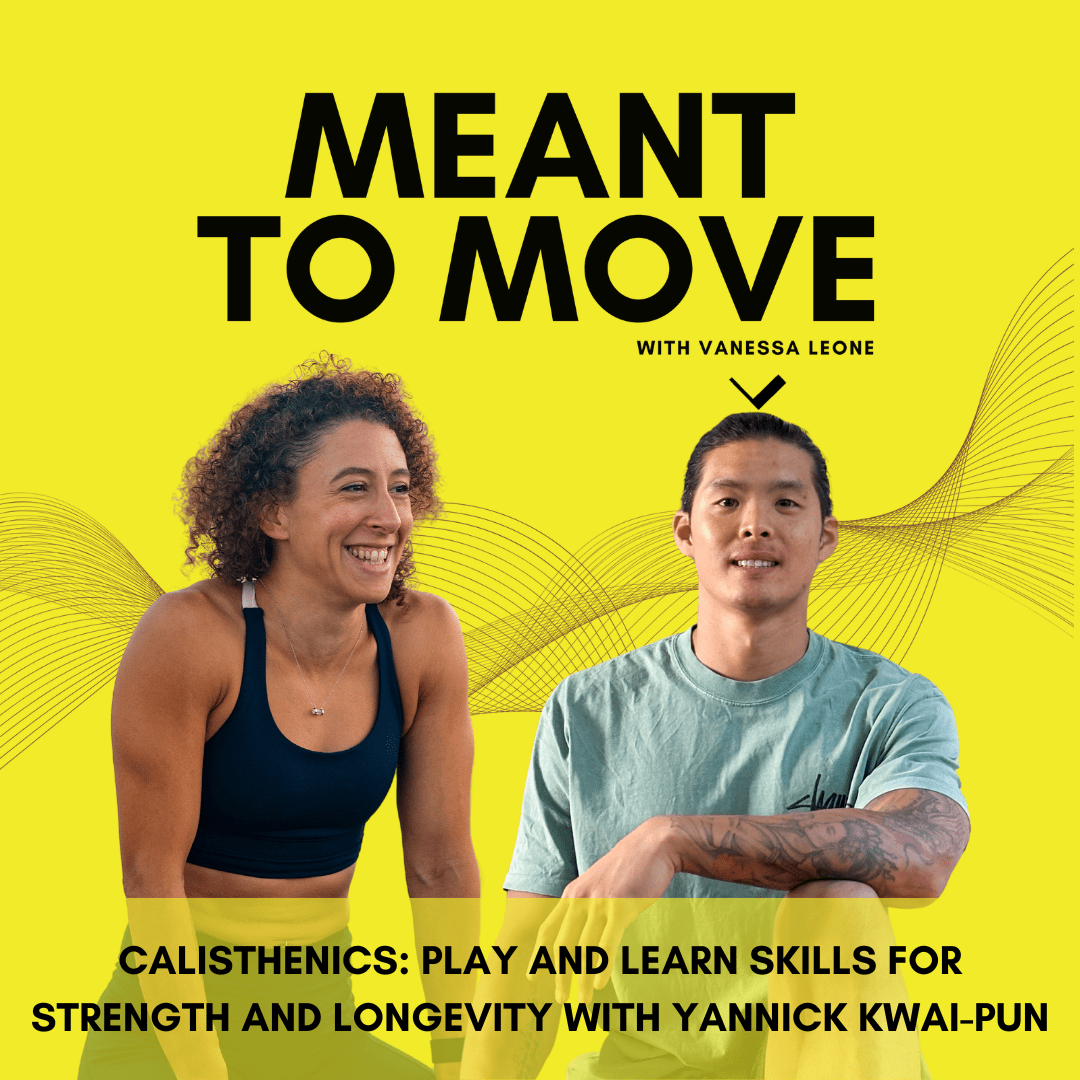
Meant to Move – Episode #14
Summary:
Vanessa Leone interviews Yannick Kwai-Pun about calisthenics. Yannick discusses his journey from weightlifting to calisthenics, emphasizing the sport’s evolution from simple bodyweight exercises to a structured and competitive discipline. They highlight the importance of mobility, strength, and skill, and the benefits of breaking down complex movements into achievable tasks. Yannick also stresses realistic goal-setting and the value of small wins in maintaining motivation. The conversation concludes with insights into the future of calisthenics and its potential for broader application in fitness.
Vanessa Leone (00:01)
Hello Yannick, how are you?
Yannick Kwai-Pun (00:01)
Hello Vanessa, yeah I’m well thank you. Thank you so much for getting me onto your platform and I hope I can share a little bit of insight and yeah.
Vanessa Leone (00:13)
⁓ I’m sure you will.
No, this is great. For context, for you listening out there, I am a calisthenics enthusiast, I am a coach, but I would say the way that I coach it would be maybe… I don’t want to call people beginners, but I like to coach skills, I like to coach really quite technical, biomechanical, so I’m really looking forward to hearing your point of view on things.
But I suppose what my first question is for someone who is completely unaware, what is calisthenics? What would you define as calisthenics?
Yannick Kwai-Pun (00:52)
I think that the definition has definitely evolved over time. think when people became more aware of calisthenics, we had… I’m not sure if you remember, there was the Bar brothers, was Hannibal for King…
Who else? know that Barstarz and I think they started a movement and made it really really popular and you know that’s like on YouTube and I think you’d had your pioneers like fitness FAQs and you know like ⁓ and it was solely bodyweight movement and it was very much so it’s bodyweight or nothing.
Right, so it was very adamant, very dogmatic I would say per se. And I think that now, although yes it is bodyweight strength and bodyweight skill, I think that it is becoming more of a sport. know with the introduction of street lifting for example, I think which revolutionized the…
they took a very different dimension. All of a sudden you had sponsorships, had equipment, competition, athletes. And I think this contributed to calisthenics, so the skill part or the freestyle part being ⁓ taken a bit more seriously. So now I think that the methodology has very much evolved in…
it’s becoming more specific and less like a bunch of kids playing in the park. I think this is what it was like if you took it… Obviously, know, like when the people that started the whole movement, you know, it wouldn’t be… the space wouldn’t be where it is now without them. But the evolution now, I think, that it took from just being
play session to now you have some very very serious athletes and you have a method, you have courses and you have some proven ways to achieve certain skills how to get you there, how to condition yourself. So I think in definition yes it is still okay to think that its definition is bodyweight strength training or bodyweight skills.
But the space has completely changed. I think it took a whole 360. Now people are using a lot of weight training. They’re using traditional strength and conditioning, but super specific. I hope
Vanessa Leone (03:55)
I really like that.
Yannick Kwai-Pun (03:56)
that answers your question without being too one-dimensional and just giving you bit of perspective.
Vanessa Leone (04:04)
No, it’s perfect because I mean, the simplicity of your answer in terms of its body weight, skill and strength, it’s still there. Okay. But people can kind of see this evolution of why they might be seeing it in their feed a little bit more or why more people are participating in it. And I think what a lot of people don’t realize is that this type of skill and strength conditioning has been around in many cultures for literally thousands of years.
This isn’t new. This isn’t a new thing. This was what we used to do to our bodies that thousands of years ago when we didn’t have exactly 100%. And we wanted to condition our athletes and, and, or just condition ourselves. So I think that people can be a little bit scared by it, or they do see that that culture that has emerged that kind of like boys in the park, a little bit of
Yannick Kwai-Pun (04:37)
Equipment or gyms, yes. Absolutely.
Vanessa Leone (05:00)
I might call it little bit ego driven, particularly coming at it from a female perspective. You see the guys in the shirts off and they’ve got big muscles and they’re doing these things that look quite unattainable. But I really like that the evolution of it has come back around and we are seeing it more and more because I think that it’s incredible. So for you, we just say for your own conditioning, what is your calisthenics practice, I suppose.
Yannick Kwai-Pun (05:31)
Well, it changed a lot over the years. Per se, I didn’t really start as a calisthenics athlete. And I don’t think that I would put myself in that bracket per se, like just completely. I would say that I always chased strength. I was always attracted to see how strong I could get. And it took very different shapes.
So started as a weightlifter and then I got into bodyweight strength training. Through YouTube I saw a few videos and I was like, oh, okay, that’s pretty cool. I did a little bit of this for conditioning and for fun, really, because my main sport was weightlifting, which was pretty serious. But then I had a hobby, if you want, on the side, right?
Yeah that’s right, another hobby which is training as well, which is completely mad right? But then I discovered through some injuries, a friend of mine, I was looking at some rehab one day for my knees and one of my colleagues introduced me to a YouTube video again on OVIDO and I was mind blown, I saw a guy just
so freely and doing some incredible stuff and doing some strength like incredibly strong and having skills that I wanted to achieve and I was like whoa okay so this guy can do this but not only he can do those skills he can also lift he can also move through ranges and I was like okay what is this and that’s how I came in on to the Ido portal method and then I got in touch with I went to my first workshop in 2000
end of 2014 I went to Brisbane and then it completely changed my… so I went in as in the mindset okay I’m going to learn how to get more flexible for my knees and etc etc maybe I’ll learn a little bit of bodyweight strength skill I thought I was strong and I went in and it was it really blew my mind how actually not strong as well as right it was it was really like a big shift
And I think since then it still has a big impact on the way I train. So again, to answer your question, how do I condition myself? It depends what type of goals I had. I had periods of time where my main goal was when I first started, I wanted to get as strong as possible in everything. So I changed a lot of skills like the planche, front lever with one arm chin up, the 90 degree push up, etc.
So I would do a lot of skill-based work, so mainly skill and a little bit of conditioning with weights. And then a few years after, I really wanted to train rings because I just got really naturally gravitated towards them. And I saw someone doing some online, I saw something called a reverse muscle-up, I’m not sure if you’re familiar with it.
I was about 10.30 and I thought, okay I’ve got two years until I turn 30 and I really want that skill before I turn 30. So I made it my goal and for two years I just did rings training. Rings training is not different, I seeked an aerialist Anthony Tran, I’m not sure if you know Anthony, so correct, in Western Australia.
Vanessa Leone (09:18)
in Western Australia? I do.
He is incredible, shout out. It’s been such a long time since I’ve seen him, so yeah. He’s aerial training studio, right?
Yannick Kwai-Pun (09:23)
Yes, so I reached out to Anthony and we delved deep into that and for two years my strength and we did a bit of self-acro as well so yeah I big credit to him to get me where I am now strength wise right so I really it really took the next step like in in strength and ring specific so without him I wouldn’t have had a
the backward roll elevator and so on. So yeah, think this is where it took the direction. So then the elevator became the, when I got the elevator, I got it just before, think, I was just like a few days before I turned 30. So it was like, it was incredible. Like it was a life-changing thing. And it was that thing that I thought was impossible at first, because it just looks so impossible.
And then that’s when something shifted inside of me again one more time where I went, okay. So really if you put your mind to it, you’re not, because before when I achieved skills, I was quite young and I always attributed a lot of it to, you know, when you’re younger, have a bit of neuroplasticity, you’re more adaptable, your tendons repair quicker. And I was definitely feeling the change, like closing 30 and I wasn’t responding as well as I was before. ⁓
And I couldn’t get away with just trying stuff, if that makes sense. And then I realized that, yes, even later on, you can still progress. So I did that. And then, unfortunately, a year after, I had two tears of both my rotator cuffs. So one my supraspinatus got torn at probably 80%. And I couldn’t move my arm anymore. I went from being able to do one arm chin-up on my same arm to not being able to do a ring row.
Vanessa Leone (11:32)
Wow, okay, yep.
Yannick Kwai-Pun (11:33)
Yeah, like overnight. It just happened. I had no pain. We just had, I just had a really big session and then the next day I felt shaky in my arm and then I went training on Monday, I kicked up to a handstand and I just fell. So it was very scary because there was no pain. I didn’t know what was happening. I didn’t know what was wrong. I just couldn’t move my arm. So it was very scary. I thought, fuck, like I went from overnight having all those peak level skills to…
not being able to just do basic movements, right? And that shifted a lot too. So I had, took about, I couldn’t train for about four months. I didn’t go to a gym because I just, it’s not that I couldn’t train. I was just so devastated that I couldn’t do anything. So I didn’t really train for four months. So that again, that was a big turning point for me when I went, okay, you can’t, you probably went too hard and like,
your body just… You know that saying of, if you don’t de-load properly, your body is going de-load for you, right? So I think this is what happened. Unfortunately, this is what happened. Then I slowly went into the route of introducing a little bit more hypertrophy work again. After a few years of quitting, yeah, traditional. Just like…
Vanessa Leone (12:35)
traditional.
Yannick Kwai-Pun (12:57)
Just some basic bodybuilding work and just conditioning work that I didn’t do for a long time because coming from weightlifting, coming from Olympic weightlifting, we did a lot of conditioning and I think that for me, part of me leaving weightlifting was a bit of a relief that I didn’t have to have that because there was no competition really to go to, right? So we did it for fun. It was very, a bit of a relief for me to not having that set
to have to work towards something and treat it like a job and get rid of the conditioning that you don’t want to do because it’s literally it’s not it’s quite boring you know it’s very painful correct correct correct it’s a lot of things that you don’t want to do but I found love again I fell in love with it again I think after a few years and I think this is where the next step took in it was
Vanessa Leone (13:33)
It burns, it really burns.
Yannick Kwai-Pun (13:56)
a combination of very much so. Treating it again like the skills as if I was treating a snatch or a clean jerk or a deadlift or a squat. Periodization. Looking at what function are we trying to achieve and I think this is part of what I’m doing more with my page 2 is looking at the skill, breaking it down in a way that
where we can make it accessible to everyone. Meaning, again, like what you said before, instead of looking at that skill as something that’s so scary, we can break it up into very digestible pieces that we can achieve one at a time. And each little piece can be like having that big task in front of you.
And instead of trying to chip away at that big task, we go, how can we, what’s the function of it? What are we trying to do here? How can we segment it into multiple tasks so that we can create a roadmap to achieve one little task over time? And then slowly it allows you to be a bit more consistent, have small wins along the way. And with each win, you take the next step and the next step and the next step.
and the next step and along the way your conditioning will have to adapt as well with the next task that you’re trying to achieve and I found that yeah it worked really well for me because I’m very task oriented if I know what I have to do on the day then I just it doesn’t matter if it hurts or whatever it is it would just I just have a direction to go and not trying to get too distracted in trying that new thing that especially nowadays with social media it’s so easy right
But if you have that, I think that’s a big part of my current training and coaching philosophy at the moment.
Vanessa Leone (16:05)
Great. No, that’s, there’s a lot of things that you mentioned in there that I like to kind of digest and go back over with people. But I think that you make a really great point. And I want to highlight this point that many people look at calisthenics and think it’s unachievable. But from everyone that I’ve coached and even personally for myself from participating in it, I don’t have the weightlifting background from it. I’m a gymnast by trade.
So achieving even a part of a skill, there’s nothing really quite like that sense of achievement, that sense of, know, I did this for myself. And I think that that is what you’re talking about. Those are those life-changing moments. And that’s what I really love to see when people step into calisthenics and you watch it as a coach, no doubt. And it’s really quite fulfilling that
you know, for yourself and for the people in front of you, hitting a PR is great for a deadlift or for a snatch or a bench press or whatever. But you never really refining the skill itself. Like you hit the skill and now you can do it. Now you just kind of get heavier. But I think the thing that I really love about calisthenics is that the journey to attain the skill is so much greater. It’s there’s so much technical capacity.
and elements to it, that it really can be a lifelong journey of refining and creating these little, these small wins, like you said, of things that you never really thought that you’d ever would achieve. And that’s really cool. think that in itself deserves its moment for people to acknowledge. And this is why I’m a big believer in calisthenics because
The journey for most people is the hard part, is the cloudy part in terms of their own training. Everyone’s searching for the end goal or searching for the result. Whereas I think calisthenics turns that on its head and creates the wins in the journey. I don’t know if you, what do you think about that?
Yannick Kwai-Pun (18:09)
Yes. I think that you’re right. think it’s just the… If you look at…
If we call it a practice, if you look at your practice in general, especially in that journey, you can look at it as more so the purpose just being what makes you begin, then you find your purpose, you get started, you’re consistent, it gives you a reason to stay consistent, which is like you keep going.
And it’s just really a vessel to channel the conditioning work because then now you have a reason why you need to show up to the gym and do all these things that don’t really make sense on their own, they don’t really make sense. if you look at a lot of conditioning work, it just doesn’t make sense for someone to do it on its own, but put together, then you can put the pieces of puzzle together. So I like the…
Yes, the whole channelling, your work into something bigger than yourself. And then the sense of self-achievement by having those small wins is like what you said, it’s incredible because there’s money involved, there’s no… Yeah, because it’s not pleasant either.
Vanessa Leone (19:34)
Nothing tangible in a way, right? It’s just, it’s…
Yannick Kwai-Pun (19:52)
Like a lot of it is painful, right? So why would you put yourself through
Vanessa Leone (19:54)
It’s hard.
Yannick Kwai-Pun (19:55)
this? It’s frustrating. know, the more you get into skill training, it’s very frustrating. Sometimes you don’t even know if you’re going to get it. And that’s, think, that’s, I think, one of the most important thing to take from it is that maybe the whole point is actually not having the end goal. Maybe the point is to
keep chipping away at a goal that’s constantly in the distance so that you keep going forever. Because the day you achieve that goal, if you’ve got no more goals, you… What’s the point of staying in that same… I’m big believer that, yes, it’s probably the point. The point of this practice is that that practice never ends. And there’s always layers and layers and layers layers and layers. So every time you uncover a layer, you…
build another layer of complexity and another one and another one.
Vanessa Leone (20:55)
It’s a great point. No, think that really to me is the essence of calisthenics and its beauty and why we start seeing coaches like yourself now that emerge, that are actually bringing that scientific biomechanical periodization strength and conditioning component to it, which was very sorely needed because of
that element that kind of started as like, look at these just cool tricks that I can do. And there was no kind of methodology to be able to achieve it.
Yannick Kwai-Pun (21:21)
Exactly, I think what changed as well is now because there’s more interest into it, you have more regular people that are trying to get into this, not just ex-performers, ex-gymnast. Traditionally, when this first started, had a lot of, know, like calisthenics, if you look at it, a lot of the skill work is a… as a default of using a better word.
is a lesser version of gymnastics. Right, that’s where it is. If professional gymnasts look down at calisthenics athletes 10 years ago, they okay, these are the guys that are trying to be one of these. It’s wannabe gymnasts. So now, obviously without the training and as adults, that’s all you can achieve and it’s really impressive. And nowadays, the skill level of calisthenics athletes are, I think, it’s becoming its own thing.
Vanessa Leone (22:10)
I would also comment on that gymnastics thing as well, that I would actually say that calisthenics is the safer aspect of gymnastics training in the aspect of risk. If you look at tumbling and bars and ring, sorry, vault and all of that, that’s high risk. You’re putting a lot of limbs on the line there, it’s way more accessible.
Yannick Kwai-Pun (22:25)
It’s more accessible to people. I think instantly they can start. Someone can do a push-up. You can do a push-up, you can do a push-up on your knees, you can do a chin-up, you can do a ring-row. And I think this is how this caught on. But also at the same time, when it evolved, because we had all these ex-performers that could already do things, or ex-gymnasts that could already, they already had the skills, but they had no understanding of how to…
actually make it accessible to a normal person. I remember going to one of those workshops where I would go in and go, okay, how do we do set A skill? Just do more. And it’s like, well, I can’t do more. Do you know what I mean? For someone like them, they will go, how do I get my first one arm chin? Well, can you do 50 chin ups? Well, no, I can’t do 50 chin ups in a row. Sometimes the…
there’s a dissociation, ⁓ complete dissociation from what it feels to be a regular person that doesn’t… Imagine being that person for which a push-up would be hard. So how do we get started then? Do know what I mean? They have a fear of jumping on the rings now. How do we even get started there? Or it’s completely… And I think this is where we need to meet in the middle and…
bring something else to the table where it’s like, okay, let’s have realistic expectations. And also the material, like what you said, biomechanics and physics are really like the approach of physics because then it makes sense like where it’s all about weight shifting, right? How we manipulate our centre of mass around an object or in accordance to, you know, ourselves in our best of support and in the rings is not different. So…
I think that then it gives people a much relatable approach.
Vanessa Leone (24:56)
Yeah, for sure. I definitely love bringing, you know, in my own practice, I think I never thought I’d be a biomechanics nerd when I was at university, because I hated biomechanics my first semester, but now I love biomechanics. being able to, like you said, take a skill and actually break it down so that it’s accessible for someone who is
literally just beginning. Like you said, can’t do a push-up. Can’t do, you know, just isn’t conditioned the way that a gymnast is conditioned. But being able to break that down is so important. And this is actually one of my questions is, if you are someone who is a beginner, you’ve never done calisthenics, you’ve, you hear this conversation or you start seeing some things pop up.
What do you want to say to someone who is a novice to calisthenics who might look at starting? What’s your advice to them?
Yannick Kwai-Pun (25:55)
Well, obviously, the first thing that I would say is trying to be realistic as possible. And this might sound very real and you might get a lot of people out of the equation, but I think just being truthful from the get-go. So actually, Harry and I, Harry is a good friend of mine and we’ve been trying for, we did the Ido portal method together, right? That’s how we got started. So a lot of where I came, like a lot of what I achieve now, I…
is due to him. So he helped me a lot with my journey and just learning from him. But we were saying, we were discussing about a concept that’s quite just putting things in perspective for most people. The concept of cost and how expensive something will be to you. How expensive would a skill be to you? So for example, if you’re 20,
You have no responsibilities, you’re recovering really well, you probably don’t need to have a job, like a regular job or anything like that. So, that high in skill is going to cost you way less than someone who is, let’s say, Obviously, you still have, probably still working, have responsibilities, you don’t recover as much, you can’t really have that much time on your hand to dedicate to these things, they’re going to be slower.
So I think being very realistic, you need to look at your own what you have right now and being able to choose goals in accordance to what like your circumstances. Does that make sense? So I think it’s a more difficult answer and more broad answer than what we think. It’s not, there’s not a simple yes you can start or yes you can do this.
I’m more to the point of, okay, look at all your limitations. What do you really want out of this? If your goal is just to be fit and do that, maybe you choose something else. I’m pretty straightforward. If your goal is just to be fit and you don’t want to be frustrated, there are better ways to do so. And if you want to, let’s say,
Chase, well we’ve got good examples. We have someone at Movement Co she’s called Esther, she’s 70.
Maybe 72, 73. She started when she was probably late 60s. And she can hold her handstand over a minute. So things are possible for most people. I trained someone who’s in the 60s too, and she’s on her way to get her muscle up. So there are ways to start, but you really need to address the fact that, okay, certain things are going to get slower.
certain things you will never get. And I think that’s very important as a coach to tell your client this without feeling insecure about losing a client, if that makes sense, for the sake of just getting them into the practice. It’s more so, depending on what you want to do, there’s probably a lot of things that is not going to be possible just because of your communication and being as…
black and white as possible is always my motto.
Vanessa Leone (29:35)
Yes. Yeah. And I think it’s interesting because it’s, think that transparency is, great because a lot of people, it’s funny, you know, I’ll use this as an example. I’ll go to see Cirque du Soleil and I’m one of two or three people in the audience who gasp at a certain skill because I know the requisite strength that’s required for that skill, but because it doesn’t look
that fancy or that hard. People aren’t really necessarily, they’re not quite understanding it. And that’s not their fault that they don’t understand it, because you haven’t felt it. And I think that that’s what calisthenics does, right? As soon as you start to feel what it takes to achieve some of these skills, it really humbles you in your own ability. But I also think not only does it humble you, also then you really appreciate the strength that you have and then the journey that you can take to build more strength.
So yes, you’re right. It’s a hundred percent frustrating at times. but that’s where I think that’s that to me is the difference between, I’m just going to go like jump on a bike and then I’m just going to lift some weights in a pretty traditional way. For me, I would just be very bored personally.
And I, I love, I almost love the unattainability of some of these skills because I look at it with such respect and I look at the people who can practice those skills with such respect. And, and I’m really considerate of my body’s challenges to, then when, when I do overcome those challenges, it’s, it’s your own personal achievement as well. It’s, it’s, that’s the really cool thing. So yeah, I, I, I agree. Here’s a, here’s an interesting question for you. If you had to choose.
Yannick Kwai-Pun (31:05)
Absolutely. Sure.
Vanessa Leone (31:26)
just say five movements from the calisthenics family of skills or, you know, movements, whatever you want to call them to create, just to create a well, if my goal is I want to be fit for life, but I’m going to train calisthenics. you know, I want to, I want to do a handstand when I’m 60, but I also want to go for a hike, you know, whatever. What are the five movements or skills that you would say?
Yannick Kwai-Pun (31:29)
Very interesting. Yes.
Vanessa Leone (31:56)
Okay, these are the ones that I think are going to give you the most bang for your buck.
Yannick Kwai-Pun (32:00)
Okay, you were talking about someone who probably is highly capable, Let’s say that, and they can achieve most things and they want to be able to train forever. I would say that if you’re capable, some sort of press handstand is probably, I think I hope we did very high out there. Because the press handstand requires you to work on your mobility and your strength, depending on where you’re at. So you have a lot of people who are very strong.
and yet can’t press handstand because they don’t have mobility or they don’t understand. I think that the press handstand is the perfect blend of coordination, skill and strength. And it also challenges you to keep that level of figuring things out that will keep your brain stimulated.
Because there’s always a way to approach it, you can always make it better, you can always refine it. And as you get more efficient, you probably will use less and less strength, or you can try to use more strength if you want to progress. The traditional trainers the Straddle Press handstand, I think is a great goal for most people and achievable for a lot of people, like very achievable. The Stalder Press on the other hand is probably the, I would say that for a non-
Gymnast is probably one of the holy grail, think, to get that because again, mobility and a bit more on the strength aspect. Very good.
Vanessa Leone (33:26)
Yeah, that one’s on my bucket list. that’s
the yeah, yeah. So if you what I can do is I can link some of these exercise videos team if you’re interested. All right, so click the show notes. So it keeps it we’ve got we’ve got hands down, hands down press.
Yannick Kwai-Pun (33:38)
Absolutely. Think if anything else, some sort of straight arm pulling that would require you to go through different ranges of the shoulder. very, actually I’ve always been very interested in the 360 pull, which is a variation of a skin-the-cat, pretty much.
So it requires you to go into shoulder extension, but it also requires you to use your lats at the first part of the pull. And straight arm pulling is not something that we see very often. A lot of people are used to using the biceps. Whereas here, the scapula, the humerus needs to move for a big range of motion. So a 360 pull.
So you can make it as hard as you want to, or can make it as easy as you want to. If you need to use compression work, can also take it to… So you can have it on the strength aspect where you can extend the body, go from front lever to back lever, or you can compress yourself going from a simpler to a toe to bar to a German hang. And we can go on and on and on, and even at the bottom it is…
At the German hang, the really interesting thing about the German hang is that I think it’s one of these… It can be a really good expression of how well you understand the shoulder mechanics and how mobile your shoulders are. Because if you look at a full 360 pull, you get people now who can go through a full shoulder dislocate.
Vanessa Leone (35:26)
gosh.
Yannick Kwai-Pun (35:38)
So you can take it, so that’s why you know that’s a good skill to start with and you can actually take it very far or you can keep it very close. So same as the Press Handstand, as a pull equivalent. I would say that it is very much so. You can take it as much as you want on the Strength spectrum and as much as you want on the Skill spectrum.
Vanessa Leone (35:39)
Yep.
Yeah. I will interject there.
That German hang, I would say, is probably one of the most underrated just exercises in general. I even think that it should be implemented into a lot of traditional training for its mobility element in the shoulders. just, think it’s absolutely incredible. And so many people have shoulder challenges and I think
Yannick Kwai-Pun (36:16)
Absolutely.
I think so too.
Vanessa Leone (36:24)
that this is the part of calisthenics that I think, because people think it’s unattainable, those real basic elements of calisthenics I actually think can improve a lot of people’s lives. And that exercise I think is an excellent example of that.
Yannick Kwai-Pun (36:29)
Hmm
Absolutely. And then I think the… So as you can see, we delve a little bit more into the movement realm, with the press handstand, the 360 pull, which are not really traditionally found in calisthenics. As for the… A great goal to shoot to, you’d have your bent arm strength, so a variation of the handstand push-up.
which I really like. So you can take it all the way from a back push-up and we can go all the way down the rabbit hole to a 90 degree push-up.
like now you’ve got people doing some incredible stuff just because it opens so much door to first of all you’ve got to learn the handstand so you need to have somewhere to go so without the handstand you have no handstand push-up so it forces you to work on your handstand and you can develop a very decent
amount of overhead pushing or shoulder strength in general. It’s like upper body strength in general with very little equipment. All you need is a space on the floor pretty much. Then I would think that the handstand itself is probably one of the best things to… If you had the one thing that you wanted to keep forever, like for very long time, I think…
The handstand is probably at the top of that ladder because it will force you to work on your wrist mobility, your shoulder mobility, your hip mobility at some point. You have to be present. It’s one of these movements that…
You really have to be there. You can’t just sit on a bike and watch TV, for example, or sit on the treadmill and not actually do anything. You really have to be present. You have to be connected with your body. And obviously, at a certain level, yes, you don’t have to be so focused or whatever it is, but I think that it still requires you to be there.
in that moment in time, which is why I really like that. And the last one would be probably at default of choosing between a one-armed chin-up and a muscle-up, I would choose the muscle-up. Now, the muscle-up, and when I say the muscle-up, I’m talking about muscle-up on rings. Not just because of my practice itself, just because I found that…
Vanessa Leone (39:22)
Rings. Yeah, I thought you might.
Yannick Kwai-Pun (39:36)
The ring muscle-up one would be probably more accessible to more people, especially to women in general, just because you can use a lot of range. If you got good elbow flexion and shoulder flexion, then it is a movement that’s very achievable. The greatest value that I find about the muscle-up is not just the muscle-up itself, it’s actually the transition, the notion of the transition. So if we look at the muscle-up as a skill,
per se and instead of thinking, most people think of the muscle-up as a pull to a push. Well, it’s a bit more than this. It’s actually the ability to get over an obstacle. So muscle-up per se, in here you have the rings of a bar, but really if you were climbing on top of your surfboard, your paddleboard, on top of a boat, over a wall…
on top of the table, getting out of the pool, this is the muscle-up. So that’s why it translates to, it’s a very function, it’s a very, not really functional, I don’t really like the word functional because function is a matter of perspective. But it’s a movement that will serve you for very long time, right? If you need to run away and you have a wall in front of you, if you can muscle up, you can
get over the wall. So this and the muscle-up is probably, so the transition. So, this is the end of the first
let’s say the transition to that conversion, the shift of weight is probably something that we never… like it’s probably the first time that we actually ever do this because people don’t climb anymore, they don’t climb the walls anymore. So having access to that, it changes a lot of how you will approach and break down things, like you start understanding it’s a very particular thing to feel your weight shifting and for you to also
shift your weight by not using because in our day and age we do a lot of this or we do a lot of this.
Vanessa Leone (41:38)
Elbow. Yeah, elbow extension and flexion.
Yannick Kwai-Pun (41:43)
everything comes from the elbow flexion or extension. When we look at the muscle ups, same as the skin, the cut, the press handstand and to the handstand push up to a certain extent too. The most important mechanics here and the most valuable one is how the humerus moves according to the torso.
So in that socket, if you look at the muscle up, if our elbows are constantly, so I’ll be here, if my elbows are constantly shifted, I’ll go from the top of the chin up and I’m going to go to the bottom of the dip. So ideally, we’re not losing any of the flexion here, but it’s just the humerus that moves across. So there’s going to be this, and we are also required to perform correctly. We’re also required to understand how to articulate our scapula.
And I think this is one of the movements that we’ve lost over time. The understanding of how to manipulate. The awareness of our scapular rhythm. So how it goes from protraction to depression, elevation, and etc. So it’s a skill that’s been lost. So I think this would probably make one of my top movements.
Vanessa Leone (42:35)
I like that. That’s very cool.
Yannick Kwai-Pun (43:02)
And it is the base, if you want to, if you’re interested in any rings practice in unlocking different rings skills, the transition is the foundation of that whole thing. So if you can’t go on top of the rings, if you don’t understand how to shift your weight over, well, you’re very limited. But if you understand how to do this, if you look at the muscle-up, the forward roll, the backward roll, even the reverse muscle-up, these are just extensions
of the transition. If you remove the pull or the dip, it’s the same movement just done differently, integrated and in different planes.
Vanessa Leone (43:43)
Yeah, I think there’s a couple of things that really stand out to me about those those movements that you talk about. You talk about shifting your body, body awareness and body control, I think is is underrated when you look at like weight lifted. There’s a there’s quite a, there’s quite a big
push from lot of longevity experts and a lot of health experts to lift heavy. And I think that that in itself has taken its own meaning is that I need to pick up heavy dumbbells or heavy barbells and, and, and move mass. But we don’t necessarily do it well. And the thing that I love about calisthenics is that you’re moving mass, you’re moving a lot of mass, but you have to do it in a way that is safe and achievable for your body, for where it’s at. And that transition.
even with your feet on the floor is one of the most humbling exercises that you’ll ever do when you haven’t ever done anything before. And everyone who does that ring transition work from, in your different groups as well, they, they all say the same thing is like, why is that? I barely move. Why is that so hard? and
And you’re talking about, also don’t like the word functional anymore, but you do talk about, you know, how it relates to other sports or other movements in life. And I think that there’s a lot of carryover and a lot of transference from calisthenics strength because of that body control.
Yannick Kwai-Pun (45:16)
I think so, I believe so. I believe that there’s a lot of potential there for cross-training. So if we look at… It’s also to a certain extent. Also to a certain extent because… Calisthenics is great, for like, yes, absolutely, for body awareness, load, accessibility, because obviously…
the minimalistic approach and it gives you, yes, like the layers are very fun. The risk though of calisthenics is if you look at a lot of calisthenics athletes, they’re not very mobile.
And I think this is what, if I would mention a downside of that is to the sport or the discipline is that mobility is a very neglected aspect of it. And that’s why the movements chosen here will force you to get some sort of mobility to it. And I think the carryover is great for
Vanessa Leone (46:19)
100%.
Yannick Kwai-Pun (46:34)
a lot of sports that are very close to it, meaning we see a lot of carry-overs. Right now there’s a big… I’ve got a friend of mine who coaches a lot of pole dancers and they do great. They do great with the calisthenics approach of conditioning, but again, super specific, right? But for example, if you train bodyweight strength for a Olympic weightlifter,
Vanessa Leone (46:49)
It’s not going to work. Yes. You still need, you still need a barbell. No, I think, I think the transference comes from more weekend warriors, not necessarily athletes. You know, I want to go out and play football with my mates on the weekend. Okay. You need mobility, you need control, you need strength.
I think that in that aspect, in a kind of a more general aspect, there’s a lot of, there’s a lot of carry over, there’s a lot of, of transference. You know, I want to pick up a couch and move my house. Yeah. Okay. Cause you’re to put your spine in some interesting positions in calisthenics and that has a great carry over to being able to manipulate your body with an object that, you know, so that’s, that’s where I see a lot of the, the, the carry over, suppose, in terms of, that, of that transference. Now,
I have like 50 more questions, but I don’t have any more time. So if you were going to say one last thing really quickly about calisthenics, is there anything that you haven’t said that you would like to finish on?
Yannick Kwai-Pun (47:57)
Fine.
I think that it would be interesting to see where this goes because I think everything is taking again, I think it’s changing. Like what we said, traditional weight strength, weight training and strength and conditioning didn’t used to be part of it and now it’s becoming more and more. I think the word calisthenics, body weight strength, is it still going to be called that? Who knows? I think there’s a lot of people making some good changes out there.
I don’t know if you heard of the guys at Stenix who have a very interesting approach towards calisthenics and they have lot of success, lot of periodization, they treat it like weightlifting, I love that approach, I think it’s very sensible approach towards strength and conditioning. Then you got the other side of the spectrum which is more movement culture approach, which is what Harry and I got.
Vanessa Leone (48:47)
I have not.
Yannick Kwai-Pun (49:11)
taught under and I think that there will be a lot more mobility work. think people are getting a bit more aware that they need a bit more mobility work to be done. So yeah, I think it’s going to be interesting to see how the space changes because I feel like there’s always been a resistance for calisthenic athletes to train mobility because I think that
Mobility is seen as something that if you are more mobile in your shoulders you probably have more difficulty in generating a lot of torque. Which is true in certain extent, but for health and longevity you probably need to move the shoulders, especially if you’re going to go in big ranges, shoulders, hips, you know. And spine, absolutely. think that’s the one thing that I would add is
Vanessa Leone (49:55)
100%. Yeah.
Yannick Kwai-Pun (50:08)
I’m excited to see how the space will change over time.
Vanessa Leone (50:14)
Amazing. Me too, actually. Really, really very excited about that. I thank you so much for your time and all of your expertise. I really appreciate you and everything that you have said today. If you want to find Yannick, check out his information in the show notes. Otherwise, thank you. I will definitely be calling up again.
Yannick Kwai-Pun (50:34)
No problem. Thank you Vanessa, thanks so much for your time and the opportunity for me to share a bit more about the sport.
Vanessa Leone (50:40)
Great.
Amazing. All right. We’ll speak soon.
Yannick Kwai-Pun (50:44)
Thank you, as we do soon. Goodbye.
 Vanessa Leone Movement Therapist