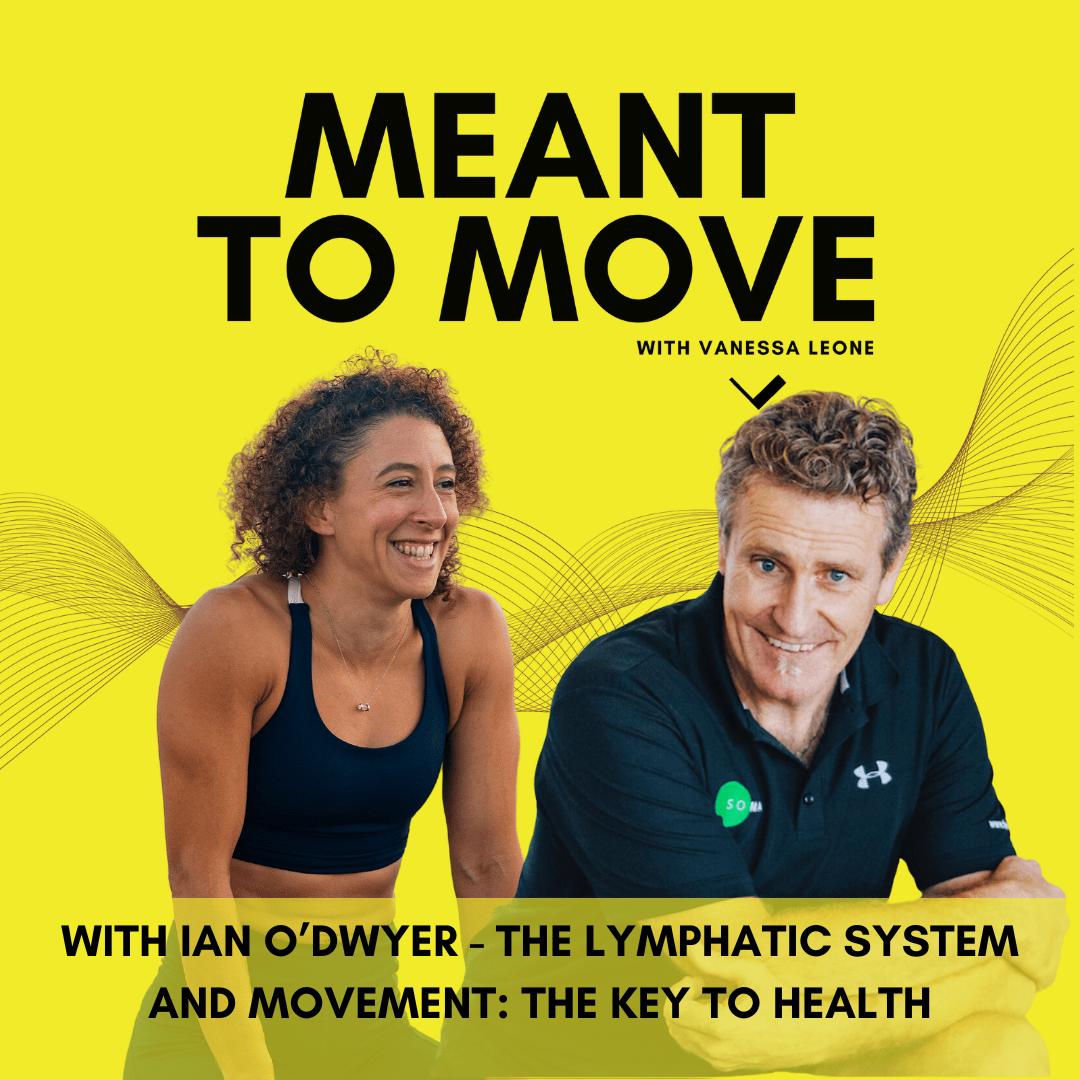
Meant to Move Episode #15 with Ian O’Dwyer
Summary:
In this conversation, Vanessa Leone and OD explore the concept of fluidity in the body, discussing the importance of fascia, movement, and the lymphatic system. They delve into how emotional health is connected to physical fluid flow and provide practical tips for enhancing fluidity through breath and playful movement. The discussion emphasizes the significance of applying knowledge to improve health and well-being.
Vanessa Leone (00:02)
OD Yoda, you’re back again. Thank you.
OD (00:06)
I’ve just been hibernating for four weeks, and I’ve awoken to some more surprises.
Vanessa Leone (00:13)
Yes. Surprise. I, for those of you who have been following along, this is OD number four now. And I just, just before we get on each week, I don’t actually tell him what I want him to talk about. just throw it in his face. I’m like, we’re talking about this now, OD. And he just like, okay, sure. And what I love about these conversations is that they never really go where I think they’re to go in a good way.
But the reason why these topics pop into my head is because when I listen back to our conversations, because I have to edit them, edit out me interrupting you or all these things.
OD (00:57)
Doesn’t happen to me often, Ness
Vanessa Leone (00:59)
Um, I find these little golden nuggets of things that you say that I go, what the fuck does that actually really mean? And I was having, I’ve been having really deep, deep conversations with my clients and everything. I feel like at the moment, everyone’s very interospective. Everyone’s like trying to sort things out in their life and trying to figure out why they do things a certain way. And last.
time we talked about fascia and a few times you mentioned this word called fluid flow or we’ve talked about fluid and I think this is the perfect segue, the next step we talked about fascia. When we talk about fluid in the body, what do we mean, OD Like what is that?
OD (01:48)
You know, it’s, I’m going to go back one step further and just unpack it a little bit, Ness, in the fact of, you know, I’m a plumber by trade. And it’s interesting how now I’m a plumber of the body because I’m dealing with the fluid right? But it’s interesting because of the fact that, you know, when we look at the body and we look at the way, it doesn’t matter what sport it is, whether it’s ballet, whether it’s gymnastics, whether it’s Aussie rules, rugby union, rugby league.
When you see, if I use this tensegrity model that’s just sticks and bands, and we look at this tensegrity model and it’s well recognized now that we talk about this as representing the tissues of the body. And for those of you who can’t see this, what we’ve got is a number of sticks that don’t touch each other and they’re separated by these rubber bands. And let’s just call these rubber bands, I don’t know, the fascial system, the myofascial system, call them what you want, I don’t care.
I’m not really emotionally attached to anything anymore because I don’t reckon there’s one thing that we know that actually is true to what we actually thought we knew. But the fundamentals tell us this, is that if this model, is seen all over the world, we see this in bridges, we see this in construction, we actually see this in human beings. So if these are the bones and these bands are the fascial system which separate the bones, so not one bone touches a bone.
and not one muscle touches a bone, it’s connective tissue, it’s fascia, right? But what’s interesting is if I push this model, no matter where I push it, if I spun this model on the ground, it would always land on three points. So we would say big toe, little toe, heel. Now when I push those, if I let it land on the floor and I push from above, you’ll see how it distorts and twists. If I push from the front, it distorts and it twists. What’s interesting is,
It’s not what you’re seeing that creates the strength, it’s what you’re not seeing. And that’s what’s in between these sticks and bands. And what’s in between these sticks and bands is a whole lot of fluid. And that fluid is blood, because blood is recognised now as liquid fascia, is lymph, and remembering, blood is 92 % water.
Then we’ve got lymph, which is 96 % water. Fascia itself is 70 % water. Muscle 70%, nerve 70%, bone they’ll say is 30 % in situ. I’ll argue it’s 50. And skin, 70%. So if we just stop for a moment, and if we stop looking at this perspective of this muscle does this, this muscle does that.
Let’s look at what makes up the tissues, i.e. muscle, nerve, bone, fascia, skin, blood, and lymph. The majority of all those tissues is water. It’s fluid. So for me, when I look at someone, and this as I said, I’ve said this before on the podcast, when I look at something, maybe having an artificial eye enables me to do this a bit different. I look at the whole being.
And when you look at the whole being movement, my first question to myself is, is it fluid? Is it now rhythmical and has it got timing? Because when you see someone who moves well, they just have this beautiful flow to them. It’s amazing how these words all relate to water, isn’t it? So when we have the ability for the body, to take force and say someone runs into me and being in ex AFL footballer on many, many moons ago and they hit me in the shoulder and I’m doing a shoulder press as my strength exercise and I take that whack in the shoulder and the rib cage and the hip because I have to because the shoulder’s not going to absorb at all. My question is which direction, if this is the shoulder joint, does that shoulder move?
Vanessa Leone (06:09)
Mm-hmm. He’s not hitting you from above.
OD (06:10)
And if we look at it from the ground up,
bingo. If we look at it from the ground up, from the bottom up, we would see how at no stage does someone running in from the side who hits us from the side, at no stage does the body shift sideways. It shifts in rotation and sideways motion, and potentially it will shift in a forward-back motion because it has to disperse the force.
So if we think about that, you sort of go, hmm, wow. Okay, so we’ve got a scenario now where if my tissues can’t move three dimensionally and I push too much fluid into an area, what’s gonna happen? So am I breaking the tissue because of the inability of the tissue to cope with force from the hit or am I breaking the tissue from the inability of the tissue to handle force from the fluid?
Vanessa Leone (07:12)
Hmm. So it’s almost like what you’re kind of saying there is when we’re seeing these kinds of, I really liked the example of this, of this hit, because we can all visualize it in whatever sport we’ve played, right. Or watched. And sometimes you see the athlete literally just bounce off, right. And they, and they roll and they just like spring back up and it’s totally fine. And then, and then, you know, the next player could have.
hit nearly identical and they like fully crumple. They absolutely crumple. They can’t move. They can’t get up. They’ve, they’ve really hurt themselves and things like that. And it’s interesting that you mentioned fluid because what you’re saying is if there’s, if there’s something internally, that’s not allowing you to push that pressure, that force around the system. Well, then you, then you’re going to get that impact a lot more direct. That’s going to cause that crumple, right?
OD (08:11)
So if we’re conditioning our body to move in a vertical or in a linear pattern and we’re not incorporating the entire body when we’re conditioning our strength, well, once again, I’ve said it before, the muscles are predominantly the force producers, but they can only produce or mitigate, share as much force as the fascial tissue has been conditioned to do in three-dimensional motion. So… is really, really important in that regard.
Vanessa Leone (08:45)
Very cool. just, makes me, it paints this picture, I think very clearly about them when you’re looking at, ⁓ you know, an injury, just say like, let’s just talk about running and walking. If someone is getting pain when they’re walking, you know, how number one, how do we get pain walking? And it’s like the number one movement that humans are designed to do. So first up, have to, we have to look at.
what’s happening to be able to cause that. But, know, very scientifically, we look at it this kind of cause and effect, or you have this tight muscle or your joints degrading or something like that. But I don’t think the exploration goes much further than that in a lot of instances. So if you if you were taking this example, what do you start to look for in terms of a fluid or a fascia perspective that could help us understand a bit more of the puzzle?
OD (09:43)
Is this a seven day podcast? Because I would love one day to get down this rabbit hole. Because remember, we don’t know the answers, but we can ask the questions. And if we can ask the best questions, we can get better solutions. So let’s just look at one system. And I’m going to pick one system purely because it has the most water content of the body. One system.
It’s encased in fascia like everything else is, but it’s one system that apparently is being blamed for disease.
and it’s apparently being blamed for pain, and it’s apparently being blamed for many things. So let’s just unpack that a little bit. Let’s talk about the lymph system. So the lymph system, from an AFL footballer’s perspective, who’s walking, he has 20 litres of fluid in the feet, five to six litres of blood, 13 to 14 litres of lymph.
Vanessa Leone (10:34)
Okay, let’s do it, let’s do it.
OD (10:52)
Just imagine, take your fingers viewers and run your fingers through the top of your foot. Now run it up around the back of your calf, migrate, spin your fingers around to the knee bone, up around your patella, that’s it. You can do that because you can, Nessie. Run it up your thigh, run it over your pelvis, up your gut, over your sternum and finish at the collarbone junction, because that’s where that lymphatic juice
fluid has got to get to. Those lymphatic ducts are super important, right? Now, just imagine where you ran your fingers. We call that a river.
And that river is wide and that river is narrow. And it consistently changes. So we would say the foot is a narrow part of the river. It’s a bony structure. There’s not much meat there. It’s a narrow part. But then it comes into the calf complex, lower limbs gets wider. So it’s meaty, it’s muscular. There’s lots of fluid that can flow. Then it comes into that narrow part of the knee. And then it comes wide again into that.
big thigh area, then it comes into that bony structure of the pelvis, which is really quite narrow when we look at the bony component. And then it comes into the gut, which is an amazingly wide part of the river because you have all these organs. And then it comes into the sternum, lateral rib cage back, which is very narrow, very bony. Everywhere we have bone, there’s the potential for that river to block because fluid has to continue.
Vanessa Leone (12:26)
That’s such a beautiful analogy.
OD (12:28)
Thank you very much. So it’s interesting though, because think of this, Ness, and this is just me thinking from my dorky perspective. We know that every piece of tissue is encased in fascia. Every organ, the brain, the gut, the bones, the nerves, everything’s encased in fascia. And that fascia has to continually slide. So if I gently rub my hands together,
you’ll feel how the skin will create a heat and that heat will actually allow some lubrication for the skin to keep moving. Now what’s interesting is if I apply a bit of force to both hands really lightly, now you notice they don’t wanna move in any direction. So my philosophy is from a field soma perspective is that from observation and 30 years of working with people that if bones and joints
don’t move and aren’t sequencing well with the muscles, the fascia and the fluid, then what will happen is I will get bony structures that will stick. And those areas that stick, fluid doesn’t move well through them. And if I try and force it, I’ll create some form of pain because we know that there’s 200 million nerve endings in the fascia. And if you try and force fascia to move on fascia with no lubrication, it’s really sensitive.
But on the other end of the spectrum, if along that river system, my foot’s moving well, my calves are moving well, my knees are moving well, hang on, I’m getting up to the thigh area, I’m getting up to the pubis area, I’m getting up to that belly area where we tend to hang on to fluid. Why do we store fluid there? I eat clean, I exercise, I’m sleeping reasonably well.
Well, is there repetitive movement? Is there emotional stress? There’s lots of things that can stop us, but the question I will ask is, wow, we go to the pelvis and we look at the pelvis, our very bony structure, and we know from an emotional state that we store a lot of stress in bone and fascia.
Now, the pelvis, what does it do? Well, it’s a movement center. It’s a waste disposal unit. It’s a reproduction system. It’s a have let’s have fun system as we’re getting growing up. But it’s also an emotional filing cabinet. So if it’s got five reasons for being there, and I reckon there’s a few more, but I’m just going to leave those five as it is. Then at any stage, I get a gut feeling that things aren’t good. Guess what happens in my pelvis?
Things glue up, bingo. And as soon as the pelvis glues up, which is the crossroads of the body, then I start to store fluid in areas of thigh, lower gut. So it’s kind of interesting. It’s looking at the river, understanding fluid flow. Where’s it gotta go? Point A to point B. And if I can get it point A to point B nine times out of 10, we’re going to get the opportunity for the body to be pretty healthy.
Vanessa Leone (15:18)
Yeah. That’s in like, I felt the like light bulb go off and like all of the puzzle pieces start to fit together from everything that we’ve talked about. And I think that that was, that was amazing. What I think is extremely fascinating about the lymphatic system is that if you didn’t move, it doesn’t do anything. Like the lymphatic system is completely dependent on movement.
And that in itself should tell you how important movement is to a human being. We have literally an entire system you’re talking about. It’s so much of the fluid in our body and it is mostly water. We have completely reduced our water consumption as humans and added in all of these other, you know, things, we’ll just call them things for now. And then we have completely reduced our capacity for movement.
And the system that completely relies on almost maintaining the status quo of our entire equilibrium, our health is forgotten and stagnant. It’s like, think, I don’t know if you, I think you use this analogy of like, or maybe it was actually, it was Dave Liao. It was like, if you’re going to go find water, you don’t want a stagnant pond, right?
of know you want to find the stream, the trickling stream and the river and fluid, like flowing water because you know that that’s clean water, you know that that’s fresh and it’s exactly the same in the body, right?
OD (17:22)
Correct. And it’s interesting because if we stop and pause our thought process right there, the question was if I’m walking and I’ve got pain, if there’s too much water in a location, let’s call it the pelvis, if the pelvis can’t move effectively, it’s like getting a balloon and filling it full of water. If you don’t turn the tap off, at some stage it’s going to explode. Well, the body’s a bit smarter than that.
it’ll dump fluid, dump fluid, dump fluid. And at some stage, the nerve endings say no more. Either don’t move, or if you do move, I’m gonna give you pain because there’s too much fluid in that area. And fluid restricts movement of joints. So think about it from a hydraulic perspective. Once again, go back to that tensegrity model. We talk about a hydraulic ram, it just goes up and down in one direction. Our body,
is infinite directions and it’s taking fluid in infinite directions. So it’s kind of interesting, right? When someone comes in with, and this has happened in the last five years, that many people who have come in with hamstring pain and you stimulate the area, a hand width up from the crease to the back of the knee, the hamstring pain disappears. And you go, hmm, okay.
So maybe it wasn’t the hamstring. Now, if I muscle tested the hamstring, I can tell you right now, if you’ve got stagnant tissue that’s not sliding and gliding and you’ve got a stagnancy, a hardness in that area, your hamstring’s not gonna function. It can’t slide and glide against an adductor or an ITB or whatever it may be. So yeah, you’re gonna go, it’s a hamstring tightness or a hamstring restriction. Funny part is, correct.
Vanessa Leone (19:06)
or a dysfunction or a timing issue or all of the above,
right? And the funny thing is, that’s not wrong, but what we’re saying is as well is like, that’s not wrong that muscle test is showing that there’s something there, but it’s kind of like we need to ask more questions about why that’s there and how it got there in the first place.
OD (19:16)
It’s just not complete Vanessa. It’s not a complete picture. know, a lady comes in yesterday with me and she’s got this, she’s got this clavicle junction ⁓ pain and it’s pretty severe. Anyway.
Vanessa Leone (19:48)
So that’s just
like in the front here, right? So if people doesn’t know what that is, clavicle junction, colic, exactly.
OD (19:51)
The two collar bones, the two collar bones come together at the sound
of the storm. Perfect. And these collar bones are really important. They’ve got to move, they’ve got to move sideways and they’ve got to rotate. They do a lot of stuff. You don’t think about it much, but they do. Anyway, so she’s had all the scans, she’s had all the look, the doctors done a complete, you know, going over of her and guess what they found.
Vanessa Leone (20:16)
poor lady.
OD (20:17)
and suggests that we can potentially have a cortisone to take away the inflammation. Anyway, she’s a registered nurse. She said, no, that’s okay. So she comes in yesterday and we firstly went to her hips that were all over the place. She had back pain by the way. So we reset her hips. We then go to the front of her sternum, front of her chest, and we just start to move it just by getting the rib cage to move. Now you can do it with your hands. You can do it with a vibrating roller.
You can do it with a normal roller. There’s lots of ways to get it to move. You haven’t got to belt it up. Remembering if it’s bony, that the tissue around the bone is very fluid orientated. So all I’m trying to do is to get the fascia tissue, the periosteum, to get sliding glide so the bones now can have more space to move. Well, once we did that, we went up to the occipital, the back of the, or the base of the cranium, went up there, took some tension out of there.
Come down to the sternum again, a diaphragm at the base of the rib cage, all of a sudden goes soft. And she texted today and said, I’ve got no pain. Can’t believe I’ve got no pain. Now that’s not from me being brilliant, Ness. That’s from understanding and having the humility to ask the body, where would you like me to work on you today? Where would you like me to focus on you today? And if we can change our perspective to say, all right,
Did she have a bit of stress? Because you and I both know the answer is going to be yes. And she has had a lot of stress, a lot of emotional stress. So once again, she’s got emotional stress, which means she’s not breathing through her nose. She’s breathing through her throat, which means now she’s not activating a pelvic floor. She can’t. So these throat muscles now, are movement stabilizers, become breathing stabilizers, which is not what they’re meant to do. So if these can’t move,
then the rib cage tightens or restricts, shouldn’t say tightens, it just restricts, it glues down. So which two joints are gonna move the most? I don’t know, just so happens it’s the clavicle joints that create the pain in, right?
Vanessa Leone (22:28)
Mm. And it’s interesting. ⁓ sorry, OD. You can finish if you like. got excited. I got excited. Well, cause it’s interesting. Cause that, that, that pain, that tightness, that tension, whatever everyone’s calling it. I don’t know anyone who hasn’t experienced something like that. And, you and I both know the, the looks of
like surprise that we get from a client who comes in, who’s in pain, and then all of a sudden they leave and they’re not in pain. And we’re not saying that we fix anything. but what we’re saying is that we just look at it a little differently. And I think the, the biggest part for me when it came to understanding a little bit more about fluid flow and getting things moving in the body is that, like you said, force isn’t necessarily the best.
the best use of this. And I want to bring this into like foam rolling and massage because I have recently and I’m dying to get her on the pod. She’s being, she’s going to be coerced into the pod because she’s just such a lovely lady. She is a body worker who I would say does not, has a reluctance to use force and
It is a completely different experience than, than any other body work treatment that I’ve ever, I’ve ever done. I used foam rollers initially to the point of pain, but I don’t use them like that anymore. And I think that there are tools out there that we use and that other people can use really well, really easily that can make quite a big impact on things like pain and, and this fluid flow. But why does force.
Like what’s happening if we apply too much force to these issues?
OD (24:28)
Okay, so, and I’m gonna talk about the fascial system in this regard purely because it’s nebulous, it encases everything, right? So it doesn’t matter. If I go on to a muscle, right, let’s just call it myofascial release as it’s been known for years, we would call it at feel soma, self myofascial engagement.
One, there’s no science anywhere in the world to say that you can release tissue. Two, when we use a roller, we’re engaging everything, not trying to release a muscle. Because as we’ve just spoken, we don’t know whether it’s an overactive or an underactive muscle, or whether it’s a geographic location in the body that’s stuck, that just needs more fluid flow.
which then allows everything to reset the sequence, right? So it’s interesting because if we go to the muscular situation, there’s a few things we’ve got to stick in the fundamental basket that don’t change. We used to think that we could change tissue through movement alone. We now know we can’t. Firstly, we know that…
When we look at the movement continuum, if I wanna reset something that has had, that does now have freedom, I can’t use speed and I can’t use force. I take my hand, I twist as hard as I can on my skin, and at some stage the Chinese burn starts and my skin says no more, because you’re gonna break me. So it stiffens, it stops. But if I take that same hand with no speed and no force and I keep rotating,
it just keeps rotating around to where it says, I’m uncomfortable with that. That’s enough. So it’s kind of interesting, right? So understanding speed and force will create tension in the tissue. And at some stage that tension will create stiffness, which is fine, because it shifts the stress. However, if I’m trying to get a muscle, which is really looking for a neural response, if I’m trying to get a muscle to more…
take away the tonus to be more relaxed. Well then I really am looking for that area that’s most sensitive that I can tolerate. And to do that, if I put too much force in it, I’m not gonna be able to identify.
Vanessa Leone (27:04)
Mm-hmm. Yep.
OD (27:06)
Right? So it’s a matter of, it’s a bit like when I get someone to do a sit and reach. And the sit and reach is a four second breath in through the nose, and they’ve got to take four seconds to go into a sitting pattern. And then they’ve got to take four seconds to come into a standing pattern. Now, there’s a few reasons, but one of the major ones is it allows them to slow down to feel. And if you’re putting too much force through a roller,
into a muscular region which you’re trying to get a neural response in, well then you’re not going to feel. You’re just going to stiffen and tighten because it’s too intense. Remembering that even if I’m going after the muscular section, every muscle fibre, every muscle fibre is encased in fascia and there’s 200 million nerve endings in fascia. you know, it’s just tolerating to where we go. We need to get layers of fascia to move. We need force.
into that tissue to create shear and the shearing is what allows the fascia to move but the force is relevant to you and your biofeedback system is going to tell you how much force today I need.
Vanessa Leone (28:04)
That’s a great tip. And, and I think that that’s where the tips or the, you know, the hacks about foam rolling when people, you know, showcasing this on social media, not to say that they’re bad, but it’s just a little bit incomplete because like you said, you’re not giving them that picture. is, it is purely a personal experience. You have to dictate what’s going on. And I have some clients who are like,
super gung-ho. love the feel, like they love the feel of the pain. And it’s kind of like, that’s okay. Like, but let’s, just, you know, shift it back out. And then, then you have the other end of the spectrum where people are like they’ve, the pain triggers a fear response. And that’s no good either. Right? Like you don’t want to work on either end of those spectrums, but you know, self myofascial release and massage. When I stopped
getting really hard massages, I started to feel better.
OD (29:26)
Because I mean the whole thing is if we’ve got locations that are really sensitive That’s pretty much telling you that there’s not much fluid moving through there So the more you stimulate that area the more you’re release toxins right and we need the toxins to get to get moved but In a manner in which we can cope with it You know that It is and it’s about stress like you know I had a guy who came flew in from Melbourne to see me and
Vanessa Leone (29:44)
Yeah, and that’s the hard part.
OD (29:52)
And he wears, it’s funny, we were talking about biofeedback a couple of episodes ago, and he rates the biofeedback system he wears and loves it. And, you know, he’s now got to go on the road and produce performance in various games. And, and he said, but you know, my biofeedback system said I was good to go. said, hmm, you’ve just got a business that’s starting to really kick goals, haven’t you? He said, yeah. I said, so what’s your last seven days been like?
And it was really funny because he stopped and it was like, Jesus, okay. Yeah, there was a couple of nights where I didn’t sleep well, I got late to bed. The last couple have been good, but I said, just remember the algorithms that you’re getting feedback are not looking at the last seven days. So, you know, if you’ve got a detriment, if you’ve got something that has actually been depleted over seven days, 10 days, two weeks, a month, whatever.
and your immune system, your lymphatic system isn’t functioning well and you’re restricted in certain areas and you go and load those areas, something’s gonna blow.
Vanessa Leone (31:02)
Mm, mm, yeah, 100%.
OD (31:04)
So it’s interesting, it’s interesting, that’s because we’re not talking about stuff that’s hypothetical. We’re talking about our life. This is our business. This is what we’ve done for our career for 30 plus, 20 plus years, right? So it’s not, I’m happy to talk to anyone and say, I’m wrong, but I’m telling the client what I know so they can make an informed decision, not me.
But if I can inform them with what they can potentially look for and what may be the best option, well then I’m empowering them, right? So just like we’re empowering the clients in this conversation, we’re not bagging anything. We’re not bagging. I love technology. It makes my life a lot easier sometimes. But what I’m saying is when we’re talking about the human being,
I’m sorry, there’s not one person in the world that I know that understands the human being that well that an electronic device is going to actually give us the answers. And there’s not. Because it doesn’t measure emotion, physicality, spirituality. It doesn’t measure mentality. All together.
Vanessa Leone (32:06)
Yeah, and even sickness, you know, like, it’s the feelings in your body are so like, that can be so internalized, it can be a whole number of reasons why you feel more sensitive one day to pain or exhaustion or tiredness than the next day. But that’s just an internalization of what’s happening in your world, not necessarily physically, potentially the, you know, my heart rate’s the same, my resting heart rate and you know,
I clocked the same sleep and all of that kind of stuff, but it doesn’t mean that it’s not, that it’s not the same, that it’s, it’s a different story underneath. I, I want the, the, I always want things, don’t I? I’m a very demanding person. Well, this is why you have a mentor everybody to keep you on track.
OD (32:46)
Right.
Yes, what do you want? What are you wanting? I want. It’s all about you, isn’t it? Me, me, me, me, me. I want.
Vanessa Leone (33:08)
Let me rephrase that everybody. I would like. I would like for the listener, for me, I’m going to be really selfish. I would love for me, if someone is still like, okay, I want to get better fluid flow. I want to, I want to see if I can, you know, experiment myself and number, you know, and have one to increase the fluid flow in my body. What’s something that someone can do?
really quickly or maybe like three things. Let’s just do three things. Cause I know I think I have an idea of what you’re going to say, but let’s do like three things.
OD (33:49)
I’m glad you
do, because I’ve got no idea what I’m gonna say. That’s okay.
Vanessa Leone (33:53)
Really? Really?
But like, yeah, just like something like some simple things that are going to change that fluid flow, maybe create a little bit of space between some bones and some joints or yeah, let’s dive. Let’s see where we get to.
OD (34:09)
Put the snorkel on and we’re about to go. Let’s go. Come on. All right, the very first thing, and this is the thing that it’s interesting that, you know, we talk about, but we don’t really practice in movement is breathing through the nose. Super important. And the reason being we have this, you know, oxygen out there that’s acidic. We breathe through our nose, the hairs neutralize the oxygen, floods over our sinuses.
and it fills the oxygen full of nitric oxide, which beautifully creates vasodilation, a really sexy word that just really means it allows the blood vessels to relax, it allows more blood to pump, more oxygen to pump, more nutrients to pump, it grabs the waste disposal stuff that’s in the blood, it lowers blood pressure, and it resets your autonomic nervous system, your fight, flight, freeze, or faint, into repair, restore, reset.
Vanessa Leone (35:09)
That’s all it does.
OD (35:09)
Just simply nasal breathing. Right, so if it was for me, if it was for me and I’ve got a combatant, I’ve got a combatant client in front of me, could be a kid with a learning disability, it could be a corporate, it could be an elite athlete, my words would be, I want you to lay on your bed, put your head on the foot end of the bed, let your head lay over, and I want you to be kind to yourself.
For two minutes and take a four second breath in through your nose and take a four second breath out through your nose. And all I want you to do as you’re doing that is you’re going to take everything because there’s going to be an area, there’s going to be an area in them that they’ll feel gunked up in. It could be someone who’s got bloatation if they’re going through a female going through their period, they’re bloated right there’s back pain.
If I can actually disconnect my mind, if I can suspend my mind from buying into pain, if I can get my mind to focus on the breath, you I could often say to people who are in pain, I want you to listen outside to the noises that are really obvious. And we’re just going to do it for 30 seconds. And as that 30 seconds, you can see their body change. And then I’ll let them keep going. Yep. And I’ll say, okay, now I want you to listen to what you can’t hear.
Well, you can see they’re just so acutely bought into. Wow. Now within a minute and a half, that breath, those organs, that neck, that diaphragm, that pelvic floor, everything now is just starting to inter-react to each other, interconnect. It’s just starting to get this beautiful sequence. That would be the very first thing that I would want someone to do is to be able to breathe.
through their nose and give themselves two minutes a day of kindness, of softness. Because, don’t know about you, Ness, but we’re pretty hard bastards. Because we, you know, we go out of our way to try and help people because it’s our passion, right? And I love that, and you love that. But you know what? That will eventually kill us. And we know that.
Vanessa Leone (37:22)
hard sometimes.
OD (37:36)
It’s very hard, but that’s we’ve got to practice and we do, I know you do. We’ve got to practice what we preach, right? And that’s the difference. People say to me, wow, you need to get all this done. You’ve had that done, you’ve had this broken, this torn. How come you move that well? Well, how come you can do it? Because you’ve got to practice what we do. I, you know, so here’s an interesting one. Just for some shits and giggles, right? So we all know, we all know that platelets in the blood,
Pretty important platelets are the things that that when you cut yourself they come to that cut and they clog it all up and happy ever after Well, I’ve got a few platelets that have been compromised over the years maybe through lack of looking after oneself. I doubt that very much, so Anyway Research came up last time two weeks ago and it said and as we all know platelets are formed in the bone.
Right, bone’s the big kicker. So when you have an issue with platelets, let’s go and stick that 27 inch needle into your bone. Let’s test that marrow and let’s just make sure you have a hell of a day. Now, the research says, we’ve known for some time.
But now we have the science to prove it that 10 million platelets are produced per hour in the lungs. In fact, there’s a million stem cells outside the lungs.
Wow. What was I told not to do way back in 2012? Maybe cut down the strenuous exercise. What am I starting to do now? Ramp up the strenuous exercise.
Vanessa Leone (39:17)
Yeah, increase the strenuous. It’s insane.
OD (39:31)
It’s like saying you’ve got back pain,
rest, lay down, don’t move, bullshit. Move within your threshold. 60 to 65 % of lower back pain comes from lack of range of motion in your ankles. What else lives in your ankles? 20 litres of fluid. Like, know, yes, really, come on.
Vanessa Leone (39:52)
Hahaha
That’s so cool. I love that, that, that platelet research. That’s incredible. And I love how much of this is coming through because the way that you just talked about breath there and you know, we had Emma on a few weeks ago about breath and doing breath work. I, like, it’s really put me in this mind of wanting to become a breath work coach as well now, cause why not? I do everything else. So may as well do that too. ⁓
OD (40:25)
being soft, giving yourself rest time, of course.
Vanessa Leone (40:32)
For sure.
It’s so I can practice breathing. But there it is. Like you take some time to breathe deeply and you actually could be stimulating stem cells and platelets to help increase your healing. And that’s not even something that we even really physically know about. And you talked at the start of the session about how when we’re in flight or fight, we go into this
grip, like all of your muscles, your fascia, everything starts to grip. And so the first thing that is the inhibitor of movement is rigidity. This is this gripping sensation that we have in our body constantly. So yeah, it makes sense. Okay. Breathe, calm down, and then we can start to move. you know, it just,
came into my head and it’s not something that I did consciously. It’s something that fell into a practice that I do with my clients. 99 % of my clients, I tell them to start their session lying down on their back. We just do some really gentle movement and it’s just nice and slow. And it’s that. It’s, I don’t want you to be tense. I want you to put whatever was outside that was in your brain, leave it out there. And then you come and lie on the floor.
And you just get to, right. You just get that nice exhale. And, you know, there’s something just so powerful about what you just said. You know, you could have your head off the edge of the bed or you could just lie down on the floor and you could just lie down on the floor and breathe. Yeah.
OD (41:59)
Absolutely. Yeah, it’s just taking a minute to stop. But then,
Ness, if that’s number one, number two for me would be, all right, let’s perform a pattern that we do every day incorporating the breath in a gentle manner. All right, so we take the speed and the force out, we go through whether it’s a stepping pattern, a sitting pattern, whether it’s getting from the ground.
OD (42:40)
Standing up, standing up to get into the ground, whether it’s a gait exercise where you move in different directions, you know, in a different room where you’re going with different arm directions and feet directions, it doesn’t matter. That would be my second thing. And the third thing I do is I probably get someone to play.
And the reason why I get someone to play is because if I want to stimulate nasal breath, if I want to stimulate the maximum contraction of the diaphragm to create stability mobility, if I want to de-stress tissue, de-stress cells, play is so simple. I don’t care whether…
You’re hitting a balloon, don’t care whether you’re bouncing a ball to a partner, I don’t care whether you’re handballing a football, I don’t care whether you’ve got a sand bell thrown into a surfer. You see people’s true movement come out when you put them in an environment that they’re comfortable with, and then you get them to breathe this nasal breath. So instead of having nasal breath over there and movement over there and mindset over there and rehabilitation, reconditioning over there and then personal training over there and…
whatever, we actually start to bring it together. And you know, the best part is I could stand here and do slaps with your hands, no expensive, no expensive equipment. You’ve experienced that and we laugh our butts off and you just feel so good, right?
Vanessa Leone (43:59)
Yep. Yes.
OD (44:15)
So you can go anywhere, it costs you nothing. And the best part is, you’re the person who gets the benefit.
Vanessa Leone (44:24)
Mm. Yeah. Yeah. I mean, I think this concept of play is foreign to a lot of adults.
OD (44:35)
I think this concept of fluid flow is foreign. So what you’re really saying is the Yoda is nothing other than a foreign correspondent. ⁓
Vanessa Leone (44:39)
Yeah, honestly, like what are you even talking about? No.
I think it’s super fascinating to me though, because like playfulness is something that you hear people talk about in relationships, right? They’re like, the playfulness is gone. And you like, if you had to quantify that as a word or like a physical sensation, it’s lightness, it’s joy, it’s, you know, it’s, it’s fun.
It’s non-judgmental. It’s vulnerable.
OD (45:25)
it’s moving in any way you want. It’s all the stuff that we love because it’s freedom. So what you’re saying is our freedom has gone. In our relationship, our freedom has gone. You know, we get old because we stop playing. You know, it’s just crazy. And the more I can, you know…
Vanessa Leone (45:30)
Yeah.
Yeah, freedom. is, it’s freedom.
Yep. Yep.
OD (45:51)
I’ve said this many times, if someone said to me, you know, what do you think’s the best fitness craze you’ve ever seen? And I would say Zumba. No overheads, no equipment. People go to a space with no expectations to lose weight, hypertrophy, to get fitter. They go there to laugh, to move, and generally they sweat their backsides off. And it’s all in a room where they can do whatever they want to do. I love it! I love it!
Vanessa Leone (46:00)
how good is that? It’s so good!
Yep. Yep. Yep. It’s one of the most underrated forms of, ⁓ of exercise. think that’s like truly wholly beneficial mind, body, spirit, all of that, all of that. I’ve always said it. I’ve always loved it. I thought it’s a great, great concept. Great, great class, this is cool. I didn’t expect us to, end, like to, to fit, finish in the play because the play, the play is interesting. So.
OD (46:21)
Yes! Yes!
You’re stuck, you really there you’re just get all you forgot about that fly I want to get there to that play hole because
Vanessa Leone (46:58)
Just my brain like is a step ahead of me all the time. I’m just running to catch up to it every day. That’s where all my energy goes. Like my brain lives out there somewhere and I’m like, I’ve got to figure out what that thought is. Play. I love this. I think play.
People think, you know, I have to play a game or something like that. But I think play can be as simple as I follow Mel Robbins. I don’t know if you know who she is. She’s got a couple of incredible books. She’s very popular at the moment. One of the things, yeah, I think she’s incredible. One of the things that she talks about is finding love hearts. I don’t know if you’ve seen what she does with this.
)
So one of the concepts for her play is to help her get through her day or maybe be a little bit more present when she’s out for a walk or when she’s, you know, in between things, she looks for love hearts and she tries to spot them in places that are random. So, you know, it be on the footpath or it might be on the fence or it might be, I don’t know, whatever it is. I think we overcomplicate things when we hear a word like play. Like, I have to like…
rough and tumble or you have to make up a silly game or have to have a balloon or whatever. Play is just finding joy and freedom, like you said. And that can be a whole number of things. I think that that, you know, finding the love heart or like you said, maybe you’re walking and the game is, what do I not hear? You know, and you create a game for yourself or
You know, it’s like when you were kids, you’re in the car, you’re like, how many red cars go past? Like, I don’t know, whatever it might be that fills you with whatever random, you know, nostalgia that you had. I think that that’s kind of fun as well, but I don’t think play has to be this forced thing if you’re a little bit skeptical about it.
OD (48:42)
No, and just think that if were animals that enjoyed walking, just think that if we go outside, and it’s probably a little bit harder in Melbourne and Sydney now, up here, we’ve still got some nice early hour sort of days, but you go walking in the morning. And sometimes when I’m walking, my play is to notice how many butterflies I see.
Vanessa Leone (49:24)
Yeah!
OD (49:24)
And every time I see a butterfly, I thank the universe for that. And it’s interesting because the gratitude, how it makes you feel, breathing, being aware, not putting stuff in your ears, not getting caught up with distractions around you. It’s really amazing at how much better you feel from that time you’ve spent in what we call a peaceful environment.
Vanessa Leone (49:52)
Hmm. Okay. Excuse me, everybody. I’m going to go lay down on the floor for a while right now.
catch up to my brain or let my brain catch up to my body perhaps. O.D. I actually for the first time did not write any questions because I knew that this is going to be a really juicy one and you always deliver. You’re such a good postman. Now, anyone who has any questions for us, obviously shoot them through. But thank you so much for your time, O.D. I absolutely love it.
Any last words?
OD (50:32)
no, I just think the biggest thing for us is just to understand that this human vessel that we have is pretty amazing and we’re all going to have pain at some stage. It’s just a matter of listening to what this amazing vessel tells us. And it’s interesting because if you listen to the guests that you’ve had already, you know, we’ve all got different perspectives in certain elements, but they’re all
pretty much after the same outcome. So go ahead and try a couple of simple things from each of the podcast. Try one thing, apply it. Because it’s okay for us to say this, this, this and this. I can assure you, everywhere I’ve gone has told me knowledge is power. That’s bullshit. Knowledge is power, application is king. If you don’t apply it,
You’re just not going to feel the benefits of it. So go out there, take one thing, do it, and then just stop for a minute and go, how does that feel?
Pretty cool, right?
Vanessa Leone (51:43)
Wise words to finish. Very good, thank you. Thanks so much. Until next time, OD
OD (51:49)
Pleasure. Thanks,
Nessie girl. See you guys.
 Vanessa Leone Movement Therapist