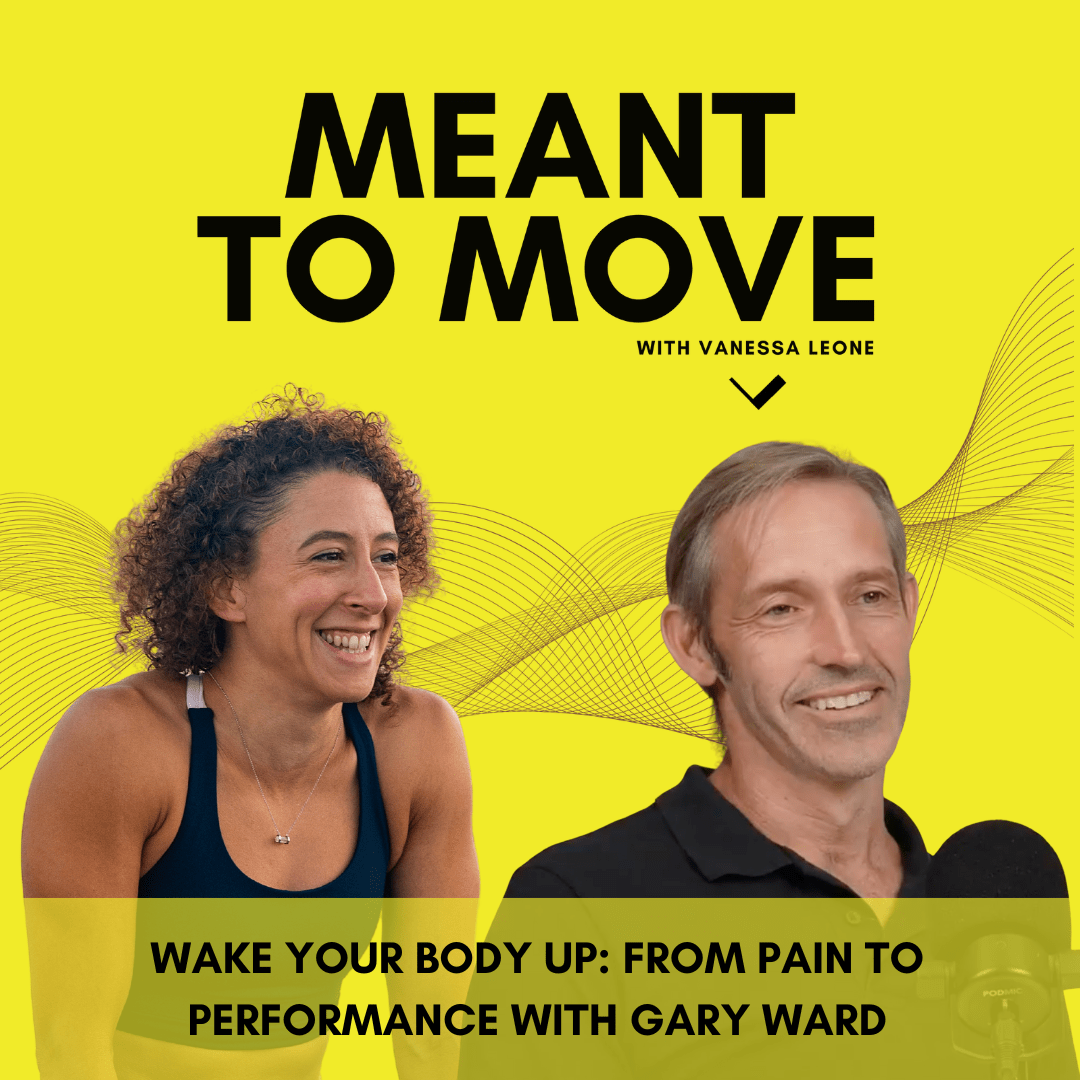
Meant to Move Episode #18
Summary:
Vanessa Leone interviews Gary Ward, a movement specialist, about his journey from ski boot fitting to developing the Anatomy in Motion model. They discuss the importance of experiencing movement to truly understand it, the impact of injuries on movement habits, and the significance of joint motion in overall body function. Gary emphasizes the need for self-investigation and ownership of one’s body to address chronic pain and improve movement. He also shares insights on his programs “Wake Your Body Up” and “Wake Your Feet Up” designed to help individuals explore and restore missing movements.
Transcript:
Vanessa Leone (00:01)
Hello, Gary, all the way from Bali, not from London, welcome!
Gary Ward (00:06)
A rogue Londoner ended up in Bali in the Southern Hemisphere.
Vanessa Leone (00:11)
I think there’s a lot more of that happening these days.
Gary Ward (00:15)
If you sit on the island here, that’s very, very clear. Well, certainly in a small cluster of the island anyway.
Vanessa Leone (00:23)
I’m a little bit jealous. I’ve got a few people in Bali at the moment. I’m gonna channel some like island vibes for this conversation. Just like, let’s ease our way into some interesting questions that I have. I am so excited to have you on the podcast and thank you, I really appreciate it. Our mutual friend, Sally, got us in contact and…
Gary Ward (00:40)
Thank you. I’m happy to be here.
Vanessa Leone (00:48)
I was looking through your Instagram just recently and she has a quote that she was working off, which was understanding to truly understand something, you really need to experience it. And with all of your background in the fitness industry with so much of what you do, can you go into a little bit of detail about what you mean by that quote?
Gary Ward (01:15)
Yes, just to organize the thoughts, the idea from Sally’s perspective is I think that we can talk movement all day long. And I’ve always said that movement is not a topic for radio, which is interesting because we sit on a podcast and you can watch us talk, but the reality is, I mean, there are many concepts for movement going on in the world right now. And I’m even at odds with the word movement.
Vanessa Leone (01:28)
It’s hard.
Gary Ward (01:48)
sometimes. We can walk, therefore we are in movement. But then what we’re interested in is do all of the pieces engage in movement in order to make movement better. And so the idea that we can walk one way and we can walk another way and one be more efficient than the other is in essence the kind of goal for me and my work. And at some point,
you need to stop talking about it and start experiencing it because sometimes what we thought was a spinal extension, for instance, will suddenly feel a whole lot better if a lot more parts of your body are involved in that spinal extension. And that might sound like a crazy statement until you experience it. And so that’s where that quote kind of comes from.
Vanessa Leone (02:34)
Yeah, I wanted to start here because I don’t necessarily have an issue with online programs or anything like that. Obviously you sell online programs, but what I really love about what you do is the getting together and the experiencing and like you said, the feeling. And I’m really curious now that you’ve dropped the, you’re not quite happy with the word movement. What would you describe your profession as and what do you do for someone listening who isn’t fangirling like me?
Gary Ward (03:17)
Wow,
I didn’t realize we were… Well, now I’m embarrassed. It’s funny. Here’s how not to sell yourself. I’m not qualified as a therapist. I was a ski boot fitter in the French Alps and I did that for six or seven years. Before that, I quit teaching.
I was going to teach foreign languages, French, German, as a school teacher, secondary school teacher. And that wasn’t working out for me. So I kind of ran off to the Alps for a kind of clear your head and figure stuff out. And then fell into the ski boot fitting. And so I met feet. I became obsessed. And I guess I’m the kind of guy who wants to know always what’s what.
and lucky enough to be taught I was marvel at this actually even today. Three people taught me over four days about the feet and enough to light up my kind of passion if you like for it. But I was just very good at and back in the day it was classic kind of orthotic building for ski boots. So we would organize the foot better.
so that people could fit in the boot for no other reason because ski boots are super uncomfortable. But if you if you set the foot correctly, it actually makes the foot a bit shorter, a bit narrower, puts it into the right part of the boot. And when you when you kind of press go and bend your knee, the ski responds quicker than it would if the foot was in a faulty position. So timing, effortless efficiency. Two things happen. People felt they would come back and say, wow, my back never hurt today.
what did you do? And of course I was like, I don’t know. And then the other one was I felt I’ve never skied so well before. So there were two elements, pain and performance. And I was going, this is crazy. All we’re doing is changing the foot’s position in the boot. Now, of course, this was in early 2000s. In fact, it was 2000 to 2006, 99 to 2006.
during which period podiatrists were banned from using those kind of like wonky diagrams. This is your posture. And then now the posture is super straight because we’ve put an orthotic under it. And they got banned from using that as kind of advertisement back in the dark ages. And then, but that’s essentially what we were doing was realigning feet and bodies changing. So I just wanted to understand it more. And eventually over six years of
qualified as a personal trainer. So I said I’m not qualified as a therapist, but I qualified as a personal trainer. That was a three month course, which is, you know, gave me enough of a license to go and wreak havoc on many bodies. then, and then we, I eventually, the love of skiing was overtaken by the love of anatomy.
And then I wanted to understand the foot’s relationship with the body on a higher level. So that became like an unquenchable quest. And I lasted 18 months as a personal trainer before I started working therapeutically with people. one of the main drivers for that was that I was never asked if I was going to be, if I could help someone bulk up, it was always like, wow, you want training sessions, but your back hurts, go and see Gary. And I was just figuring stuff out on the road.
it wasn’t long before people were asking me to teach. I love teaching. I’ve been teaching ski boot fitting for the past six years as well as actually doing the fitting. So I started teaching anatomy. and then, I wrote a book called what the foot, and then, I started, I was invited to teach internationally. So I was on the international circuit from about 2014. and so back to your question, like what, what is it that I do?
Again, I’m it’s am I am I a therapist? Am I a movement specialist? Am I? It’s I’ve never really carved out a name for that, but the concept is called anatomy and motion, and it’s based around my observation of the human gait cycle. And so what I did rather than what I do is I documented the journey of every single bone and joint through a single footstep. So at any point, you could take a photograph of.
of that, of somebody walking. And in theory, we should be able to tell you where every bone should be. And that’s essentially an assessment. Your pelvis should be rotating left, but actually it’s rotating right. That could be contributing to X. everything from, and this is where we, we’re, we’re not talking, even talking to practitioners, it’s sometimes too much. So in talking to lay people, like just take a breath for a second, but a foot has 26 bones.
and 33 joints and each of those joints moves in three dimensions. And so to document all of that, to have a thorough understanding of the foot and its influence on the rest of the body was immense and golden. It was like one minute stumbling upon something that anatomy is teaching and recognizing that that’s the truth.
Vanessa Leone (08:46)
Immense.
Gary Ward (09:00)
And then the next minute, stumbling across something that anatomy is saying absolutely doesn’t exist and recognizing that that also is the truth and having to filter through all of these stories from different disciplines to kind of, I call it the truth of human movement because it’s purely based on observing how the body moves. And so as I said before, like you can do a squat or a lunge, but you might be doing it without.
the necessary pieces joining the party and moving. And that just is our body’s beautiful way of adapting to its own limitations to achieve a goal that our trainer or therapist or a sport is putting upon us or just a daily activity. And so then if you are in compensation to achieve a movement, it will lead to compression in the joints or tension in the tissues, which leads to an ultimate complaint like this hurts, like that hurts a strain here or a
a disc there, whatever. And ultimately being able to look at it through the lens of what I three dimensional human movement in the closed chain, which means standing up rather than on a table. It means that we would be able to see the drivers in that system that are leading to the pain rather than just my back hurts, let’s treat the
And so it an investigation, it was a thorough investigation of how to understand people’s discomforts as a therapist and then give them specific tools to overcome that.
Vanessa Leone (10:37)
a great story. It’s a great way to explain it. You’re a movement investigator. No, it’s a, I love your description of it because I came from the science, the biomechanics side of it. I was terrible at biomechanical theory because I’m not good with numbers. But once we started going into the lab and
Gary Ward (10:43)
Yes. quick buy the dot com
Vanessa Leone (11:07)
putting the dots on everything and seeing, experiencing human motion. It was incredible. And to this day, the subject that I utilize the most from my exercise physiology degree is biomechanics. Is that understanding of how to investigate bodies in motion, like you said, and I think that that you would know as a
Gary Ward (11:10)
experiencing.
Vanessa Leone (11:36)
personal trainer when you got your cert, that’s not a conversation that’s really held unless you go a bit deeper. But even if you do go deeper, the biomechanics angle is often very scientifically rigid. And I don’t believe that that’s the way that you approach it at all.
Gary Ward (11:58)
I mean I would love to say yes actually I’d love to say that all of the beauty that’s been uncovered by the model was was scientifically validated but actually it flies in the face of a lot of scientific validation so I’m I’m not odds with science but I’ll definitely take it with a pinch of salt I through the model I think I understand the knee differently to the way science interprets it I understand
It’s kind of cervical mechanics different to the way science interprets it. I recently, I wasn’t aware of this, but somebody almost like doing some research on my behalf, told me that there’s no actual definition of pronation and supination in the foot, to which I thought, well, I actually have a very rigid one of those. That is what we’ve been teaching for years and lived by. And actually, if you don’t take all of these boxes, I don’t even know how many, let’s say there’s 12.
I’m not satisfied with calling it a pronation. So is a flat foot a pronation? Not necessarily. It’s just this idea we want to be able to promote a perfect movement. And if we understand what that perfect movement is, we can then get people to explore it and experience it. And the magic, which is also not very scientifically based, is that if the body starts to perceive movements, new movements in the joints, it
is not used to experiencing, then the brain will actually move towards being able to use them. And that means it changes its posture. And of course, we have countless, countless discussions online going on that posture can’t change, structures are fixed. And we know that it’s actually changeable and it’s very quick. And I urge you to say, look, if you rolled an ankle, you change your structure pretty damn quickly.
So why can’t we unchange it just as quickly if you do the right thing? And I think that’s been the journey that I’ve been on now for 26 years since I’ve started working with the foot, basically. Yeah.
Vanessa Leone (14:06)
Amazing.
Thank you. Thank you for sharing that. That’s really interesting. For someone at home who’s listening and is like, this is really piquing my interest. You have something online called Wake Up Your Body. Now stemming from what we’re talking about is Wake Up Your Body designed for people who, like you said, know, this model of movement doesn’t
quite sit with me. I’m willing to try something else for better movement, less pain. Like what, what is this?
Gary Ward (14:40)
Um, I’m going to correct you. It’s called wake your body up and wake your feet up. Now there’s, a backstory to this as well. Um, if you don’t mind me sharing the backstory, um, in 2015, some of your audience may have heard of Dr. Rangan Chatterjee and he was on the BBC as doctor in the house. Um, and in
Vanessa Leone (14:43)
Sorry, my bad.
Please do. Please do.
Gary Ward (15:10)
He invited me on to help him with the first guest or the first patient that he had to work with. And then I kind of got my seven minutes of fame, if you like, with me working with this chap. And then all of a sudden I woke up to something like 6,000 emails the next day because we’ve got this guy in seven minutes on TV, an hour and a half in real time, out of 34 years of back pain by assessing the root cause, finding the root cause.
and working with it and then, you know, there’s a night and day difference that you can actually see that on my website. I could share a link with you if you want, but how do you work with 6,000 people? I instantly had like a 30 year waiting list and my way to do it was to set up this wake your body up program. And the reason I call it wake your body up was because of this kind of lazy term that people have.
Vanessa Leone (15:46)
Please.
Gary Ward (16:07)
sleepy glutes. And in one of Rangan’s books, we put together a piece called Wake Your Glutes Up. And I can’t remember what came first. I Wake Your Body Up came first. And it’s this idea that if we’ve got sleepy parts of our body, we need to wake them up. Now, what’s a sleepy part of the body? It will be a joint that doesn’t move in one of the three dimensions or all three dimensions. It will be a section of the body that doesn’t do what it’s supposed to do. Muscles that don’t activate when requested.
And so whenever you’ve got areas like this in your body, which everybody has, we have to end up moving in compensation. So where a joint is downgraded by its movement capacity, another one has to upgrade to pick up slack. And so I say the body’s always working at 100 % all the time. You don’t lose everywhere. If you lose joint motion somewhere, somewhere else exploits it. And that becomes a problem area.
But if you treat the one that’s working hard to overcome something else, the brain will keep using it hard because what you actually need to do is to wake up the sleepy bit, bring it back to life so that you can take the pressure of this one. So taking pressure off the system is the name of the game. And we do that by making sure that all the joints that we can find are able to do what they need to do. so my ambitious idea was that we would
we could do that, could get people to wake their own body up by exploring the movements, which I’ll explain the kind of details behind it in a bit. But the other side of this is that 6,000 people…
6,000 people desperate for me to help. in the same way they were desperate for every other practitioner to help them. And the reality is I really want to help people help themselves and take ownership of their body. And that’s the other element of this. Now, I recognize that people do still need external help from people, but the reliance on that, the reliance on another therapist takes away your own power. But to be able to take on your power and…
begin to self-investigate through a base understanding might help you actually find the real problem in your body. Because, and with all due respect to the industry, it’s not the industry’s fault, it’s the way it’s grown up, but most people will treat the problem rather than have a solution to finding out what the cause of that problem is. And so a lot of people find themselves stuck in a chronic system.
chronic pain system because they keep having the problem treated and never address the cause. And so I talk to that. I want people to become aware of that. And I want people to recognize that this wake your body up is an opportunity to self-discover the movements that you struggle with, which you may or may not have already known. And then to be able to create movements and exercises.
that will help to restore those missing movements so the brain starts to move towards accessing those on a daily basis. we can see, you can literally, when we do an assessment, we might find 12 things that a person can’t do in their body and you might find that they all come down to one moment in the gait cycle, which is like the moment that they put their weight on the right foot, it just all goes to pop. But they’re great with the left foot forward, but right foot no. So they end up with all these…
contortions and blah blah blah. But when you put them into that movement and have their brain experience as close as it can to a perfect movement, where it goes, I didn’t know I could do that with my knee, or I didn’t know I could hike my pelvis in that way, didn’t know I could rotate my rib cage with more freedom, you see a change in their gait cycle immediately. That’s the beauty. in that is the magic, the complexity is the…
you know, there’s 206 bones with a joint at each end, moving in three dimensions, two or one, depending which part of the body. And then a myriad of muscles that strap to and cross each one. How do we manage that? Well, the gait cycle, when designed it, not designed it, observed it and wrote it all down.
What it showed is that we have two different leg shapes, which is a pronating leg and a supinating leg. We have two different arm shapes, pronating arm like this and a supinating arm like this. The whole thing’s connected. And then eight different body shapes. That’s the way that my pelvis, rib cage and skull interact. And so to take all of those numbers, we come down to eight body shapes, two leg shapes, two arm shapes, and can we investigate how well I use those as groups?
And in that you’ll be able to see, you know, if I can’t actually side bend my own neck to the right, whether it’s painful or not, you’re going to start to see how that connects down the chain. So wake your feet up is an opportunity to look at your own feet and work up the body. Wake your body up is looking at your skull, rib cage and pelvis to see how they articulate together. They work beautifully together, by the way, and create some really nice flowing movements.
that most people are, you know, if you’ve got forward head postures or rest a little bit to one side or sunken rib cage, these things, you can start to organize them all in a really nice way. And so that’s, essence, that’s what wake your body up is. And wake your feet up, I think, is for people who do it is a really…
It’s a real opportunity to understand the feet in a way I don’t think many people really do.
Vanessa Leone (22:15)
Yeah, yeah, I think the feet are some of the most underrated aspects of our body and human motion. And I love the way that you articulate it because I think that for a lot of people, you know, just I’ll use my personal experience when you work with someone and you get them to feel something innately, they know what feels good, what feels right, what doesn’t feel right.
And because they have been pushing out their own treatment or their own diagnoses or whatever it is to professionals for years and years, it’s almost like they come back to you with doubt about what it is they actually feel in their own body. And it’s really hard for someone to articulate it. So they start using like words that you’re like, okay, tension, pain, tight.
hear tight a lot or whatever it might be. it’s not even necessarily actually related to any of the words that you use, but we just don’t have a dialogue to understand what’s really happening in our body because we’re not taught movement as a language from a young age. We’re not exposed to it anymore, really.
Gary Ward (23:34)
No. And I think, like you use the word tight, I instantly think a muscle can be long and tight, or a joint can be closed, which creates a shortness and a tightness. So even tight doesn’t describe the quality that you’re feeling. You could be a long muscle, could be a short muscle. The only way we’re gonna know that is if we investigate the joint and how it’s being used in the system. Definitely.
We don’t have a language. What we do have is our labels. And I also want people to recognize that my discovery of the model is that all of these labels actually occur when we’re walking. So when they show up and we own them, it’s because we’re stuck in that part of our cycle and can’t get out of it. So plantar fasciitis can be a long stretch from a flat foot.
But we kind of need that flat foot to take part in the cycle. But if we got stuck in it and we’re starting to create the tension in there long term, it might be that we just need to be better at that movement. We need to get into it and get out of it. lot of movement is, movement’s never still, so you’re always going in and coming back out, ebb and flow. There’s a fore foot varus was another thing that people may have heard of where they need orthotics to support their…
the big toe area under the foot, but a forefoot varus is a relevant part of the gait cycle. A hip compression or a hip decompression, we need to do that in the gait cycle. We even have a moment where our spines are not straight, or we have a scoliosis that shows up somewhere in the gait cycle, right? So all of these things, and maybe you’re just stuck in a position for too long, but when we give it a label, when we take ownership of something in a different way
we’re not really seeing the opportunity to get out of it. And every movement shape has its opposite shape, which is sometimes just the solution. And that must be really frustrating to hear. But often that is the case. I remember, this is a long time ago, and I was very young in the work, but a guy I was working with asked me if I would see his wife who just had a young child who she’s carrying on the hip.
And her back was hurting and blah, blah, blah. I drew her out that she, her pelvis was hiked up on this side and her shoulder was dropped on this side and she had pain in the low back, et cetera. It matched the pattern because the way the pelvis was hiking was making her foot pronate. And I just thought to myself, well, she just needs to enter into the opposite shape. So we put her left leg forward, got the hike, got her to bend her side bend, rib cage by reaching her arm, keep her eyes on the horizon. And within three minutes she was like, oh.
Great, thanks. And kind of left, she’s back to the baby. And I thought that’s just beautiful that she could just experience the opposite shape to the one she was in and be relieved rather than have the back rubbed or crack it, but not actually change the habit of movement that she’s been got stuck into. And I think that can be big part.
Vanessa Leone (26:45)
Yeah, what you said there was, think is really important. You call it the habit of movement. And that’s really what it becomes is, you know, quite often it’s subconscious. We, hurt ourselves or we’ve stumbled. Like you said, we’re sitting in the same posture because it’s just the way that we’ve sat at our desk and it’s become a habit and we haven’t realized it consciously. It’s just now it is ingrained subconscious pattern and you spoke about it beautifully. There is like the hardest.
thing to do is to change a habit. But the first part of that is just noticing it really. Yeah.
Gary Ward (27:24)
Be aware of it. absolutely. Yeah. I say movement is a behaviour and behaviours have become habitual. And so once we’ve learned a way to move and actually I’m going to jump into because the other part of all this that we haven’t mentioned yet is that we all hurt ourself. And when you hurt yourself, you impact your body and that can change the way that the joint moves.
As soon as I hurt myself and I reduce the joint potential there, I have to do that something else there. And now I move around in that habit.
have all had injuries where maybe you, ankle sprains are classic, rice, rest, ice compression, elevation, no actual treatment of the ankle. And then two weeks later, get back running or playing football, soccer again. And the way that you adapted to, to, to move and play soccer or football, whatever you guys, I don’t know what to call it anymore. Global citizen.
That habit stays in. And the only way you’re going to break that habit, because now you’ve got distortions all over the rest of the body making up for the ankle, you can get pain anywhere. But the real reason that it happened is because of the ankle. So you have to treat the ankle. It’s amazing how many times we do that. Or you have head impacts, boom, and the head stays over here a little bit. The weight goes into the left foot and all of a sudden you’re in a new habit. people, we, people take injury history, but what are we taking it for?
Can we use that injury history as a way of helping our clients to understand what their body has been moving around for years, often years? And people will say, it was just an ankle sprain. It was fine. was playing football again two weeks later. And you go, I’m going to pay attention to that. There’s nothing.
Vanessa Leone (29:11)
Yeah, yeah. One of the most powerful practitioners I worked with, she was a body worker, funnily enough, but she checked my entire body for scars everywhere. She’s like, where are your scars? Where are your scars? I want to know all about where they are. And that is along the same lines there. It’s your body remembers, your body remembers just like your brain remembers, but we just don’t have access to those memories.
Yeah, it’s so fascinating when you start to dive into it.
Gary Ward (29:55)
The scars will you you’re in order to stretch through a scar you need joint motion to be able to create the stretch but because because it’s there’s a when you start to let’s say an appendix scar on the on the right nobody with an appendix scar can extend their hip I’ve never seen anyone right it’s like 100 %
until you put your fingers in that scar and all of a sudden they can do it. It’s like that little act bypasses. So as soon as they start extending their hip, there’s a pull on the scar and it stops moving. But where there’s no equal and opposite pull on the left side of the hip, so they just freely go into the extension and then you have an imbalance on both sides. or scars will cut through the muscles and those muscles struggle to contract again. instantly joint motion is immediately affected.
and other joints then come to play to kind of overcome that. So pre-medical history from surgical operations, dental work, to then your everyday injuries, that everything’s relevant. Your life is relevant to the problems you’re experiencing today. And sometimes it’s just worth looking back and trying to tidy it up so that you can move forward.
Vanessa Leone (31:13)
that’s a great little snippet there for someone. It’s like tidying your house. Just find little bits and just kind of work away at it little bit by a little bit.
Gary Ward (31:21)
Yeah.
Yeah, previous colleague of mine, he used to say, after a party, you’re going to tidy up the big bits, get all the big bits out first before ending up to tidy up the smaller bits and then the sweeping up at the end. Sometimes therapies like that.
Vanessa Leone (31:35)
Hmm.
Very cool. I like that. One of the other things that I noticed as part of your work, I don’t know if it’s more recent or when you kind of tied this in was your work around the nervous system, as well as obviously you’ve done movement and biomechanics and looked at anatomy in detail. And I love the anatomy biomechanics side of it. And I think the nervous system is something that is more emerging. So when we talk about the nervous system in relation to perhaps what you’ve just been talking about. What do you mean?
Gary Ward (32:13)
It’s a great question. just think if I got images in my mind of a brain and then like a tree of nerves coming out down the arms, down the trunk, down the legs. And there are movements that people call like neural flossing where you’re kind of moving a wrist in a certain direction and opposing the neck or whatever to create movement and slide in the nerves.
And then when you look at the model and how the body moves effortlessly through, that should move effortlessly through the gait cycle, that’s like the holy grail of movement. You recognize that it’s just one big neural floss that’s actually happening. So when you start putting the exercises into place that have been broken down, so we take a pause at the moment that the front foot is on the floor, three points of contact.
foot’s pronating, body weight’s stacked up on top, and there’s three dimensions to it, you’ll recognize that by exploring that movement as an exercise that you will be sliding and the opposite of sliding, the nerves, they’re going in and out in the same way as muscles are going long and short, at the same time as joints are decompressing and compressing. And so the whole body is a pump.
So we can talk about the skeleton and get really excited about it. We can talk about the muscle system and get really excited about it. We can talk about the fascial system and get really excited about it. We can be nervous neural specialists and get really excited about it. But it’s all one thing. We cannot have any of it without anything else. so to, I wrote joints act and muscles react in what the foot my second.
big rule, there are five rules. The first one is that muscles lengthen before they contract. The second one is joints act and muscles react, which means that when we move a joint, it creates a length in the tissue. So think about pulling an elastic band or a catapult back. The further you pull it back, the more length you get, the further it will be projectile across the field. So we get the same thing. So talking about that appendix scar, if I get a nice hip extension, I lengthen the hip flexor muscle.
At the end of that range, it contracts and brings the leg forward. That’s effortless movement. I shouldn’t have to contract my leg to bring it forward. So effortless movement happens like that. Joints act, muscles react, was let’s focus on the joint system in order to make those muscles give them that unconscious reaction, which is actually the waking them up part. All right. But then we recognize that in the joints, all of the nerves are housed, the proprioceptors in the ligaments, the tendons.
And so they get a great experience. The better our joint motion is, the bigger the nervous system experiences. And then in 2008, looking for something to kind of validate these weird ideas I was having, I came across Tom Myers and anatomy trains, and then started to overlay his fascial lines on the body. And then,
where they had like movements to try and stretch the fascial chains, I was seeing that the movement that the body is going through, the joints that they’re going through will create a change in the tension and compression relationships of these fascial lines. So I recognized that they had a role in the cycle, but only if the joints did what they did. So I know I said nervous system, muscle, fascia, joints, they’re all part of it.
but I started moving away, not away from, that’s not the right word, but joints act muscles react is really important, I think, in this piece of work. But I started to get to the joints act everything reacts. The better your joint system is, it gives the opportunity for the whole system to go. And then people will say, but you know, have a scar, it reduces the joint and the scar is more important. All of that is relevant. I’m never gonna fight with anybody, but can we…
can we create a way where we can reorganize the system, people can reorganize their bodies to actually just move more freely without efforts, because effort is using energy, so we want to be energy free, because all of that leads to a state of balance, which leads to a place of comfort. And going back to the labels thing, and just to finish this little piece, the idea of being perfectly,
balanced means that no muscles are under tension and no joints experience compression and that’s a pain free space.
Vanessa Leone (37:11)
That would be a very lovely space for many people to be in.
Gary Ward (37:15)
Now in order to achieve that, when I put my right foot on the ground and I side bend to the right, I need to then be able to put my left foot on the ground and get the equal and opposite side bend to the left. So when you do wake your body up, you’ll do this like, it’s easy to go this way. it’s not so easy to go that way. Now you know that there’s an imbalance written in your system and when you walk it would be, it would be showing up. And so how do we then get better?
going left to match right because that’s moving in the direction of improvement.
Vanessa Leone (37:48)
beautifully stated. You said something there for me that was really profound. You said that the bigger the joint moves, the greater the impact on the nervous system. And, that is, is huge. I, I, you know, it takes a while sometimes I think for these implications to really hit home for a lot of people. But even if you’re just sitting, some of your joints are in, you know, quite a
big stretch, they’re in a big movement, but you’re not by anyone’s standard doing anything. Yet what you’re saying is if the joint is in this movement consistently, you’re having a huge impact on your nervous system. like that’s, that’s so number one, that’s just huge, I think just a really thing to, to people to quantify. But the other part that came up for me is that I’m hypermobile.
or bendy as Ian O’Dwyer likes to say it. My joints have a very large range of motion and chronic fatigue, Hashimoto’s, fibromyalgia are huge, huge contraindications and consequences of people who have these connective tissue disorders. And it was like the light bulb, the penny just dropped you like, okay. That’s a big reason why.
Gary Ward (39:13)
Yeah, and if they, because of course excess will have the same, but it’s more of a flaring response rather than informative. It starts off informative and then it’s like, whoa, you know, I think, a couple of things flashed across my mind then, but one is that when I kind of did that, whoa thing is, is we also, we also need to recognize. So I said that we have labels and labels exist in the, in the body as a requirement of movement, but we get stuck in.
And then the question is, is pain? Like, why does my back hurt if it’s not the cause? And it’s because it ends up in a compromised position, trying to help you overcome your previous injuries and obstacles. then so, but pain, if we can take a step back, we can recognize it’s a warning shot from the system and nothing more than that. And so if you’re having it every day, it’s like, not listening to it.
But you will be listening to it. I don’t mean that like disrespectfully, but you will be listening to it. You will be hearing it. You don’t know what to do about it, but it’s actually, it’s just part of the system going red flag here, red flag here, you know, and then, and maybe, maybe it’s a calling to, to, to try and find the cause for it. So that popped in the hypermobile. Of course, if you’ve got joints, then moving in excess, it can do all sorts to your system.
And then I’m reminded of what I said to you earlier, is that you can’t have all of your joints hypermobile. It’s not physically possible. So there must be joints that are hypo mobile and that becomes the quest. But the attention is always on the big moving thing. And there’s a 99.9 % chance that you’re completely unaware of the joints that don’t move. And this is going on somewhere else.
We don’t feel the quiet and immobile and affected, we feel the excessive and scary and the ones that are shouting a lot. So hypermobility is an interesting arena for sure.
Vanessa Leone (41:26)
100 % interesting. I love that response. Thank you so much.
If someone had to choose, they wanted to start moving better, feeling better. You mentioned one of your programs is like kind of top down and the other one is, is foot up.
Is there, for just like an everyday person, I want to live my life better. I just want to be able to do the activities that I really want to do. What’s a great place for them to start to think about this?
Gary Ward (42:06)
Do you mean without buying the program for instance?
Vanessa Leone (42:09)
buy the program, not buying the program.
I’m all for it. Cause I think that they’re very accessible. And like you said, it’s, it’s helping you understand what’s happening. And I don’t think, I think if you can find yourself, there’s a lot of practitioners who have done your work, Gary. And there’s a lot of practitioners. think if your practitioner, whoever that might be, body worker, know, PT coach,
If they’re open to trying something with you, you know, you’ve got a good coach. know, you’ve got an allied health practitioner who is willing to listen to you rather than, than tell you. And I think that that, for me is, is way more important. Like if a client comes to me after hearing this and they’re like, Ness, can we do Gary’s program together? I’m like, yes, let’s let like, Hey, let’s do it. But do know what I mean? Like I’m, I’m willing to try.
I’m willing to try things because like you said, it’s in the experience that the real learning is happening. So if someone just wanted to start moving better, where do you think we should, like, where’s a good place to begin?
Gary Ward (43:19)
Well, I think I probably should say the Wake Your Body Up program. And I’m looking for ways not to say that, in a way.
The truth is that I could say, take up yoga. And I always have to be careful about what I choose, yoga, pilates, or dance. Because this is not an opportunity for me to bad mouth those things, because I think they’re beautiful. And I’ve done yoga for many, many years, actually. But let’s say we say go and start to do yoga.
What you don’t realize when you start up something like yoga is that you are going to do yoga not how the teacher tells you to do it but in your movement habits.
And so even if you go to the… Most people can’t even stand up when you’re actually investigating properly. We’re all stood up, but there are certain parameters to being stood up well. And you have people whose heads are one sided. There’s a twist here. The pelvis has done this. One foot’s flatter than the other, so it communicates differently. So the very first thing you do in yoga is stand up. But you’re going to stand up in your habit. And then…
The idea is that you get better at yoga, but you don’t actually break these movement habits because they’re so ingrained and unconscious. You create new access to new movements because of the asanas or postures that you do, but the overriding habits around how you manage your life history unconsciously without thought are so much stronger than these movements that we step into.
So when I work with athletes, you’re looking, you see the treatments that they’re having every day, the exercises that they’re putting themselves through every day, the performances on the court or the pitch that you see week in, week out, and then you assess them and you look at them and you actually go, how the hell do you do what you do? I don’t mean that disrespectfully, guys, anyone who’s listening, but I mean my other athletes. but it’s like, wow, you’re amazing.
Vanessa Leone (45:31)
It’s baffling sometimes. It’s baffling.
Gary Ward (45:36)
The way you use your body is amazing, but it might be to your detriment in some way because we keep having this problem, we keep having that problem and it’s recurring and I don’t really get to bottom of it. So we create ways of coping. And I always think, and this is getting back to the yoga thing, I always see this piece of work as sitting at the base, at the foundation. Like a lot of people say, oh, this is the foundation, you need to get your…
Get your feet right, get your pelvis right, get the spine straight, core stability, whatever, was kind of less now than it was.
But this is a foundation where we’re trying to get your brain and nervous system to unconsciously access movements that it’s been avoiding for a long time because of patterns it created to survive and thrive. And then when we do that, you’ll start to notice that you can do your yoga postures differently or the way that, you know, the things that you notice in your exercises are different. You have different experiences in your body around pain. You start to recognize different.
Muscles, things change and it can happen pretty quickly. So this, I want to invite people to take interest and pay attention to the things that they’ve done to themselves over the years and try to find solutions through their own movement and their own body. So what you were saying about the practitioners, were, and I taught in Australia pre-COVID every year from 2015, so we did five different tours there.
So there are a bunch of people in Australia.
When I first launched Wake Your Body Up, a lot of my practitioners would go, right, I’ve had a request from a client. They would say, I want you to do this program so that you know how I’m going to work with you when the time comes. So even they were still saying, let’s get this locked in and then we’ll start the work. I want to preface that it’s not the most exciting program in the world. There’s no beats in the background and me dancing around like an Instagram buffoon. This is like really kind of
calm, quiet, can you do this, can you do that? And I’ve had complaints that it’s boring. I’m not here to entertain, I’m here to try and help people find solutions to their problems. And so, I wanted the price of this thing to be less than the price of a physiotherapy session, and for it to last you a lifetime. And so, the more you understand about your own body, and the more times you revisit it, I think that’s the missing piece.
people forget to go back to it after a while, the more chance you’ve got of taking ownership of your body and having an understanding. So I think that’s where I would pitch that.
Vanessa Leone (48:25)
Yeah.
Well, I think that’s priceless. I, I’ll use again, my own experience. When I first start working with a client, I say to them, this will feel slow. This will feel like you’re not really doing that much. And I think that what you’re talking about is that is, is, is we have a propensity to really want to drive forward as fast as we can. I just want to see the results now.
And taking the time to actually ask your body and sit in with your body and feel what’s happening is a little bit of a process, but it’s not a prohibitive process. But we’re so bad at taking that time away and shutting off those distractions and listening to ourselves for fear of what we might hear in our own mind or in our own body. Exactly. I think that that’s probably
Gary Ward (49:23)
Really hard.
Vanessa Leone (49:28)
In my opinion, why people are going to say it’s boring is because you have to quiet the chatter around you to really listen. Exactly, exactly.
Gary Ward (49:36)
Nobody wants to look inside! Lift the lid! No, I know. I
know. I know. You know, not everyone’s wired the same for sure. But I do believe that those who enter into this work and enter into this layer of what is actually been going on and they take their time to listen, learn, reach out for help with practitioners whether online or
in person. See the beauty of this work during COVID when everybody went, I can’t go to work anymore. We were working like mad. We’re just looking, we’re just going, your pelvis isn’t level and your ribcage is rotated. Do this movement. Describing movement, reach here, reach there and pulling their body into shapes that they, you know, it’s incredible. So you can do that in person, you can do it online, you can do it in your own living room.
But where a lot of people are oh, I’m starting to get backache, I’ll go to the gym. Or I’m going to go to a, I was going to say a Zumba class. This type of stuff. you’re always going to go and do that and move around your problems rather than look into what the problems are. And that sounds like a therapy session right there, which is enough to put everyone off I get it. But we’ve all done stuff to ourselves. And if we can unravel that and to be able to move freely and better again, then can actually move into those spaces that you really want.
Vanessa Leone (51:05)
No, I mean, we’re all about the woo woo here, so feel free. That’s amazing. I want to keep you much longer. I have one last question for you. And it’s a nice quick one. I call myself a movement therapist because I think that, you know, there’s lots of things that we can do that’s movement potentially is the word there that we can do for therapy. Is there something that you’re currently doing for yourself that feels like therapy?
Gary Ward (51:25)
myself.
Vanessa Leone (51:35)
Yeah!
Gary Ward (51:42)
Gosh. I have such a like.
rich and busy life. There’s anatomy in motion. I’m currently putting together a manual for the fourth iteration of our online education, which has been incredibly satisfying. I think that might be it. And when I, when I, I get called to that, I’m also running a mentorship at the moment. There’s 26 people sitting on this mentorship and
and it’s just assessing and guiding people all day long. So that’s also satisfying for me. There’s a level of therapy there. I have a 16 year old son who is definitely can be described as an elite rock climber who I class as another business where we travel to Kuala Lumpur at the weekend. We’ve got competitions in Western Australia. Actually it’s Australian nationals this weekend but they wouldn’t let us go because they didn’t have residence.
So, you know, I think the things that I’m bringing up are things that to me are incredibly satisfying and rewarding. And that’s, that’s where I get my therapy. So when I feel like I kind of need that side of things, it’s, it I’ll actually move towards those things that, that, that feel, but in turn, the other thing I do is, which I met in Bali is play padel
Vanessa Leone (53:14)
cool.
Gary Ward (53:15)
tennis game in the glass fish tank. And it’s just a right royal rumble and everyone’s doing it here. that’s also really, really a great way to switch off and reward. But I’ll finish that with, I got into this work. because I was told that nobody could help and they didn’t know what to do.
They suggested, you know, I basically realized I had to help myself. And so the curiosity, the skiing didn’t help. There’s lots of incidents when I was skiing. But the curiosity of the movement, the understanding of the feet and the putting it into my own body was the beautiful revelation of the power it held. And I was able to take ownership of my own body and resolve it. And
I always say to people that the model uncovered the movements. I didn’t create them. And as a result of that, I haven’t needed to create any more. And there are five phases of movement in the gait cycle, which literally creates five exercises. And if you can master those and understand those, you may well crack the code of human movement. And so the injuries, and I’m very happy to relay mine. had 80 % of my medial
meniscus removed. I broke my jaw through the ramus, broke my nose twice, dislocated my shoulder, ruptured my right ankle 13 times and somersaulted onto my neck and kind of did some weird compression in my spine. I was born with an umbilical hernia and I had to unravel all of that and it did take me a long time but I had no assistance. It was me.
me, me, me, me. And then the colleague that I worked with before, Chris, was obviously helping me as well. We worked a lot of it out together once we’d started, but it was a journey. So I had some help and I had the opportunity to explore movement in my own body in a way that was very relieving and again, satisfying. And the reason I wanted to bring that up actually is because I still do those movements every day.
because the structural change to my shoulder, ankle, knee and jaw means that I’ll never be that perfect person. And so I’m always moving into my habits. I’m so last week I was ill for three or four days and you kind of wake up out of the illness and go, wow, what happened to my movement? Okay, back to the drawing board. And, and I’m, I’m content with that. know it’s not, no.
such and such is hurting, I need to go and see someone, like I’m just gonna get my wedges out, do my movement, check my movement potential, and reorganize my system through that process. so that probably is the number one therapeutic thing that I do for myself, and it’s all about my body and enabling me to have longevity and go and destroy those people on the padel court for years to come.
Vanessa Leone (56:34)
That is an excellent thought to finish with. Thank you so much, Gary, for your time. I appreciate you. I appreciate your work and what you said today. Thank you so much.
Gary Ward (56:45)
Thank you, Vanessa. There’s been a lovely 56 minutes.
Vanessa Leone (56:50)
Excellent. See you next time.
Gary Ward (56:53)
Thanks, and goodbye.
 Vanessa Leone Movement Therapist