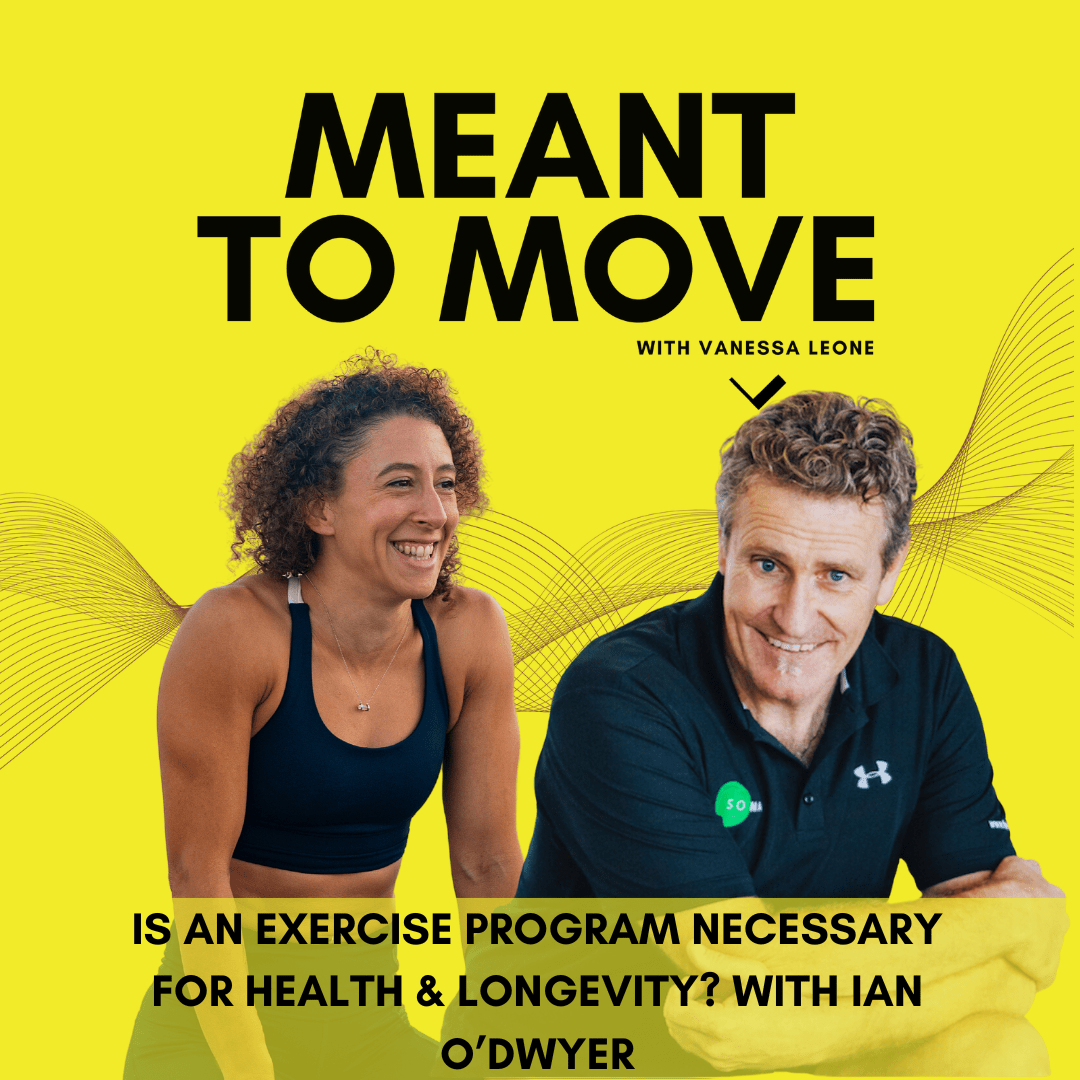
Meant to Move Episode 19
Summary:
In this podcast episode, Vanessa Leone and OD discuss the importance of programming in fitness, emphasizing the need for variety and adaptability in exercise routines. They highlight the significance of understanding individual needs and preferences, and how emotional and mental states impact physical performance. The conversation covers the benefits of incorporating playful and unconventional movements, the role of fascia in movement, and the balance between routine and novelty. They also share practical advice on creating personalized exercise programs that cater to real-life activities and stressors, ultimately aiming for a holistic approach to fitness and well-being.
Transcript:
Vanessa Leone (00:01)
Hello, OD.
OD (00:04)
Hello Ness, how you going?
Vanessa Leone (00:07)
I’m smiling now. And hopefully I made you smile too. And this is how we’re going to start the podcast today. Everybody driving, sitting on a bus, wherever you are, just listen to that chuckle of that man. And we know that we’re in a happy place right now. So thank you.
OD (00:26)
Well, as we all know, it’s that, you know, we all get thrown these curve balls, we all get thrown this stuff at us that, and a lot of the times we actually can feel it, but we ignore it. You know, the body’s always whispering to us. But for some reason, we tend to ignore the whisper, whether it’s distraction, whether it’s fear, whether it’s, you know, I just haven’t got the energy. I don’t know. It doesn’t matter. But at the end of the day, you know,
You’re happy because you’re small, you don’t small because you’re heavy.
So if we can bring something that puts a smile on our face, which then enables us to be happy and enables the listener to get touched, to get touched in a space that maybe they haven’t been touched for a while. And that just may be, that may be just in a manner. And that’s where it’s, where they have that freedom, that freedom just to listen and not have to think or create an answer or find a solution.
Vanessa Leone (01:03)
You always say something profound.
I like that because I’ve come, as I always do, OD with my ideas and I want to do all these things. And there you are, as a constant reminder to park Ness. You’ve got to put the car in park to be safe before you move anywhere. right? I like it.
OD (01:49)
Yeah.
Yeah, I’m good at that now. I probably wasn’t good at that 10 years ago in this.
Vanessa Leone (02:04)
We all need that somebody to remind us. We all have that somebody. So it’s cool. No, I, I, I like, know, you’ve put this in a really interesting frame of mind for me because I’ve listened back to all of our episodes, the lymphatic episode that we did last time. We went gangbusters. Loved it. Everybody was like, Oh, this is new. Haven’t heard this before. Super interesting. And it got.
me thinking about, we’ve talked about movement, movement for therapy, movement therapy. We’ve talked about fascia, we’ve talked about lymph. We also talked about, you know, measuring things. And so I feel like if you’re, if you’re coming along this journey with us, we’re getting to the point now where it’s like, how do I do? I’ve got some good background. I’ve got some really good knowledge behind me.
And I want to talk today about programming because I feel like, you know, we talk about programming, like it’s this in the fitness industry. If you’re not part of the fitness industry, maybe you’ve heard of programs, right? You understand maybe what a program is that you follow, but programming in the fitness industry is like, you know, it’s revered. It’s your program, this or, you know, what’s in the program.
OD (03:27)
Unless I’m not sure I’m the one who’s listening to all of their programs too!
Vanessa Leone (03:32)
But this is my point. This is my point. Because you always point out, we’re trying to point out things in the industry that we’re like, hold on a second here. We, you know, we get a program that we get given for eight weeks, 10 weeks, whatever, many weeks. And I don’t know about you, Odie. I’m absolutely shite. Like so shit at following a program. like, I just get so goddamn bored.
Sorry, when I say programming or programmed to you, what does that evoke? What comes to mind for you first up?
OD (04:11)
Well, firstly, let’s take it from a traditional perspective. Let’s come down the way that we’ve all been taught. We’re going to do a program that’s going to involve 45 to 60 minutes. It’s going to have some form of potential reconditioning, some potential stabilization work, some potential strength work, power work, and then some sort of recovery at the end of it. Now, it was interesting because…
I could, you and I’m a person who’s had a bucket load of injuries, a bucket load of injuries. And you know, Ness, because you’ve experienced it, you’ve been a conditioning coach at the elite level. When it comes to reconditioning, to rehabilitating, it is the most boring as bat poo thing that you can do. But the good athletes do it to the letter because they know that if they follow it, there should be a positive outcome.
And you know, the one thing I learnt about programming from a very early stage was that our aspiration was in five weeks time or six weeks time, fantastic. But it was interesting because every time I did the rehabilitative reprogram by some of the best in Australia that we had available, as soon as I got back into the game, I broke down again. And that…
you know, that happened two or three times and it was just like, come on, you know, I’m doing everything. Maybe I was doing too much. Maybe emotionally I hadn’t addressed what was going on because you’re playing at that level where there’s a lot of fear and anxiety. You know the story. So I guess for me, when someone says programming and I talk about Phil Sommers programming, there’s a very valid piece of research that I didn’t get until later in my coaching career.
But from a common sense perspective, it doesn’t make sense to me to try and teach the muscles the same thing over over over over over over over. And the reason I’ll highlight that is because it’s boring.
Now, from a common sense perspective, now proven through neuroscience, from a common sense perspective, people won’t learn and basically take in information when they’re bored. They have to be happy, they have to be joyous, they have to be engaged. So it was very early days, Ness, that I found out that my programming was based around how the client felt that day. Address the niggles that they had.
then give them something that was a positive, a positive win, whether it’s strength or power, and then do something that made them smile. So when they left, they wanted to come back. And when I say come back, I don’t necessarily mean to me, they wanted to come back and condition themselves again. So the science I’m going to talk about is from a neuroscience perspective,
It shows that it takes about 450 repetitions to retrain a muscle. In play, it takes between 10 and 20.
Hmm now Once again, that’s not me making that up. There’s stuff out there now that just shows this and it’s kind of funny, right because you know, you know me plays one of my biggest things because Going to the gym bores the crap out of me and It’s intimidating it really is and I’m a person who’s lived in the because I had to because of my sport, right? but
It bored me because of the fact that every time I went down the traditional path of overloading tissue to get sized like we were taught, I would break down. But as soon as I then started to manipulate, to challenge my body in a more multi-directional moment, so instead of just taking a shoulder press and pressing it above my head, I might take it out to the side, I might bring it to the front, I might rotate my hips and take it to the back, and start to feed that shoulder, trunk,
whatever it is, region, what we call intelligent motion, and guess what? Shoulder pain disappeared, strength got better, so that when I did go into a traditional shoulder press, I could actually do it safely, effectively, and I was getting heavier lifts. Now, the heavier lifts weren’t what I was after, but they were the KPIs that the conditioning coaches needed, as we know, because if we don’t, if we don’t,
tick our KPI’s, we don’t have a job. So Ness, I guess where it all comes, I’m not bagging physios, I’m not bagging exercise scientists, I’m not bagging anyone. What I am saying is, I’ve been in the industry for 30 years, and I get the cases that most people would just scratch their head and go, what do I do? And I enjoy them because the people just wanna get better, and that better might be 1%. And if I can help them,
get out of a chair better, if I can help them walk better, if I can help them breathe better, if I can just have a positive change of some sort, all of a sudden, the layers that they improve in is just amazing. So I’m sorry, that was a long-winded what’s programming to me, but it’s, I think we’ve got to unpack the term. We’ve got to define the term. I’m not saying repetition doesn’t work. I’ve got some great conditioning coaches, good friends of mine.
highly qualified, done check, it, and they’re amazing coaches, amazing. But if you’re a person who’s not an analytical brain, and you’re a person who potentially needs to be challenged, entertained, given freedom, then our programming will look very different to someone who loves structure and loves to know what the movement is and to feel in a certain area.
Vanessa Leone (10:27)
Yeah, I don’t think that was long-winded. think that was great. Thank you.
What that brought up for me was a really interesting dissonance because I learnt the science first. this is where I think, you know, we have this breakdown between the science and then the real life because the science is done on athletes. The science is done usually, especially exercise programming science on people who
have to go in and do the same, the same thing again and again, because you need to reduce the amount of interference, so to speak, in a, in a study so that people can be studied so that you can get an answer to a question. And this is where I think that it breaks down because like you said, I have zero emotional attachment to a program that makes me do exactly the same thing for eight weeks in a row. I will lose my mind because I
I just don’t move that way. Now, differentially, my partner, you know, he loves to move that way. So he loves to move that way. But even then I would say he’s smart enough week in week out to feel his body and adjust. I’m not going to do chest press with dumbbells today. I’m going to do it with a barbell because whatever. Right. So even that has a slight amount of variation when
When you’ve trained and you know what’s going on, know, it’s the same exercise, just a little different. That’s the bodybuilding ethos, right? Do an incline and then do a flat and then do a decline. It’s the same kind of principle that you’re talking about there. But I think that this is where we’re working with people who don’t have movement intelligence. And that’s not necessarily their fault. Movement’s a language that you and I speak. We’ve spoken it since we were children.
And I, and I was interviewed for a podcast a couple of weeks ago and movement isn’t most people’s language. You movements, our language movements, what we do. And so we have to translate that science and go, okay, we know that X amount of repetitions or X 450 repetitions on the, on the muscle is what’s going to get changed for people. But if they don’t move that well, if they don’t know how to manipulate the exercise based off
how they feel that day. That’s up to me to be able to monitor and educate them on how to do that. That doesn’t mean I’m constantly changing the program. And I say that in inverted commas for those of you listening, because that’s where I think that this conversation breaks down when we’re talking to exercise scientists or people who really stick to the science. I’m not disagreeing with the science. I just think that we’re not very good at applying it to the people who
Yeah, who don’t speak that language at all.
OD (13:30)
Yeah, and it’s interesting, Ness, because even when I was conveying what a program was to me to watch your face, the visceral change that I could see inside you, because we’ve all done it. you know, I’ve got clients that I conditioned back in 2002, 2003, who used to still call in to my studio in 2020 and say, I’m still doing those exercises. I have a cringe thinking, oh my God, what did I give you back then? But they’re pain-free.
and they’re a life and they’re happy, right? And we know, we know this just to add a bit more layer to that, that the brain really doesn’t like repetition, not as facial tissue. So it’s interesting because when I’m conditioning someone, just as you are, I’m not thinking about the physical, I’m thinking about the emotional.
Thinking about the mental I’m thinking about every time I take my right hand can I cross my body somewhere? So that I can now cross pollinate the brain That I can now get them in a better position to breathe so I can get oxygen to the brain So then they are they can actually feel that Wow, how come I’ve got a calmness about me because I’ve got oxygen going in my brain So it’s just interesting. It’s not this you know, it’s physical emotional mental even the spiritual side. Let’s be perfectly honest. I’m not gonna go
spiritual to me is I treat people the way I want to be treated. Just imagine if society did that at present time, if we treated people as we would want to be treated, how much more calmness, how much more politeness, how much more patience there would be in society, right?
Vanessa Leone (15:12)
respect. No, I think you again, you bring up this super interesting paradox and I can’t remember if I’ve learnt it from you or just suddenly somewhere down the track of, we learnt it. Well, there’s this continuum, right, of humans needing routine to a certain degree, but also needing
OD (15:13)
wow, I may be on the track already.
Vanessa Leone (15:41)
variety and novelty. And I think that this paradox is exemplified really, really well in this programming capacity because I see people craving variety when they step into group exercise. And the reason why they step into group exercise is because nine times out of 10, you’re going to a class that’s different week in and week out. And the instructor has variety and they’ve got different music and it’s a bit of a different vibe every week. So you get that variety.
But we also know if you did something like Les Mills or something, they followed that science of, know, we do this for 12 weeks and then we change it and we do that for 12 weeks. We might bring in other tracks and add a little bit of variety along the way. But like that to me, it was one of the most perfect ways to introduce variety and repetition at the same time. And I think that what people don’t
realize when we talk about this variety and repetition, the way that you move is represented in what is what’s happening in your life. If your life is mundane, very regimented, very routine, very same all the time, you’re likely to want to crave that variety somewhere else. Maybe you do it on the weekends because you go out with your mates and you go do all these fun, crazy things, but maybe you’ll do it in your programming because
Monday I do Pilates, on Tuesday I do yoga, on Wednesday I do CrossFit, and on Thursday I do this, blah, blah. And you just say that you like all these different things, but that’s maybe your body saying that I need this stimulation because my life is very routine, it’s very similar. But on the other hand, if your life is chaotic and a little bit out of control and things are happening that you don’t have a lot of control over, well perhaps…
the routine of doing something safe and doing something similar in the gym is actually super useful and super reassuring for you because now you have that safety and knowing that you’ve got these patterns that you can come back to while everything else in your life is chaotic. And I think we really need to pay a lot more attention to this paradox that we kind of live in as humans between this variety and routine.
OD (18:02)
And it’s kind of interesting. No, I didn’t teach you that. You would have found that from a personal experience. So it’s really what you’re saying in a simplistic setup is life’s about stress. If our life is very low stress, very structured, we need some more you stress, more challenge, more whatever in another area. But if our life’s already
Vanessa Leone (18:02)
Did you teach me that?
OD (18:32)
Crazy busy go. I love it. I enjoy it. Then I want to get away from that when I go into my Gym, Pilates, whatever it may be to something that is just known. So yeah, I totally agree with it totally agree with it because it’s You we use the word stress like it’s a filthy word. It’s a bit like, you know, Mental health like there’s so many things depression and anxiety are real emotions
But if we could just help people do fundamental things and give them what they need based on their environmental stresses, let’s call that a lifestyle. I feel, because I witnessed it, I would feel that we would change a lot of people, a lot of people very, very effectively. And we could do it through sunlight, we could do it through breath, we could do it through movement, we could do it through getting out of the ocean, for a walk through the park.
going to a group class, there’s so many ways that we could have a greater effect by understanding those stresses.
Vanessa Leone (19:29)
Mm.
Yeah. And I, I think that, you know, you’re with me on this side of it is that we tend to see people who’ve come from that chaos that everything’s kind of, too much for me at the moment. And so I actually think it’s much harder to find guided exercise that is slower, that is more feel-based, that doesn’t have to push you when you don’t need it.
And I think that that is what we’re really trying to highlight here is that a lot of people, we know how to push people, we know how to give them a 12 week program. And if they did it, they’d probably get great results. But that’s not taking into account absolutely anything else that comes into their life. And that’s the challenge that needs to be met to create lasting change for people.
who want to immerse themselves in exercise and have a program and be able to do things for life as well as for exercise as well.
OD (20:41)
And it’s, you know, just imagine, just imagine as coaches, allied health professionals, Breath instructors, whatever you want to call, whatever you come under. Just imagine if we empowered people by saying, you know, for those who don’t have enough stimulation in their life, okay, you know, do some breathing, reset the nervous system. Now I need you to go out onto the grass and just do some sprints. you know, get that heart pumping, get that lung open or those lungs open and feel what it’s like to actually run again.
And I don’t care whether it’s only five or six strides. I don’t want you to run 150 meters. I just want you to maybe work your way through your gears and go from, you know, from slow to half speed, but feel what that’s like when you stop because I can assure you when you’ve been a person who’s played as a child, running is one of the most exhilarating things you can do. And it’s one of my go-tos. I’ve got an 80-year-old who comes in and he’s quite…
round-shouldered kyphotic. One of the first things I’ll get him on the wall is a running drill. So he’s leaning against the wall, he picks his leg up to hip height, he stands on one leg and he drives his opposite leg back. So he’s basically just doing a reverse reach with one leg and then stands back up into that running position. But because his arms are straight against the wall and he lifts his chest, my God, when he comes away from the wall after 30 seconds, he can breathe, he’s smiling and he’s taller. Now this…
That’s just common sense, right? That’s what you and I have done all our life. We’ve been able to do those things. That’s not through reading a book. That’s not through going and doing the advanced course of, you know, whoever. That’s just saying, wow, that’s pretty amazing that I can rekindle an emotional time that I felt great. And if the body recognizes the pattern, so you’ve taken the emotion, you’ve taken the mental, you’ve given the body a movement challenge, which is now the movement pattern.
and you’re in a situation where you think, wow, it’s safe. They come away from the wall and we’ve got a new person in the room. How cool is that?
Vanessa Leone (23:01)
It’s so cool. It’s, and it happens every time. I, I taught a charity class on the weekend and so fun. Just like the music and you you knew my demographic and number one, the music sparks joy because it’s nostalgic and people having a bit of a sing along, but it also gave people permission to like scream in the middle of like their workout and to, and we played.
This is, this is definitely a you game for sure. Where I section off an area and you know, there’s a big group. So it’s a little bit congested. That’s the whole point. You’ve got a partner and you’re not allowed to run. You’re only allowed to walk and you’re only allowed to walk as fast as you can walk. And you have to chase your partner only walking in between the congestion of everyone else trying to chase their partner. And it’s just the most like, it’s the easiest game to play because everyone can play. Most people can walk.
relatively fast and as soon as you give adults permission to like run amok, the noise level just increases. So funny, the smile.
OD (24:07)
off the charts, smiles on your faces,
a great dentistry ad.
Vanessa Leone (24:13)
Yeah. But it’s, again, it’s, it’s, it’s super simple. And then, you know, that, that component of the workout came before intensity. So that was like the builder for me to, to bring intensity into, into the body, because you know what, if you, if you start feeling happy before you’re about to do something quite hard, you’re in a better position to be able to do it as well. So,
It’s just fascinating when you start to put all these pieces together, how well they work.
OD (24:46)
Yeah, yeah, look, that’s great coaching, right? That’s using all their tools in our toolbox, not just using, you know, a strength component or a balance component or a power component. It’s about using all the tools and understand that we can manipulate the group through an emotional mental reaction.
Vanessa Leone (25:09)
Yep. Yeah. Yeah. Shout out to Shania Twain who like everybody went nuts too. Alright. Let’s dive into perhaps a little bit of practical advice. So someone’s coming, they’ve listened to all your episodes and they’re like, okay, I’ve exercised a little bit.
dabbled in and out, I kind of know I know how to squat and how to deadlift and how to do a push up, you know, just kind of the basics. If I wanted to put together a program, OD, you know, in inverted commas, if I wanted to do something, what components do you think are essential to, to think about to add into this program?
OD (25:36)
I love the questions you ask because they are on the money. So the very first thing that you want to do as a person to create a program is to identify what the program is going to help you in. Right, so in other words, if I’m a person who works in the garden, I want to make sure that I look at the positions that I’m on in the garden that I may need to be able to get in and out of. So for instance, if I’m a person who
Just say I’m a gardener, they’re gonna kneel, which I’ve gotta go from ground to stand and stand to ground. I’m certainly going to squat, for want of a better word, they’re gonna squat down, but the squat will never be in a squat pattern, it will be in what we call an odd position. So you might have one foot turned out, one foot straight, one foot slightly forward, one foot back. So you’ll have these odd positions. You’ll start conditioning yourself.
Remember what we said at the start, the brain really doesn’t like repetition and not as fascia. So the more that we can condition the body to move differently, the better it now is at adapting under stressful loads. And stressful loads is when you’re in the garden and a snake pops its head out from the rose bushes.
and you’re not expecting it and you’re kneeling on your knees and all of a sudden your sphincter bulb is fairly tight, you can’t breathe and you’re trying to go backwards but your knees are stuck to the ground. That’s what I’m kneeling people for. So it’s…
Vanessa Leone (27:29)
I’m really glad
I didn’t take a sip of my tea then because it ended up all over my microphone.
OD (27:38)
I had this client with this couple who were clients of mine for 13, 14, 15 years anyway And this beautiful lady came in both Canadian couple He was probably at the time 61, 62ish Chartered accountant she came in she’d done 30 years on the airlines in Canada. She was the most beautiful placid amazing person he was the most
Gruff. Just didn’t speak much. Just very matter of fact. Him and I finished up best mates. He was just the greatest guy, But the interesting thing was, three mornings a week they would come in and see me because that’s what he was. He was a regimented person. He wanted to do it. They loved it. Anyway, Alison said to me one day, she said, and this would be 10 years after they started.
and there used to be 30 stairs up and there used to be 30 stairs down from my practice. she said, I walked out last week and I walked down the stairs and I stepped onto the street and this kid came past on a skateboard at a rapid rate of knots. And she said, I basically hopped back and landed on one leg. And she said, I turned around, looked up the stairs and said, thank you, Ian. That’s conditioned me to be able to do that.
Because she said that was certainly an AC, that was a knee injury or a back injury happening, ready to go, right? And it’s interesting because you don’t, they’re the things we’ve got to do. So if you’re not training for your outcome, then don’t train. Right, so first of all, the pattern’s got to look like what you’re going to do. The second thing is move through the patterns with very little weight. So you might say you’re going to pick up a bag of, you know, soil.
which is a 20 kg bag from a garden supply. Well, get maybe a 2 kg weight and go through some odd positions of squatting down or of going into sort of a lunge position where you step forward and maybe twist or step to the side and maybe put it straight down. Just get lightweight and start doing those movements. And what you’ll find is, because you don’t ever want to load yourself to max, we always want to do sub-maximal because we’re not just training the muscle, we’re training.
The fascial system as well, the neural system. So if we do it sub-maximal, we’ve got a better chance of creating sequence and strength that is gonna be successful. So movement pattern, create a weight that’s comfortable, that initially will feel light, then you’ll start to challenge yourself, and then you get to a stage where you can say, well, yeah, right, I might do a set where it’s a little bit closer to the real weight, but then I’m gonna come out. And you know.
Do that two or three times a week. Don’t do it every Monday, Wednesday, Friday. Don’t do that. Please don’t do that. know, vary your days, because the brain likes variation. The brain likes variety. The brain likes variability. The three V’s. So if we can do that, and so does the fascia. So if we can create that variety, what you’re going to find is the strength that you’ll have, the confidence that you’ll have.
the ability to be able to live the quality of life that you want will be through the roof. And I don’t care whether you’re a gym, so I don’t care whether you’re a netball, don’t care. The movements have got to look like the sport. And it’s interesting because of the fact that, if you were doing three sessions, two to three sessions a week, you’re gonna notice some pretty significant changes. The secret is,
After you’ve done your session, maybe it’s 30 minutes. You know, I’m not a 60 minute person when it comes to a session. If we give the body quality, 30 to 40 minutes as tops. You know, by the time you do some
priming, some preparation, by the time you do some recovery, you might get 45, that’s okay. Probably 20 minutes intensity, 25 minutes tops would be me. And it’s interesting because once again, I’m not training for bodybuilding.
So I haven’t got to do massive overload, repetitive overload. I’m training for life. That’s what I’m training for. I want to keep paying to a minimum. I want to keep degeneration to a minimum and I want to be able to do whatever I want to do in a confident manner. So that’s my program design for me. So if that’s the case, the secret really is recovery. Give yourself 48 to 72 hours to recover between each program. Because if you do, you’re to see some great results.
Vanessa Leone (32:08)
I like it. I like it. It’s, I think the challenge for a lot of people is their confidence to take a movement that they do in real life and apply it to the gym. Because this is, this is the thing that you and I have been labelled.
the entire time of my entire career. you’re the, you’re the weird trainer. You’re the person who moves weird. You’re the person who crawls on the floor and does like, who does strange things. That’s like, like, have you seen someone play with a child on the floor? Do they say that that’s weird? Like, no, but how many grandparents can get on the floor and play with their grandchildren without pain?
OD (32:55)
Correct.
Vanessa Leone (33:14)
for a sustained amount of time. I know this weird moving thing, it frustrates me to no bloody end because humans aren’t designed to move in a patterned way. And I’ll use an example. I had a client in training for years and she fell pregnant and having a baby.
And this was at a time where I was still training her at her, at her house. So we didn’t have access to all the heavy weights. And I said to her, we need a big sack of rice, like a big 10 kilo sack of rice. And she’s like, what are you talking about? And I’m like, you, you, you’re going to have a sack of rice that wriggles in a baby and you need to be able to pick the baby up and put it in the like carrier in the car, in the, I don’t know, whatever, wherever you from the floor.
from everything. And so we literally picked up and put down this sack of rice in as many different ways that we could figure out how to pick it up and put it back down again. And that was fine for her because she was doing it at home. So there’s no reason why you can’t just literally get a big 10, 20 kilo sack of rice, leave it at home. And then that’s how you’re practicing your.
your weird movements in quotation commas because you don’t want to be seen doing that at the gym. That’s totally fine. But I think that there is so much value to training like a real person getting up and down off the floor. Like you said, like it’s so important.
OD (34:47)
I think the hardest part you have to contend with, as you’ve said, and we’ve seen it now for the last 25 years, is that you have magazines that are still writing about the same things they were writing about 25 years ago. They’ve still got exercise of the month that is still a double-armed shoulder press, vertical shoulder press, or a chest press, or a squat, or a lunge, or whatever. I mean, there’s 69 different foot positions for a squat. Why do we always squat the same way?
Like, you know, it’s just, it’s ludicrous, right? There is certainly people out there now who are saying to take the knee past the toe, which I love, but then sometimes they’re going to the nth degree of doing stuff and you think there’s no need to do that. Like you’re putting people into a compromise potential now rather than just saying, Hey, let your knees drive over your toes.
Therefore you’re going to activate your forefoot, which means your big toe, your pelvic claw, your diaphragm, your pericardium of your heart and lung, and your tongue are all going to activate, is your deep core line. Fantastic. So it’s just interesting, right? It’s, it’s, it’s, and I’ve seen it a lot over the years. The people who are a little bit different sometimes just go too far on the spectrum. And it does, it scares the hell out of people. And of course then it makes it a real us versus them confrontation
because you know the one thing about you and INS and about a lot of people that we’ve worked with and and know they would never put people in danger to hurt. We would never put someone in danger and it’s interesting because it’s the extremes that people get broken in. It’s the extremes. It’s never you know you can blow a disc picking up an A4 piece of paper.
But I’ll guarantee you, if you picked up an A4 piece of paper and blown the disc, your knees haven’t moved. You know, you can blow a disc sneezing. I can guarantee you, if you have, it’s because you’re as rigid through your neck and shoulders as you could ever be, and probably your hips don’t move. You know, so there’s all these things that happen that we can hurt ourselves doing. Yes, I get it. But weird movement isn’t about doing the movement just because it’s weird. It’s what we call, you know, they’re movements for life.
their odd position. Odd position is where we have to get stronger. How many footballers did you condition, Ness, that, you know, they did an ACL and, you know, they were stringent in the gym, they did their warm-up, they did their roller work, they did everything, but their program didn’t reflect three-dimensional movement and that meant that all of a sudden that the ACL was compromised under heavy load.
Vanessa Leone (37:12)
Yeah. Yeah. And look, I can say it from my own personal experiences when I was working in a more traditional gym and partaking in more traditional, heavier weight training program, rather than my own exploration of those, I would have, you know, and you and I are both the same, we’re both bendy and a little hypermobile. The stiffness that I had in my body compromised me so much that I would
sublax joints, sneezing or turning too quickly. And I had like a series of ribs sublaxed and my SI joint just consistently like, yeah. And that was the tension in my body, the muscular tension, the fascial tension being so on, so overloaded from these similar movement patterns that
because my joints have too much range of motion, I could literally shift my bones out of place. And that’s wild, wild. And that’s a really common theme that I hear in bendy human populations. And that’s not really well understood because we give people again, this is your rehab program. Do some, you know.
shoulder rehab and here’s your four shoulder rotator cuff exercises that you do and I’ll just crack your rib back in because it goes in real easy because you’re hypermobile so you just knock it back in and it’s fine. But it hasn’t really addressed any of the issue which was when I, for me particularly, when I do the same thing again and again that exercise becomes the problem.
quite literally becomes the problem and I see that quite significantly represented in the Bendy community.
OD (39:34)
Yeah, and that’s very true. I had a lady in here two weeks ago and she goes to India, she runs retreats and very bendy person. And to the stage where her feet just collapsed. It’s just like, But it’s interesting because…
when we started talking and I said, okay, so we need to get some stiffness into your fascial tissue. So they’ve heard of fascia because the yoga community has, and a lot of people talk about it. But when I said stiffness, she straight away went into fear because she thought that meant rigidity, right? And I said, no, no, no, no. That’s a very different perspective. Rigidity is the enemy of movement. Stiffness allows you to stabilize and pass the force through. So it’s this.
You know, it’s this constant education that we’ve got to create for people and hopefully these podcasts help the listener understand better because you know what? In all the years that I went through a rehabilitatory process and I’ve got some of my best mates are physios, chiros, know, osteos, they’re great at what they do. I consider them to be healers more than anything. And we’ve had this discussion and
They’ve said, we were never taught about tissues that were bendy. No, they weren’t because they didn’t look at the fascial tissue, you know? But at least they’ve got the humility to be able to say that. So if someone gives you an exercise and you don’t know what type of tissue you are, it’s a bit like going and getting an operation, not having a blood test and finding out what blood type you are in case something goes wrong. You’ve got to know your type.
Vanessa Leone (41:25)
Yeah. No, it’s a fascinating discussion. What I would love to ask is for people who are following a program now, so just say they have an online coach or they’ve been following a program and they’re hearing this and they’re like, okay, how do I introduce variability variety?
Where do you think is a really good starting point for someone who’s just trying to do their best? How can you help them with that?
OD (42:02)
All right, so let’s narrow it down because if we spoke about programming, we would talk about a traditional person, a progressive person who’s more functional, wild, crazy, and there’s a hybrid in between. Now, I would suggest you and I live to the progressive hybrid side, but let’s just say that you have a typical person who is a
you know, analytical brain and they want to do traditional. They love the known exercise. They love the sets and reps, that sort of stuff. My first question is, you know, what makes you uncomfortable if you step outside your program that you know now? What will make you uncomfortable? Now, the majority of people will say, well,
I don’t feel comfortable pushing a shoulder press out to the side or I don’t feel comfortable doing a step with a bicep curl. So what I would say is, all right, let’s do something really funky then. Really funky. Instead of doing three sets of 15, let’s do a 15, a six and a 10. What? So I’m gonna play with them in their mind.
where they can still control the movement, but I’m gonna change the numbers because that’s a big enough change for them to be able to cope.
You know, so you might instead of having to say 15, 15, 15, which is 45 reps you might say, okay I want you to do 15 and then I want you to do 8, 23 reps and then I want you to do 10 is 33 reps and then I want you to finish off with 12, So you might do four sets instead of three sets change the numbers up Don’t change the exercise at the minute just change because all I’m trying to do this me as a coach is I want to challenge them
to be able to cope with change, but the change has to be small when they’re a very traditional person.
Vanessa Leone (44:04)
Yep.
Yeah. No, I love that. think that that’s a nice, simple way to look at it as well, because my brain initially goes to, know, it’s funny where your brain goes. It’s like if you’re, if you’re chest pressing with, you know, your palms forward, can you, can you turn your palm or something like that? And, and, and playing with slightly different grips or hand positions, I think is, is a super
useful way to start, but I really love the numbers game because at the end of the day, if you are on traditional training, you know, it’s a, if you’re hitting the repetitions to, to achieve a certain result, because we know that this is, this is what it’s a, it’s a formula for a reason. that’s a really cool way to have a bit of a play with it. And I think that that also allows people on the days where they’re not feeling so crash hot.
yeah, I’m allowed to manipulate the numbers. Okay. So maybe I’ll just do a set of eight and then a set of six and then another set of six and maybe then I’ve got a seven or, and, and you know, play with it in that way because now you’re actually stressing your body to its capability for the day while still following the program.
OD (45:16)
Yes, yes.
And the biggest thing I’ve learned over the years, Ness, is that when you take someone who’s truly a traditional, passionate trainer, as soon as you take their form and change their direction or their distance or their height of their push or whatever, they stop breathing. And of course, when they stop breathing, they become rigid. And that’s when they’ll damage themselves. So it’s a matter of…
really just focusing on something small first. And, you know, depending upon how long they’ve been training, I’m sure they’ve alternated and they’ve done simultaneous movement. They’ve done all the basic stuff that we teach. And if they’ve done that, they’re halfway there to being a hybrid trainer, because you can start to do all sorts of little weird things from a, from a, you know, you might do a traditional squat with a deadlift. So, you know, Olympic bar, a couple of plates to the rim.
And you might just simply say, all right, I want you to take your right foot forward 20 mil, three quarters of an inch, and do the same exercise. So as you say, same as you said with the wrists, with the hands, with the arms, we’re just changing direction, we’re changing how far we push it, whatever it may be, we’re manipulating that, which is gonna make a big difference. anything that’s too big, too hard, people will stiffen, people will become rigid, people won’t breathe because they go into that fear of change.
We just want to make sure that if I do anything, if I do anything, probably the biggest rule I live by, if I change one thing, I change everything.
So if my foot is half an inch narrower in stance, I change everything. If it’s a half an inch wider, I change everything. If it’s half an inch forward, I change it. So change one thing, change everything. Change your grip, change, you know, put more weight on one end than you do on the other. Not much, just a little bit. Same squat pattern, do a traditional squat pattern, but maybe put 25 on one end and maybe put 22 on the other and do it. Because trust me, the brain and the body is gonna go, what the?
Vanessa Leone (47:19)
Very cool. like, I love those suggestions. What I will carry out that by saying is if you’re someone who is doing one to five RMs, don’t change things. Probably do it sub maximally. Just, just a little note at the end of that one.
OD (47:34)
No, you take this. Well, we’ll see you next week. Thank you,
It’s
not funny because we’re just talking as it is. And I guess I used the word submaximal before, but I should have highlighted that bit. So thank you for saving my butt.
Vanessa Leone (47:58)
got your back, alright? You got mine, I got yours, this is how we do it. No, it’s, and I love, obviously I love this concept of, you know, people, that’s where, again, that’s where people who are going to be science be like, but you can’t change that if you’re lifting heavy. And you’re like, yeah, don’t change that if you’re lifting really heavy, you need to be in your established pattern, you need to go where you feel the most safe. But we’re not talking about that.
And honestly, I don’t know how many regular, regular people, you know, I’m talking about the 70 % who never step in gyms. How do we get them into the gym? I’m sorry, it’s not with 5RM programming. No way. It’s not, it’s not with 5RM programming because it’s there.
OD (48:52)
And this, know what’s interesting and I’m gonna say this because once again, you can never train an athlete for the event with the same amount of force that they’re gonna go through. You never can, it’s impossible. Cause if you do, you’ve just ruined them for the event. Right? If I train a horse for a race, you never want them.
at their top speed like they would in an event because once they do that event, they’re blown fuses. You’ve got to bring them back now and repair them, recover them, reset them, right? So it’s interesting because if we look at our programming from a one to five, and I don’t want to get in and upset anyone, but I’m just saying I would be seriously looking at probably still submaximal lifting because you’re going to build hypertrophy, no doubt.
You’re gonna build cardiac strength, cardiac fitness, no doubt. More importantly, you’re gonna leave some petrol and tanks so you’re gonna recover better, which means you’re gonna perform better, because you’ll find 20 % more in the event. Just my 20 cents.
Vanessa Leone (50:01)
Mm-hmm.
think that was worth more than 20 cents.
Just saying.
No, that’s great. I think that is a really excellent place to leave that because I feel like we could just keep going all afternoon otherwise.
OD (50:18)
I agree. And it’s a person who’s doing the program, understanding where they are, where their emotions are, are they sleeping, are they eating, are they hydrating, what’s their mood like, all that stuff, all that stuff.
Vanessa Leone (50:33)
Yes, it is all of that stuff. Excellent. That is the last quote I will leave you with. It is all of that stuff. Remember it. It’s in the podcasts. Go back and listen to them.
OD (50:42)
The people stuff is far more important than the science stuff. Just remember that.
Vanessa Leone (50:49)
Yep, yes, is. Wise words, OD. Thank you again, I appreciate you, I appreciate your time. I’ll see you again soon.
OD (51:00)
Pleasure and thanks, looking forward to it. Listeners, I hope you’re enjoying this. there’s any questions, please write in, please, please, please ask because we’re more than happy to pass our experience on. Doesn’t mean we’ll have the answers, but we will certainly give you some solutions.
 Vanessa Leone Movement Therapist