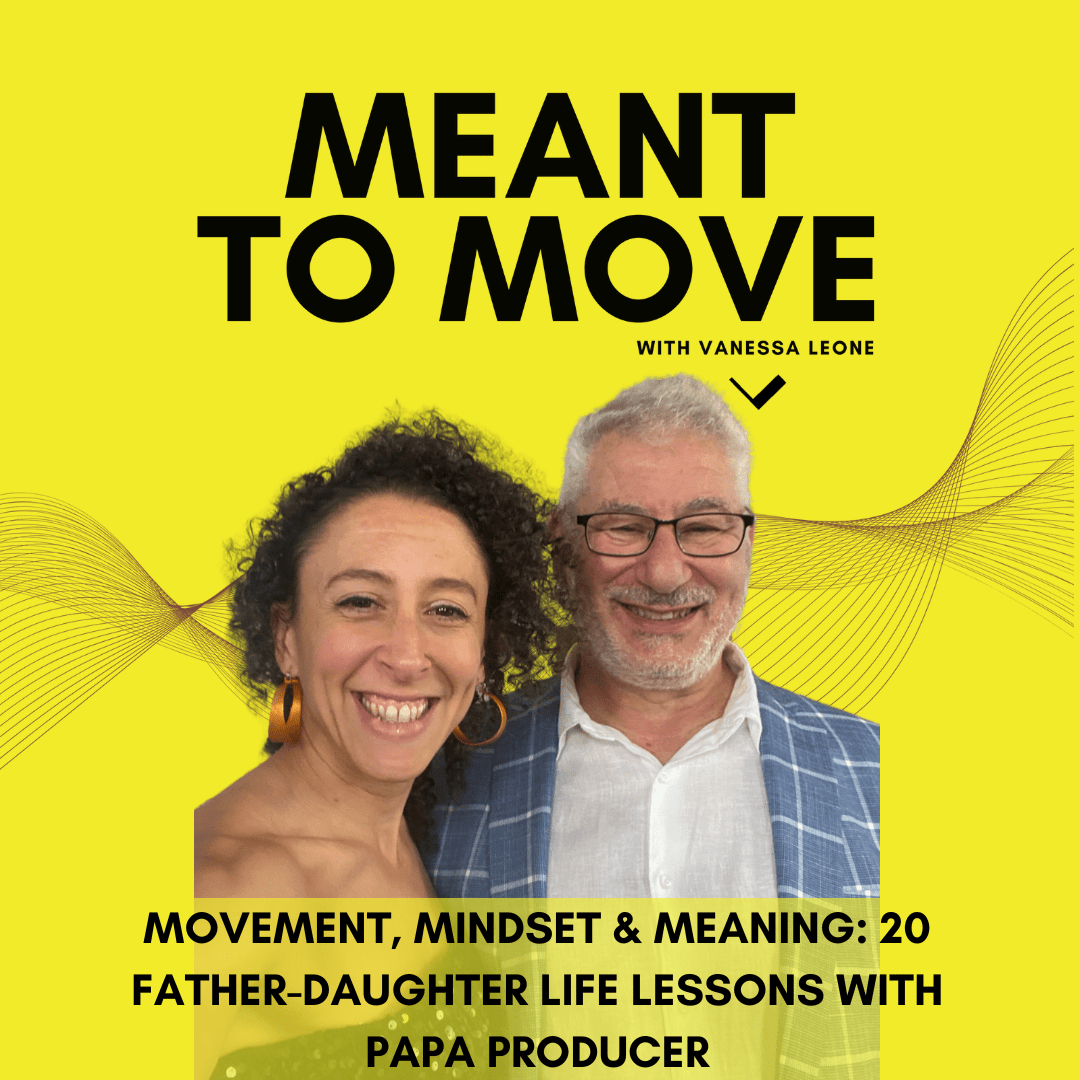
Meant to Move Episode #20!
Summary:
In this episode of “Meant to Move,” host Vanessa Leone interviews her father, Nick Leone, affectionately known as “Papa Producer.” They discuss the evolution of the podcast, Nick’s behind-the-scenes contributions, and the insights gained from various guests. The conversation highlights the importance of movement, emotional connection, and the diverse backgrounds of the guests. Vanessa and Nick reflect on memorable quotes and lessons from previous episodes, emphasizing the significance of personalized approaches to health and wellness.
Vanessa Leone (00:02)
Hello, welcome to Meant to Move. I am your host, Vanessa Leone. For those of you who don’t know me, this is your first episode with us. Welcome. This is number 20 for us, and I’m really excited and happy to be with Papa Producer as I know him as. Some of you will most likely know him as Nick Leone, my dad. That’s dad.
Nick Leone (00:27)
That’s me.
Vanessa Leone (00:30)
And I threw him in the deep end again. He didn’t think that he was going to get another go on the podcast. And I’m like, dad, we’re going to record again. So he’s here, which I love that about him. I love that. And so the reason why I wanted him on here is because he does a lot of work behind the scenes. He’s, he re-listens to each episode before they go to air. He does my transcripts. does all the summaries. And so I wanted to know.
from your perspective, Papa, what has it been like for you to listen to all of these guests and episodes? Has anything changed from you from when we first started doing this to now?
Nick Leone (01:15)
Well, thanks for having me on. Well, I think I’m thanking you, but I’m not entirely sure. Because like Vanessa, like you just said, that this was a little bit unexpected. I wasn’t really expecting to be on again after that first introductory episode. But anyway, here I am. So what’s, yeah, behind the scenes, yeah, it is sort of a bit of a different thing for me to be doing.
So it’s been entertaining. I’m retired as Vanessa probably told you, but it takes up a few hours a week, which is good. It keeps me occupied and my mind active. And I’m actually listening to the guests and reading through it. I am learning as well. I think of, you know,
listening to the guests, they’re very sort of informative and they each have their own perspective on the industry, on fitness, health and so forth. And I think I definitely take away at least a little something from each and every episode. And I’m really entertained by a lot of the guests. They’re so, I think Vanessa is a very good interviewer and she does draw the best out of them I am biased,
I think she does a good job there and they seem to sort of interact very well. But I just love how a lot of them have come through the traditional paths, I guess, through education and getting their science, exercise science degrees. But a lot of them have come from really interesting sort of backgrounds. Emma from musical theatre, which is crazy. Gary, that was the ski boot fitter and you know.
Vanessa Leone (04:28)
Yep.
Ski boot fitter.
Gee, Guillaume also was a ski boot fitter, so there’s two ski boot fitters. Fitness.
Nick Leone (04:39)
there you go. There’s two of them. Must be a specific pathway perhaps to fitness.
And Ian Dwyer was a plumber, I think. Anyway, there’s probably others as well, but too numerous to mention. anyways, I am enjoying it. But I also enjoy the fact that they come from different backgrounds, but they all have obviously immersed themselves in education, trying to make themselves better at what they’re doing and
trying to make their clients better I suppose, educating their clients. And they all have a common message and that it’s an overall holistic approach to what they do rather than just traditional methods. So I do like that. So anyway, I think, what did you name this episode? What we’ve learned or something like that, Ness?
Vanessa Leone (05:31)
Yeah,
I mean, I’m a bit undecided, we can change it, but essentially, my idea for this episode was to kind of go back through and have a think about some really memorable moments or lessons, but then also, you pointed out, Dad sent me his notes, his written notes, because I love a written note, showing that there’s quite a lot of carryover between guests.
in ways that I really didn’t even expect. And so for context, everybody, what we’re going to do, we’re to go through a little bit episode by episode. And I, of course, I asked AI because it’s there and it’s super interesting. So I typed into AI, here’s all my transcripts. Thanks, Papa. Can you give me a memorable or profound quote and the most useful or practical advice and life lesson from each episode?
And honestly, the AI is so interesting what it pops up with. And I thought that I would see if you would agree, Papa, with what the AI has generated. It will be interesting to see. So episode one, you graciously chatted to me and interviewed me, which was really interesting. The most profound quote.
Nick Leone (06:31)
That’ll be interesting to see.
I did.
Vanessa Leone (06:59)
that came up for the AI was a quote from myself, which is, movement fills me with joy and purpose. And I think that’s a really nice place to start actually, that’s quite beautiful. And we’re talking about movement therapy in the first episode. And the most practical advice is that movement therapy is individualized, it’s adaptable, focuses on coaching people to connect with their bodies and address their physical and emotional states.
And I think in terms of starting, you know, starting a podcast, starting the intention of what I was doing, I think that’s pretty spot on. I think that that’s all of the practitioners who I’ve spoken to in terms of movement therapy. That’s, that’s kind of where it is. What do you think?
Nick Leone (07:46)
Yeah, I think you’re right. think from the notes that I actually did write, which I did send to you, I think that’s a fairly common theme that movement should be, it’s different for everybody. You can take a little bit of that. Each person has their own, I guess, ideas on what movement is, but you can take ideas from other people and should be joyful. It should be something that you should have fun doing. It should not be.
monotonous. I think I’m probably a little bit guilty of that I suppose. I tend to be fairly rigid in some of the things that I do. I don’t go to the gym that often. I probably might go once, maybe twice a week if I get the chance. And yeah, I know I’ve had the trainers there tell me, you know, how to use the machines and all that sort of thing. But I think my muscle memory is not that good.
I’m one of these people that needs a bit of direction, I think. And if I don’t have that, I’ll probably tend to do the same thing. I get joy out of it, don’t get me wrong, but I think it can be, you should always be trying to seek something different as well. The other thing that I get a lot of joy out of is swimming. I go, I don’t really swim, I just do a lot of laps, walking up and down. And I think the thing there is also,
Vanessa Leone (08:48)
for sure.
Nick Leone (09:13)
connection with people. There’s always a lot of people around and yeah, so I think that was another common theme I think from the group exercise aspect of it that you connect with people, not necessarily just your trainer or coach, but with other people that are doing maybe the same exercise as you or just in the area. And I think that’s part of the whole thing.
Vanessa Leone (09:14)
For sure. For sure. No, it’s a good start. And I’m glad that you shared a little bit about what you do, because I think it’s important. You everyone thinks that you have to do so much or, you know, exercise can be the same, like very similar, similar machines, because if that’s what you feel safe and comfortable doing, that’s super important. there’s no right and wrong way.
And Funnily enough, that leads perfectly into episode two, where we had Guillaume G, as I like to call him, the Frenchman. His profound quote was, if my client leaves better than they walked in, job done. And that’s a great one. And that’s definitely something I try to live by. And I think that that is something for people out there who have a coach or even like a
you know, a massage therapist or someone who they go see for their health and wellness. think that that’s a really important factor. Nine times out of 10, you want to leave better than when you walked in. Um, because, and maybe even more than that, 99 times out of a hundred, you don’t need to kill yourself every session and feel like you’re really, really, you know, pushing every single session, um, to feel it. What do you think?
Nick Leone (11:06)
And look, from my point of view, I think that’s probably right too. I’ve never really been a gym junkie as such, or I used to do a little bit of running and things like that, but I think I’m a little bit like you. I don’t like running and that might have something to do with perhaps a heart condition that I have. So just not that way aerobically inclined. So when I go to the gym and if I wanted to do…
Don’t know half an hour on the treadmill, I always felt really tired after that. It was probably just too much. I think doing maybe not as much but doing that different variety of things is probably more fun because you get more variety and it’s less strenuous on the body, which means I could probably go back the next day if I wanted to rather than maybe not for three or four days.
Vanessa Leone (12:00)
Yeah, 100%. I think that’s a really important lesson. Yep.
Nick Leone (12:03)
And I’m, yeah, so I am feeling better after doing that. And I’ve taken a lot of what some of your guests have actually said.
Vanessa Leone (12:14)
That’s so good. That’s awesome. All right, we’re going to keep going because I’ve got some fun things. Episode three and OD Movement Yoda, Ian, whatever we’re to call him, he comes up a lot. He’s here once a month and I love how much time he gives for this. You can just see how excited he is to talk about things and that’s what I really love talking to him about it. And his first one is probably
I remember him saying this to me when I was a baby trainer and he says, emotion changes motion. And, and it definitely goes the other way around as well. So it’s like emotion is motion, motion changes emotion and the complete other way around. And we have to stop thinking that they’re not linked because they are and science is proving that they are, but even if we forget the science.
If you go out and go for a walk again, 99 times out of a hundred, you feel a little bit better. Even if you’ve just gone around the block, you feel a little bit better than when you left. I don’t know very many people who don’t feel better after exercise. I don’t think I’ve ever encountered it. The only times I’ve ever encountered is when they push themselves way too hard and maybe spewed in a bucket or something like that, which we don’t want to do, which I’m not, I’m not a advocate of.
This is where you talked about interoception because interoception is the ability of yours, of you to be able to listen in to what am I feeling? Am I hot? Am I cold? What am I sensitive to? What’s happening in my gut? How do I feel to the person in front of me or around me or all of those things? And he wants us to be aware of our inside feelings way more than I think that we are in everyday life.
Nick Leone (14:17)
Yeah, I think Ian’s a very interesting guy and that is an interesting concept, I think. It’s probably hard to practice sometimes, but I think you do get…
I think if I was planning to go to do something, whether I want to go swimming or go to the gym and something is in the way, I do feel that I haven’t really achieved it and I’m not not kicking myself or whatever, but yeah, I feel disappointed that I haven’t done that. So when I do or if I get the chance to make it up, maybe an impromptu walk or something like that, you know, with my wife, with your mother.
I hasn’t happened a lot lately because she’s just recovering from a knee replacement surgery. But that’s sometimes if you can’t get your regular sort of dose and you’ve missed out on that emotional, I guess, uplift, you can try perhaps doing something else later on. I guess it’s not being about having a program and stick to that program. So just…
the adventurous and obviously you’ve got time constraints and employment gets in the way and that sort of thing. But yeah, if you can just decide on the spur of the moment, let’s go out for a walk and we do it. It’s great. Mum turns the music on. You know, we sort of just bopping along and just walking along.
Vanessa Leone (15:53)
I love that, that’s so good. Awesome.
Really cool. There you go. Team life advice. This is important. Okay. We’re going to keep going. Yep. And you know what? 20 year olds on Instagram call themselves that. So you definitely have earned the title. You’ve at least lived your life. All right.
Nick Leone (16:03)
Can I give myself a new term, a life coach then? No.
Vanessa Leone (16:23)
Emma, episode four, she’s our group therapist and you did mention her briefly and her quote is, you can have those kinds of visceral reactions going to a fitness class, but if you don’t know that, you don’t know that you can, like you don’t know that you can have that. And this is where I think it’s super important to
give something a try, regardless of what you, you originally think of it, because she talks about group exercise in particular, about being about self love and being an empowerment tool and forget about exercise for aesthetics or for weight loss, go for your mental health. Because if you go for your mental health and you start to love what you do, then it’s not a chore anymore. It becomes that fun thing. It changes your emotion. It leads really well off from what
Ian said. And those two following on from each other are really profound because they’re talking about changing what exercise is for. And I think that that is such a big and important theme that we want to carry through with Meant to Move.
Nick Leone (17:39)
Yeah, Emma’s very interesting person. I know Emma, through you of course. So yeah, it’s good to get that extra little insight into her personality, a very bubbly personality. And she’s right about that visceral experience, I guess. Yeah, try and do something new that perhaps challenges you and see what happens.
If you don’t like it, you don’t have to do it again, suppose. you know, in that group, I haven’t done a lot of group exercises as such. You did. I’m not saying it’s not my go, but perhaps I just maybe, maybe I should get out of my comfort zone, perhaps a little bit more often and do it. I know the gym that I go to does offer a lot of…
Vanessa Leone (18:09)
forced you along to a few of my things.
Nick Leone (18:35)
Diverse classes. Some of them are a bit too early in the morning for me, I think. That’s the problem.
Vanessa Leone (18:41)
No, I think, but I think you have a different tribe that you connect with and you are a very social person. Being social at the gym, you you talk to everybody there. And I think that’s a little bit different. We all have our way of kind of interacting in that social ability. And I think Emma loves group exercise because it kind of stemmed from that musical theatre performance background. And I get why people don’t.
necessarily connect with group exercise. But I think what I see, what I see more and more groups of men doing, which I think is super important as well, is I live in Sydney with really great access to like a seven and a half K walk around beautiful water called the Bay Run. And there are just groups of men walking or running. That’s social exercise. That’s changing your emotion. They’re having a chat. They’re
going for a walk. And I think traditionally that’s not something that you would have seen a group of men doing. let’s go for a walk, guys. Like, I, it’s really nice to see that change for the better so that people can have more social interaction with exercise or movement, whatever you want to call it, which I think is her point really.
Nick Leone (20:04)
Yes, I think you’re right. Yeah, that’s what it’s all about really. I know people that like you mentioned walking, cycling is a good one for that too. A lot of people, I was kind of saying men, but there’s a lot of women that do it too as groups and there’s walking groups. A neighbour of mine is in a walking group and that’d be quite interesting too. But yeah, so it’s not just about that exercise group in the gym, is it? It’s more diverse than that.
Vanessa Leone (20:34)
Yeah, wholeheartedly. You also on your notes, I know you made special mention of this episode six, had Emily Splichal. She’s our foot podiatrist. She is so interesting. Here’s her quote. Anytime you are working muscularly you are working harder than you should be. And that’s where injuries come in. And she’s referring to walking in this instance, which is again, how good was that segue by the way?
She talks so much about daily consistent habits, which is how she developed her foot brand and her foot and hand sensory awareness, innovations and tools that she’s got and being mindful of your body, being mindful of your feet, being mindful of where you place things, being mindful of how you walk. It’s a, it’s a great message and a great lesson because again, like
walking through the city or even again like on the Bay walk. I see half the amount of people with their head up enjoying the surroundings and I see the other half people with their head in their phones and and it you know you might get distracted initially by your phone but it would be so great if we could put that down a little bit more and just connect with our body.
Nick Leone (21:56)
Yeah, I really enjoyed that episode too. And I think she also mentioned walking speed too, which was really interesting because I mean, if I go for a walk, a brisk walk, I can probably do at least a six, was it six K an hour pace? And yeah, and the…
Vanessa Leone (22:03)
Walking speed.
Nick Leone (22:21)
Your mum, Dani my wife, Dani has always said that I’m a much slower walker than her. And in reality, I am, except when it comes to that, then I can definitely outpace her, I think. But so that interests me, interested me that aspect, but also that being outdoors, just enjoying a walking. think sometimes we just walk around the block or around the local area and it’s fine.
There’s been the odd occasion when we decided, we’ll do something different. And I think that actually arose because we had to be somewhere very early in the morning. And then there was like a medical appointment or something and we were like finished at 6.30. It was winter or late autumn. And it was a beautiful morning. And we walked around Princess Park here in Melbourne. It was just so beautiful. There were people everywhere running,
Vanessa Leone (23:14)
great spot.
Nick Leone (23:20)
The sun was coming up and it was so serene and beautiful. It just made us feel really good.
Vanessa Leone (23:28)
Mm. Again, super underrated. That presence in that beautiful moment. Really nice. Thank you. That’s a great one. Episode six with Mr. Stir the Pot, my now husband. My goodness. He definitely… Yeah, he definitely stirred some things with this episode. His first quote is really him, because he said it to me many times. If you love something…
Nick Leone (23:32)
Yes, what a day that was.
Vanessa Leone (23:57)
find a way to fit it into your diet. It’s just how much you have. And, you know, his, his food journey is less about restriction and more about, you know, make sure you enjoy your food. Because if you enjoy your food, then it’s easier to eat healthy. It’s easier to be healthy. and big ups for fibre He is now dubbed the fibre King.
everywhere he goes because people have been listening to his episodes. And I really like how he brings that mindfulness to food because food is so important for movement.
Nick Leone (24:41)
Yeah, it is with putting behaviour to food I suppose and yeah, look I’m Michael with the way he goes about the food in general I guess is Cooked for us a number number of times and there’s amazing and an amazing cook too, but he’s always very Careful and measured with what he cooks because he because he takes into account that the fibre content the nutritional content which
probably I would take for granted in most cases. And probably we would tend to cook more than what Michael would cook, but it’s always sufficient, I guess. And he speaks about volume and stuff too as well, which is probably something that we would never think about. As an Italian, we always cook more rather than less. Well, not necessarily more pasta, just a bit.
Vanessa Leone (25:24)
More pasta? No.
Nick Leone (25:41)
But I think we’ve also, as we’ve gotten older in life, I think we’re trying to, and again, maybe it’s Michael’s influence as well, I don’t know, but trying not to make those meals as voluminous as what they used to be or trying to, you know, not fill your plate up as much. And if there are leftovers, there are leftovers, we can have them the next day. So
Don’t get the urge to finish what’s on the plate, perhaps like we used to do once upon a time. And yeah, and yeah, and yeah, we try and have the fibre in our meals as well as the other vegetables, vegetable content, eat a lot, a lot of legumes and things like that in the salads and so forth. So yeah, perhaps not to the extreme that Michael and yourself do, but.
Vanessa Leone (26:14)
For sure. Recall those lessons.
We’ve made some impact. We’ve made some impact. Love this. Love this. OD, here he comes again. He’s coming around. His profound quote, pain says no more. And I think this is a big one for me. I work with a lot of clients in pain.
And in this episode, we were talking about assessments and appraisals and metrics. Pain is the biggest metric in your body and everyone goes through pain. Everyone has moments of pain in various different ways of their body, and we can ignore quite a lot of them or perhaps where we’re taught to ignore quite a lot of them, you know, through the way that kind of society is, but pain is our key, awareness, danger sign. And it’s so important to pay attention to that.
Nick Leone (27:46)
It is. And over the years, I’ve had sort of a lot of back pains, nothing really structural as such. And as I’m older, I guess it’s just the usual sort of wear and tear. So get a lot of muscular sort of pain from time to time, which restricted my movement and I’d get some treatment. I probably didn’t really think about exercise as much as a way of treating it.
You know back then, probably I would do more so now. But I think I don’t get as much pain as I used to actually, because I think I am moving more. There was, there is, I mean, there was one episode and you might recall, it was about three years ago, Vanessa, when I had that really bad and it was described as nerve pain to me, but I’m not sure that it was. Then it ran through my right leg.
Vanessa Leone (28:25)
You don’t.
It’s ironic that isn’t it, right? It’s yeah.
Yeah.
Nick Leone (28:45)
from my right buttock, then my hamstring to my knee and to my shin and calf. And probably really severe around the shin and calf and knee area more so than anywhere else. And I was really restricted and I couldn’t really do anything. It was just so painful and I was struggling to get over it. I was seeing an osteopath regularly and wasn’t doing anything. I couldn’t really walk. And I think you helped me through that with…
with some exercises and also perhaps, you know, a different sort of treatment and also a different mental approach to say that it’s not really, not really suffering structurally from anything and there shouldn’t be anything wrong with me. So I can actually walk at my, you know, maybe my mind is thinking that it’s painful, but yeah.
the more I persisted. And I did get some treatment from a physio and I had some dry needling and it all helped. But I think a lot of it was, I guess, just overcoming it mentally and just getting through it until I was fully recovered. But it did take a few months, but that was probably the most, one of the most painful episodes I’ve ever had and a very valuable lesson though that don’t sit on your ass and not try and do anything.
which I did initially because I just didn’t know what to do and the medical experts didn’t really know what to do either.
Vanessa Leone (30:12)
Yeah. And this is so common, you know, that, and you know, it’s hard, it was hard for me to come and treat you face to face because we live in different states, but, it is, it’s really common that pain is so restricting and it’s so damaging physically, emotionally, and mentally. It takes so much capacity from you because you, have to rethink everything that you do in your life when you’re in pain and
It doesn’t get enough content or awareness in general fitness, but I work with clients mostly who are in pain. They’re like the, it’s kind of the main issue that I work with and it doesn’t matter what type of pain it is. There’s a whole, there’s a whole range of pain and I’m not sure why we are talking about it in fitness as much as we kind of should be because everybody goes through it at some stage.
I’ve gone through multiple weird and wonderful episodes of injury and some strange flares from my Hashimoto’s and my hypermobility and you know, and I deal, Michael and I deal a lot with pain and I think that this is such an underrated area and I’m so glad that OD is really great at talking about it and we’ll talk more about it as we go, but he’s so great at bringing awareness to it and I just wanted to really
highlight that I think is a moment for me, a moment for us all that if you’re in pain, like we hear you, we see you, there are ways, there are ways for you to get out of it. We hope you can find your person or, you know, reach out and we can help you find your person. Yes. Thank you. Now we move on to, here we go, Sarah. I love Sarah’s quote.
She’s our foreign correspondent. It’s like the longest quote that the AI gave me. And I think she’ll giggle when she hears that. Her quote is, what works for you might not work for me. What might not work for the other client. So it’s really important when you’re taking and digesting information that it comes from a credible source and that you’ve also looked into different approaches of the same argument.
you know, here’s, here’s what we’re talking about, you know, just because one practitioner doesn’t necessarily know how to treat you doesn’t mean they don’t know how to treat people, just might not know how to help you at that time. So it’s time for you to go and look and search for another credible person and Instagram and social media can be a good place to start your research, but that’s not research.
Nick Leone (33:10)
Do your research people.
Vanessa Leone (33:11)
Yeah. And so I think we use this term, do you re like, I’ve done my research, we use it quite flippantly. What type of research have you done? Have you read a book? Have you gone to the authors? Like, have you gone to maybe even the Instagram or YouTube person’s website? Do they have any information about where they get their information from or where they’re trained or how much training they have? And again, Sarah,
really highlights such an important piece and she’s journalist so she loves this side of it. make sure the person who you’re using for coaching, learning about your body, does the same thing for themselves. You know what I mean?
Nick Leone (33:56)
Yeah, that’s interesting, I suppose. And the fact, I guess you mentioned that she’s a journalist, so that’s why she would say something like that. And I can understand that because I come from a background where I had to research a lot of things, not in fitness and health and that sort of thing, but in my work as a customs officer. So the thing is, never just trust one source.
never trust your initial source. You’re always looking for corroborating evidence and that it has credible, you know, the person has credibility and what they’re saying has credibility and it’s corroborated by not just one or two but lots of other multiple other sources because sometimes you can find things that you’re looking for if you want to and
then you sort of satisfy that need if you don’t look any further. Yes, yeah, so, yeah, like you said, be aware of Instagram, Facebook and all that sort of thing. Yeah, you might have to dig deeper, and I know not everybody’s into sort of digging deeper, but yeah. Yes.
Vanessa Leone (35:00)
echo chamber.
It’s so important.
Yeah. Which is why we do this podcast so we can dig a little deeper. Okay. Next up I had Jesse and Rhys my fellow colleagues from Techno Gym. You got to meet Rhys in person. That was cool. Yeah.
Nick Leone (35:23)
Yeah.
I did. it was, it was, it was lovely.
As soon as we saw each other, I said, no, that’s a familiar face, oh, you’re from the podcast. That’s right.
Vanessa Leone (35:38)
Ha ha ha ha.
Well, I can’t remember who said it because there was two of them on the podcast, but their quote from their episode was, the testing is dependent on whatever my goals are. And we’re talking about metrics. We’re talking about how do we measure progress? How do we move forward? And there’s no point in measuring something that you don’t need to measure. Be specific about what it is you’re tracking, what it is you’re measuring. Ask yourself why.
why do you measure certain things? Or maybe ask yourself why you’re not measuring certain things, things like fibre or, you know, your daily steps. I’ve had several clients who I’ve asked, you know, how many steps do you do a day? And they’re like, I don’t really know. I don’t really track that. And I’m like, well, that’s a really easy one to track that can give us some pretty instantaneous understanding,
of what your day is like and whether you’re getting enough activity and whether if you add more activity, that’s actually beneficial for you. It’s like really simple cause and effect and we can measure it within a couple of weeks and it’s not expensive. So sometimes it’s actually a matter of do I have the right measurements for where I need to go in life as well?
Nick Leone (36:58)
Yeah, personally I probably don’t use a lot of measurements, but not now, not that I’m retired. In my work days I certainly did. But in fitness and health, there are, as you know, a lot of different measurements, but which one is best for you is up to you and perhaps your coach or your practitioner to help you decide on that too, I guess. And so, yeah, what…
Rhys and Jesse said was super important, have your goals and you can measure against those goals. I mean I’ve got an Apple watch and that’s, you know, it gives you basic measurements, I suppose. One of the ones that I look at is the sleep one, not that religiously because it can be, I think, a little bit misleading, that one, but you mentioned steps. Steps are an easy one to measure. And I think also,
I think if you have a little bit of a reward at the end of that measurement, I think it helps. We have an app which is called the Qantas Wellbeing app, which you can, it aligns with your steps and you can set a goal. And if you achieve that goal, you get a couple of Qantas frequent flyer points. It’s not much, it’s sort of like a it’s like a little reward that you can achieve every day and you’re getting something for it. So I like that little one, yeah.
Vanessa Leone (38:02)
Better than nothing.
I like that. That’s a great one. That’s a nice little, is habits. We look for rewards in our habits. And if you can add a reward that doesn’t mitigate the actual act of the thing that you’re doing, then fantastic. Yes.
Nick Leone (38:28)
Yeah, so what happens there sometimes if we haven’t achieved the number of steps and we’re, I don’t know, a thousand short, I’ll walk around the kitchen bench for 20 minutes. Yeah.
Vanessa Leone (38:54)
That’s so good. That’s what I did today.
Except I didn’t walk around the kitchen bench. I just jumped up and down in the living room while I was watching my TV show. Yeah. So same thing, everybody. Okay. Right. Number 10. Dave came on, he is our… God, he’s a powerhouse of interesting information. Detox expert, essentially, is what we were looking at with him. And this is cool because this quote, the AI picked up this quote from two different people, really similar quote. But Dave said,
Knowledge is power. Application is king. If you don’t apply it, you’re just not going to feel the benefits of it. And there’s a hundred percent right because we know that quote, knowledge is power, but we know, and we have access to so much more knowing than we’ve ever done ever in the history of humanity. So if we all knew, why aren’t we doing?
Nick Leone (39:47)
Yeah, yeah, that’s very, that’s very interesting. And I think, yeah, knowledge is power, but you’re right if you don’t apply it, but that also requires discipline to do it, I think, and not all of us are disciplined enough to do it because you mentioned habits, because we’re in the habit of doing what we do. And even though we know that there may be that what we’re doing is not
100 % good for you. We’re you know, too ingrained in it to get out of it. So it does take discipline to change. And I admire you and Michael with sort of taking those things on board. I’d like to think that we’ve done a little bit along that track. But I think, yeah, I think this generation is sort of more switched on in terms of that. And Dave, you know,
Vanessa Leone (40:33)
You have, you have.
Nick Leone (40:45)
He says a lot of very interesting things, I think one he said was what you put on you goes in you as well. And we take that, I guess, for granted, everybody uses a deodorant, and everybody uses aftershave or whatever else they might use. And I’m trying to steer away a little bit from that. It’s hard because I reach for the bathroom cabinet and there they are. But
Vanessa Leone (40:50)
Yep. Profound as well.
Yep, it is.
Nick Leone (41:15)
and cleaning chemicals and things like that. There are alternatives out there, but they’re probably for a lot of people, maybe not attainable because they’re more expensive and harder to find. So I think that’s the challenge, I suppose, is to make them more available and perhaps cheaper so that people have an easier choice to make.
Vanessa Leone (41:38)
100 % yep. And that’s exactly, exactly why we do what we do. To help that, to help bring that change across. And I think this is, this is the time where now the podcast is really starting to, we start seeing some parallels. We’ve brought Emma back, we’re on episode 12 and we’re talking about breath work. And her quote is, my teacher says that no matter what, there’s a breath for that.
And that’s a great, great, great quote because again, there’s the little things that we forget about. It’s like you’re talking about, I reach for the deodorant and I don’t even think about it. You breathe 30,000 times a day, potentially, and don’t, how many times have you ever brought awareness to your own breath? And there it is. There’s a very big breath there. But it’s like just taking notice is the start. You don’t need to change anything just yet, but
Can you just take notice of it?
Nick Leone (42:41)
Yeah, I guess you can. Again, it’s another of those things that you take for granted. Yeah, I found her episode quite interesting when you go into it quite deeply that you could get different sensations out of the different breathing methods, if you like. I probably just tend to use breathing.
as a life thing. No, when I’m training, when I’m in the gym or even at the pool, yeah, I’ll try and have that methodical breathing so that you’re inhaling and exhaling at appropriate times to help with what you’re doing. But I think, and I’d like to do it a little bit more, but yeah.
trying different breaths just to slow down at home and not to think too much about anything else rather than concentrate on the moment and the breath that you take and then it’ll mentally it’ll take you somewhere else that perhaps where you haven’t been. I know you’ve done some breath work just recently that you’ve spoken about so that must have been, you had some, I don’t know, you’d probably almost call it out of body experience.
Vanessa Leone (43:46)
Yeah. I won’t go into that detail because it’ll take me on a too long of a tangent, but go have a look at that if you haven’t seen it everybody. But yes, this is, that’s the idea. You’ve got to try it. And there’s very little consequence to a lot of the things that we’re talking about. And I think this theme has come up repeatedly for me is the things that we’re saying, go ahead and try. Most of them are low cost.
Most of them have very, very, very small risk profile, if any risk profile at all. And these are the things that change your life. Not the big expensive things, not the, have to change everything in my life it’s the small things. And if I’m moving on to the next episode, the interesting thing, so Michaela, she’s a women’s health expert. Her, her quote was actually, it’s applicable for everybody. It’s.
We want to meet people where they are. And it stems so perfectly from what we’re talking about because you’re talking about, you know, you have to try, we try to, you know, just use little things, not from the cupboard. I won’t use my deodorant today because I’m not going anywhere. Or maybe I can choose a non-chemical deodorant or something like that. Choose the smallest thing that you can do today.
Not the biggest thing you can do today. Choose the smallest thing that you can do today because the smallest thing is the most achievable thing. And that’s what I try to instil in my clients is I need to meet you where you’re at. If you’ve got work that’s driving you crazy and you don’t have any time, even if you potentially you do, but if you don’t perceive that you have any time, I have to meet you where you’re at. I’m not going to give you an exercise program that goes for an hour. Why don’t you try two minutes of movement a day? That’s it.
Nick Leone (45:57)
Yeah, her approach is quite interesting. I think also the difference between women and men as well was something that I found quite enlightening. As a man, I probably don’t really think of all those things that a woman goes through in various days. Each day could be different.
I should know that from my daughter, my other daughter who lives with me, but I can see how that could affect how you train, you do anything in life. So what she said is good, just meet you at where you are and just do what you can do, even if it’s in small doses, which leads onto someone else, I think, but anyway, you get there. But yeah, she was just very…
Vanessa Leone (46:32)
Training, yeah.
We’re getting there.
Nick Leone (46:55)
informing and calculating as to how you should be self aware of where you’re at as well, which other people also touch on, of course. But if you don’t feel 100 % on the day, you’re not gonna do yourself any favours by trying to do what you would normally do. You have to take a step back. And yeah, and then when you…
Vanessa Leone (47:01)
Yep. Yep.
Definitely.
Nick Leone (47:24)
When you’re feeling on top of the world and for whatever reason, then maybe you can go a bit more flat out. it’s, yeah, each training session shouldn’t be the same, guess. Although, you know, if you just go to a, all purpose gym or whatever like that, you probably don’t get that. Yep.
Vanessa Leone (47:33)
Yeah, yeah.
We can help you, don’t worry. We’ll help you learn.
Okay, this episode number 14, we’re getting it, we’re getting here, we’re getting through. Yannick our calisthenics expert, his quote, maybe the whole point is actually not having the end goal. Maybe the point is to just keep chipping away at a goal that’s constantly in the distance so that you keep going forever.
Nick Leone (47:50)
keep changing the goalposts. Yeah, I think that makes sense actually because nothing is static ever.
Vanessa Leone (48:12)
That’s cool.
Nick Leone (48:23)
you might have a goal, yeah, once you’ve achieved that goal, what are you gonna do next? So, like, yeah, like you said, even if you haven’t achieved that goal, maybe set it up a different way or a bit further so that you never quite get there, but you’re always striving to get there or you do something completely different like calisthenics, which is crazy.
Vanessa Leone (48:36)
different way.
Yeah.
Hahaha!
Nick Leone (48:53)
from what I’ve seen you do too. So, but that’s not just in exercise as well. That’s just in your life. I think if you just set a goal and you’re achieving and you’re happy, well, maybe not long after that, you won’t be happy because you’ve got nothing else to strive for.
Vanessa Leone (48:56)
Hmm. Having some profound moments here as well. like it.
Episode… I think I’ve missed an episode. But no, it’s fine.
Maybe, maybe. But I don’t really miss Ian. Oh no, I haven’t missed him. Here he is. He’s here. I found him. I found Ian. This is where we had the double up and AI, very smart sometimes. Guess what? Ian, knowledge is power. Application is king. If you don’t apply it, you’re not going to feel the benefits of it. I told you two different guests, same quote. It’s super interesting. So I want to keep going, but OD, you know, is all I’m…
Nick Leone (49:32)
Okay, there you go.
There you go. Yeah.
Yeah. And OD
is like, like, he feels like an old friend that we keep coming back to now. Yeah.
Vanessa Leone (49:58)
I know.
Yeah, he’s great. Okay. Back to stir the pot, Mr. Fisher, Mr. Michael Husband Fisher.
same quote. Whatever you, what are you doing to me AI? If you love something, find a way to fit it in your diet. He must’ve said the same thing twice and the AI has picked it up and told him to do it twice. Okay. This is the pitfalls of AI everybody. But what I will say is on his second episode, we talk so much more about instead of looking at your diet and saying, can I take away? What can I add?
that’s going to make me feel better. What can I add that’s going to give me more nutrition? What can I add that’s going to give me more polyphenols or whatever it might be? And honestly, so much of a better approach to overall lifestyle nutrition.
Nick Leone (50:57)
It’s interesting, very interesting, I guess, to add rather than take away. And I like that because I’m an Italian and we just like adding things to make it taste better and whatever. Sometimes we don’t think about the nutritious side, but no, that’s an excellent way of it. But if you have that mindset where you’re looking, trying to have a healthy diet, nutrition.
and so forth. And I think he also says that you can treat yourself every now and then because you are doing such a good job at maintaining a proper balanced diet. Even with every meal you can treat yourself. He can add something that’s enjoyable to his dish or it could just be a simple thing like a bit of dark chocolate at the end of the meal, which we tend to do a lot.
that and you’re not having a dessert as per se which is rich in sugar and so forth and we don’t have a lot of that
yeah, you can, there are many ways to add things into a diet or, or just reward yourself at the end of a meal without, without actually, you know, going over your, I don’t know, what, your calories or your sugar. Yeah.
Vanessa Leone (52:28)
Yeah.
Just making it, yeah, just making it too much. Yeah, yeah, for
sure. I wholeheartedly agree. Episode 17, we touched on it. John Sinclair talks about microdosing movement. I love his quote. We get old because we stop playing.
Nick Leone (52:55)
I like that very much because I’m old, for a start.
Vanessa Leone (52:57)
And can I, I’m going to interject, do you know how less old you move and look when you play with your granddaughter? Honestly, it’s true. It’s truth. And I see it in action and it’s so cool to watch and because it’s play.
Nick Leone (53:06)
Well, yeah.
It is play and it’s like you wouldn’t think of it as perhaps movement or exercise because you’re doing something that you enjoy. But it really does keep you active. I’m on the floor quite a lot with her on the day that we have her crawling around, crawling after her or just interacting with her, picking her up. You do all sorts of things that you probably wouldn’t be doing.
if you went to a gym or something like that. And it’s playful and you’re not doing it for long periods of time. So it’s also that microdosing that he talks about. Yeah, so not everybody has that opportunity, of course, to be able to do that with a grandchild. They might not be at that stage of their life, but you can probably find another way to do it. Go out with some friends and…
Vanessa Leone (53:46)
Exactly.
100%.
Nick Leone (54:14)
throw a ball or something, a frisbee or something like that, sometimes COVID I think was a good one for that. We had my daughter, my daughter Olivia and her husband, Nad living with us and sometimes we’d go to the park and he’d bring a soccer ball. And I can’t play soccer for the life of me but I was there running around and it just felt like a bit of play time, really. And yeah, I I think the other thing that John…
Vanessa Leone (54:15)
Frisbee.
It is. Recess for adults.
Nick Leone (54:42)
said I think is that age is no barrier so just you know don’t think of yourself as being too old to play, yeah just get out there and do something yeah.
Vanessa Leone (54:44)
Okay. From Gary. Now, Gary Ward is quite big in the functional fitness space. And he said, the body is always working at a hundred percent all the time. You don’t lose everywhere. If you lose joint motion somewhere, somewhere else exploits it. I like that a hundred percent thing, right?
Nick Leone (55:03)
Yeah, that’s interesting too. And I think some of the, you don’t realize it, I suppose, but even if you’re just sort of twitching your seat, you’re moving muscles. And sometimes you feel it. But the other thing too, is you said that you have, so you might be stiff on one side and more flexible on the other side too, I think. Was that Gary? Yeah, and personally, I know that’s true with me.
Vanessa Leone (55:52)
Yep. Yep. Yep. 100%.
Nick Leone (55:58)
I’m much more mobile on one side of my body than the other. I can extend or bend much further on one side. So what he said about waking up sleepy parts of the body, think that, you know, there’s a different way of looking at it that you should perhaps concentrate more on that side where you’re a bit stiff because, yeah, maybe it’s just over compensating for the one that’s…
Vanessa Leone (56:27)
Mm-hmm. All the other way around.
Nick Leone (56:27)
a bit more flexible, I don’t know,
all the other way around. It’s just, yeah, just playing off each other, aren’t they? And I think he also talked about gait as well. If you tend to favour one leg more than the other, that’s gonna affect a lot of things, a lot of other parts of your body.
Vanessa Leone (56:40)
Yeah, he’s a barefoot man and he’s a big walker.
just looked at the last quote, it’s gonna be the perfect spot to finish. OD. He just like, that’s why I called him Yoda. That’s why his section is called that. But he said in his last episode when we’re about, well, we’re talking about, what are we talking about? Programming. Fitness programming and everything that’s associated with it. And his quote is
You’re happy because you smile. You don’t smile because you’re happy.
Nick Leone (57:30)
Yeah, I haven’t really thought about it that deeply, suppose, I but yeah. So you’re happy because you smile. Yeah. I think you take that for granted, don’t you? Because, And I probably can go back to Lola, our little granddaughter, because she smiles a lot and she does funny little things that makes you happy and makes you smile and it makes you happier. So
Vanessa Leone (57:37)
because you smile.
Yep. Yep.
Nick Leone (57:59)
It’s not even just within yourself. It’s when you see it in other people and other people are talking to you and smiling. It’s a whole chain reaction, I suppose, of things that happen.
Vanessa Leone (58:13)
I try to do this experiment when I’m walking sometimes that I will smile at people.
Nick Leone (58:17)
Yeah, yeah, that’s and it works because I think it does work. I think if you’re walking along the street, I think it’s great to acknowledge other people and with a wave or a nod or a smile, inevitably they’ll smile back. And so you’re getting that energy between two or more different, different people. And it just, yeah, it is a good feeling.
Vanessa Leone (58:23)
It works.
It’s catchy.
Nick Leone (58:46)
Yeah, I think, you know, you can be just so focused on what you’re doing and not aware of anybody else. And maybe you might be having good thoughts and it makes you smile. But that’s great if you can do that too. But maybe that’s the way you should approach it when you’re training by yourself, by yourself in the gym, but we don’t tend to. But yeah, I like that.
Vanessa Leone (59:01)
I like training and smiling. I’m not usually smiling, just smiling, trying to make myself happy. I’m laughing at myself because I’ve probably fallen over and done something hilarious and instead of getting mad at myself, I’ll just laugh at myself instead because I think that’s a much better approach. But it works.
Nick Leone (59:25)
Yeah, well, yeah, you do smile a lot and laugh a lot with people and which the way you interact is great. But not all trainers are bred the same, I’ve got to say.
Vanessa Leone (59:41)
Well, look, you know, it’s not about not being authentic, but we smile for a reason. And it does, it changes your physiology. talked the first quote, emotion is motion. And the last quote essentially is him saying the same thing, that you don’t need to feel something first to change it. Or maybe if you feel something, then do something and it can change.
It’s this beautiful symbiotic circle that you have influence over that you can change, and that’s interchangeable as well. So I think perhaps that’s a way to look at it.
Nick Leone (1:00:18)
Well, yeah, you get back to Ian O’Dwyer though. He’s so passionate and he’s so jovial in his approach that it’s infectious and it makes you love it. It makes you, like I said, he’s like an old friend coming back and you just smile along and go with what he’s saying.
Vanessa Leone (1:00:40)
laugh along with his excellent chuckle and his crazy stories and yeah, that’s the way to go. Well, Papa Producer, thank you so much for your time and for being coerced again into coming on the podcast.
Nick Leone (1:00:43)
Thanks. Well, thank you, thank you. It’s been actually it’s been a nice little conversation. I didn’t know how this was going to progress. Hopefully I’ve imparted of some of the things that I’ve learnt along the way. I’m not as eloquent as my daughter, but.
Vanessa Leone (1:01:15)
I don’t know how that worked. I’m definitely not eloquent. think I just, just talk myself in circles, but no, it was great. Thank you so much. And we will chat to you next week.
Nick Leone (1:01:27)
Okay, bye bye.
 Vanessa Leone Movement Therapist