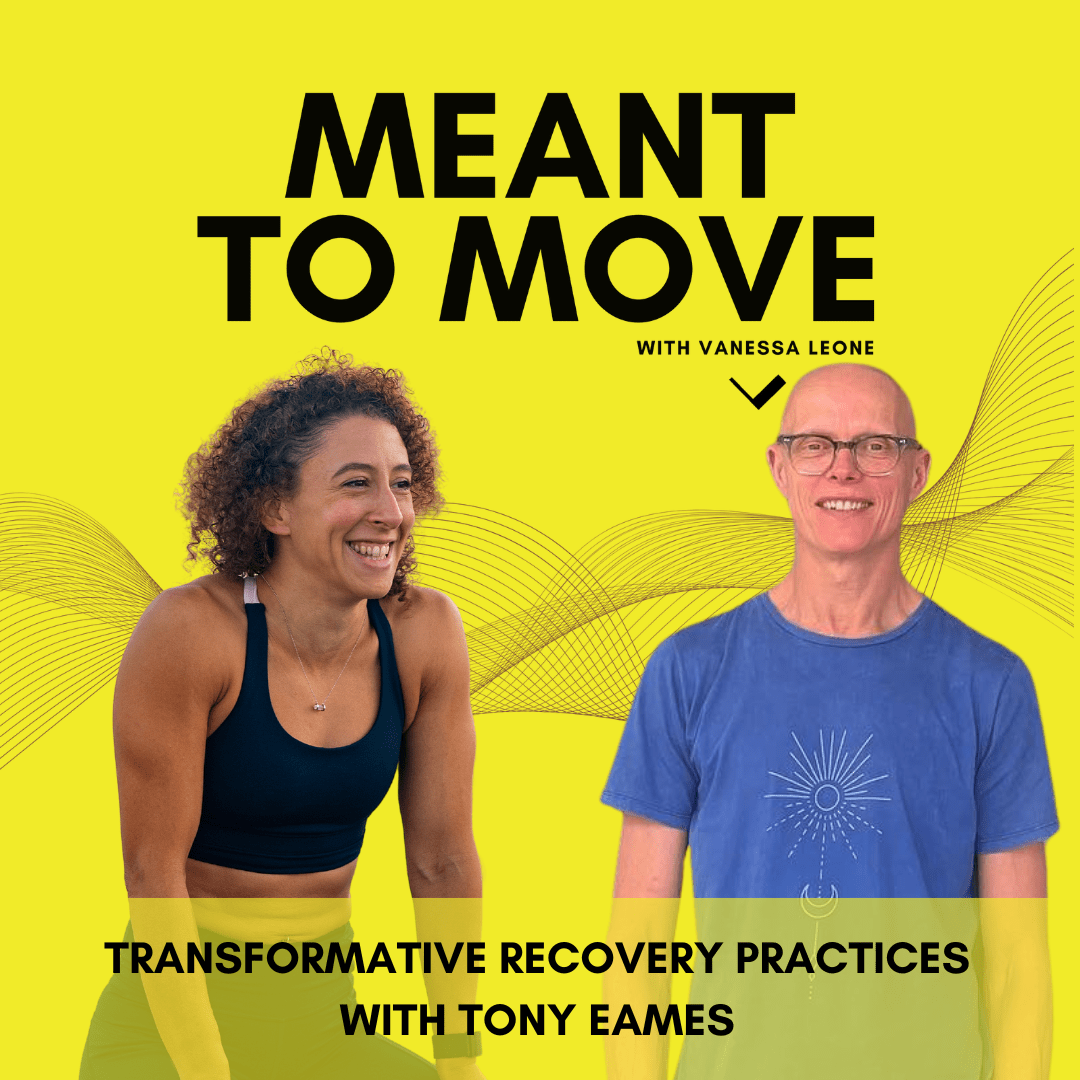
Meant to Move Episode #23
Summary:
In this engaging conversation, Vanessa Leone speaks with Tony Eames, the owner of Calm Bar, about his journey from a corporate career to the wellness industry. They explore the importance of recovery practices such as breathwork, saunas, and ice baths, discussing their transformative effects on mental and physical health. Tony shares his personal experiences and insights on how to approach these wellness practices, emphasizing the need for balance and listening to one’s body. The conversation highlights the significance of community support in the wellness journey and encourages listeners to embrace their unique paths to health and well-being.
Transcript:
Vanessa Leone (00:02)
And with me today, have, I’m going to call him a friend now. I’ve decided you’re stuck with me now. You’re going to see me at Calmbar all the time. I have Tony with me from Calmbar. Tony, welcome to Meant to Move. Really nice to have you today.
Tony Eames (00:17)
Yeah, thanks Vanessa, great to be here. And yeah, it’s been great getting to know you over the last couple of months as you’ve sort of visited us for various reasons.
Vanessa Leone (00:26)
Yeah, sorry for the listener. I have just started trying to be a little bit more diligent with my recovery in, in terms of like external recovery, making time for myself to go to the sauna and give myself that time to just do nothing for an hour, which if you know me personally, you know that that’s not the easiest thing for me to do for myself. So having a physical space.
You know, like a Calmbar or a recovery centre, we know that it’s getting super popular. And Tony is the owner of where I like to go, which is great because it’s just down the road from me. And he has an excellent and unique story about how he kind of got into this space. So I think maybe let’s lead with that, Tony. Could you tell us a little bit about your background and why did you decide to open up a recovery centre?
Tony Eames (01:22)
Yeah, thanks Vanessa. So I guess the story goes back probably five or six years now. was, you know, I was working in the corporate job, working on major projects for government, so very big complex environments. And I was always interested in health and wellness. And, you know, certainly five or six years ago, there were not any places like Calmbar that existed. So there weren’t places you could, well, there were a few that you could go for a sauna. There was…
probably not any that you could go for a nice bath. Certainly breath work, whilst it’s been around for thousands of years, was not really part of the sort of popular wellness culture. So I really got into it out of personal interest. So going back to 2020, I think everybody remembers the first Sydney lockdown.
You know, we’re all pretty much locked at home with not much to do apart from work and we’ll have the kids and try and maintain our relationships and so on. So I got into, I guess, know, searching for things on YouTube, like many people do. And like a lot of people, I discovered Wim Hof. So if you don’t know Wim Hof, he’s the Dutch ice man. I guess you could really say that he’s made breathwork and cold plunging very popular.
across the world and I think in some ways I guess he’s a bit of a bit of a superstar of that world. So I started to look at what Wim Hof was doing and I tried some of the breathwork practices and I thought, geez, you know, this is actually pretty amazing. And it was the middle of winter as well. So I think it was March, April, May, June sort of time. And then I started doing the cold showers and I actually feel pretty good doing this. So really, I just continued doing that for a few months and just started to explore it.
And then when we came out of lockdown, I started to meet up with other people who had an interest in these things. So, you know, one of the kind of leading people, I guess, in the breathwork, you know, sector in Australia is Johannes Egbert from Breathless Expeditions. So Johannes was running a sort of half day breathwork and I think it was a breakthrough breathwork session or an exploratory type session.
along with ice baths and I went to that up in Brookvale or Manly or somewhere and like great community, really beautiful experience and I thought, geez, I need to do more of this. And really I just sort of continued to roll with that for probably, you know, maybe a year or two, went to some more events, did some different styles of breath work, did a lot more kind of at home and, you know, just learning from people online.
And then of course, we were pretty much into the second lockdown. So it was really during that period where things got very difficult for me, I guess, from a work perspective, also from a family situation perspective with kids at home. And I had some struggles with, I guess, parents in the UK being sick. So it was, you know, a difficult time. And what I found was that really sort of coming back to the breath was really helpful. You know, so things were kind of
definitely edging up in terms of the stress situation, coming back to the breath every time that I could. There wasn’t really an opportunity to do much cold exposure apart from cold showers, but I did make it down to the service station a few times and try to stack the back full of ice and for limited success with that, but it was part of what I was trying to do. I was also exercising quite a lot of the time, which was good. So running, going to the gym if I could.
And I really started to think about, I guess, those recovery elements. Excuse me. What happened next was that I went to a again, an expedition with Breathless and it was a men’s retreat down in the snowy mountains. So that was about four days, I think, three or four days, which was, yeah, it was pretty full on. But we did lots of really big, powerful breathwork sessions.
lots of kind of crazy stuff where you know sort of jump in rivers and you don’t get given a towel, you don’t take your towel with you and just kind of you have to deal with whatever’s presented in front of you. And I’d always, I’d kind of probably for three or four months before that I had this idea of creating a space in West Sydney. I didn’t really know what it was going to kind of look and feel like but then when I went away and I did the men’s retreat I came back and I went yeah okay this is what I’m going to do.
So I then you know, did a bit of thinking about it, did some planning, kept working on my own skills. So I did the level one training in breath work and then I did the master’s training sort of mid last year. And really in the meantime, I just started to get the plans in place to open the space. I decided,
I suppose, maybe just because of how I am not to go half in and not try and do, you know, a few little events. You know, went full head, I leased the space.
decided that this is what I was going to do and then probably spent the best part of six months making it happen. So as well as Leasing Space, you’ve got to kind of work out what your product is, your website built, find a team of people, work out at least some basic marketing strategies, which I didn’t do very well, admittedly. I was really focused on just getting open and starting to.
I guess, deliver the services which I’d fallen in love with, which were essentially really the core of what we do today, which is the breath work, the saunas and the asphalts. And really, I think it’s still quite a unique mix in Sydney. There’s a lot of places that have sprung up since, which do, you know, certain elements of, you know, what we do, but.
Yeah, I still think we have this kind of unique experience and this unique offering which keeps developing all the time as well.
Vanessa Leone (07:24)
That’s great. I love how quickly people, when they start to experience breathwork and either cold plunging or sauna, how transformative, how quickly it can be for people. And I think that your testament to that in terms of like, you know, it took you a couple of years, but that like in the whole context of your life, it’s not that long.
when you think about it, right? It’s pretty incredible. And now you’ve chosen to kind of go down this pathway to help other people recognize that their mental health and their physical health is inextricably linked and that there’s things that you can do to benefit both at the same time. And I think that’s such a wonderful space to be in.
Tony Eames (08:16)
Hmm. Yeah, look, it’s super exciting. And, you know, it makes me very kind of energized when I think about, you know, all the things that we could be doing. And I would say though, Vanessa, that, you know, I sort of think a lot about kind of, you know, I guess the overall picture of health and wellness and, you know, you’d be right across this. And I’m sure many of your guests and, you know, the watchers, you know, often it’s about getting the foundations right first though.
So, you know, obviously sleep, nutrition, movement, and so on. I think what we do is in addition to getting those fundamentals right. So it’s not, you know, it’s not the immediate intervention that’s going to solve everything. But, you know, equally, I think that from personal experience as well, what I’ve seen is that you can do a session and that might be, you know, breath work or it might be sauna and it might be a nice bath or any combination of those things.
and it can make a very immediate difference to how you’re feeling that day and you know for some time afterwards as well, and then obviously you know as you start to bring it into your practice you know it adds to whatever you’re doing. So you know it’s not what it’s not that one thing is absolutely the answer but it’s part of the overall I guess picture.
Vanessa Leone (09:26)
Mm. For sure. I think that’s a great summary of that. I have this theory with people that exercise is often called either a keystone habit or it’s like a momentum builder. And the reason why exercise does that is because, you know, if you’re putting all this time and effort into exercising, then you kind of want to do other things in your life too.
to compliment that, otherwise you feel like you’re not quite wasting your time, but you’re not maximising what you’re doing. And I think that for everybody, that kind of momentum changing habit is a little different, or that momentum changing experience is a little different. And that’s why, yes, I agree that they’re secondary kind of things that you can be doing, but for someone…
And I was having this conversation the other day with a client and actually some guests over from the podcast is a lot of people at the moment who are so stressed, their life is so chaotic, everything happens. They may not necessarily need to work out. They need to work inwards, need to come back to their body. They need to take some stillness, take some calmness and
And that can become the habit that creates momentum towards a life change as well. And so I think I wanted to highlight that because anything in this health and wellness arena that gives you a positive physical and mental benefit, I think has the potential to be transformative. And that’s what makes it transformative in my opinion.
Tony Eames (10:55)
Yeah, yeah, agree. I mean, you’ve got to create that space and the ability to exercise as well, right, for some people. And as you’ve said, like it might not be, I don’t know, doing CrossFit six days a week might not be the best solution if you’re already highly stressed. I mean, I’ve been there and I’ve done that, you know, at different stages of my life, I think, oh geez, the first time was about 15 years ago and the last time was about five years ago. But because I was already working a lot and doing a lot,
I felt even more burnt out by doing that. So I think it’s about trying to find that balance
e as well and sort of recognizing where you’re at as an individual. Sometimes you need some help with that too, which is where your expertise, for example, might come in. But I think I see what we offer as very complimentary as well. So what I do personally now is I might train one day and the next day I’ll just do something very light. I’ll kind of go for a walk.
maybe a light jog, do a sauna, do a nice bath, and then I’m kind of ready to train again the next day. but, you know, recognizing that it’s different for everybody as well.
Vanessa Leone (12:23)
No, that’s great. That’s great. I would like to dive a little bit deeper into these modalities because I think we were mentioning this as we were chatting that we can get really sciencey sometimes about these modalities of recovery or whatever they are. And I, I love perspective, I love to hear what everybody and lots of different people have to think about them. So when we talk about sauna,
Tony Eames (12:27)
Yes, correct, yeah.
Vanessa Leone (12:52)
You have infrared.
What’s happening? What are we doing in a sauna?
Tony Eames (12:57)
Hmm. Hmm. Well, really from a kind of non-science perspective, it’s just the opportunity to relax. You know, which I think it’s kind of hard for people to do these days. Obviously, you’ve got the benefits of the heat, which help with that. So slowing down. You know, really, I guess the, you know, the opportunity to… So for example, when I’m in the sauna, I…
don’t watch anything on my phone. I sometimes listen to something, but it’s usually something kind of very calming and relaxing. I often do breath work when I’m in the sauna. So I have, you know, a particular sequence of breath work, which I’ll just work through on the day. And that’s how I’ll spend the 30 minutes while I’m in there. It’s particularly good, I would say, if you’re feeling quite depleted.
and exhausted because we do have a lot of people that come in and they’ve had a busy day or a busy week. And it’s really just that kind of quick reset that really does work. So yeah, from a non-science perspective, I guess that would be my kind of quick take on it. And then I guess, know, sort of delving into the science, know, heat is very, very good for you. As I mentioned, the benefits of detoxification, relaxation and so on.
There’s the more scientific elements such as the creation of the heat shock proteins and really what it’s doing to your body during that short session. But it’s very powerful even in a 20 or 30 minute session, find.
Vanessa Leone (14:40)
Mm hmm. Yeah. And just to touch on on kind of that, that heat shock, essentially for me, and this is really interesting, I, I’m a little bit metric heavy. love like having a little metric and seeing what’s going on, but also listening and feeling to my body. Because when I’m in the sauna, I feel like all my muscles just start to relax, but it takes me a while because you got, I go in.
And sometimes my mind is so busy and it takes a while to just sit. And so for me, my experience in the sauna is I have to either listen to something or I’ll read a book initially because I can kind of then close that busy mind off. I’m focusing on something at least that’s not work or whatever else it might be.
Tony Eames (15:11)
Yeah. Yep, yep.
So you’re not checking your emails. No, yep, yep.
Vanessa Leone (15:35)
not checking my emails. The other benefit of infrared, when you have the sauna really hot, your devices hate it. They get all overheated. So that’s a good benefit. But aside from that, so I leave the phone outside of the sauna and after about 20 minutes, that’s when I can feel myself like fully come back into my body and start to really notice what’s happening and what’s going on.
That’s kind of the more relaxing stage. And by the last kind of 10, 15 minutes in the sauna, that’s when I’m doing, like, I’ll do some lymphatic work. So I’ll like rub my skin vigorously. And once you’ve been in the sauna, yeah, that long, essentially, just feel that layer of dead skin just come off. It’s like magical for your skin.
So that’s, that’s super great. And, and then I’m focusing on the breath in those last kind of few minutes, because that’s when I feel like I can be really present. And like you said, I think most people struggle, myself included, to sit still, like just to, just to actually sit regardless of the heat shock protein and the resilience building and all of that kind of stuff that you get from being in an infrared or being in a hot sauna.
And then, and then if you go with friends, then you get the whole like social element as well, which is, which is great. But if you’re just doing it by yourself, I think it’s a completely different experience. is a completely different experience and learning to sit.
is a skill we just don’t really have anymore. And it takes me a lot of practice as well. I find it really hard to do at home. It’s very easy for me to get distracted. But if I go to the sauna, okay, I can do it now.
Tony Eames (17:12)
Hmm. Hmm.
Yeah, yeah, that’s right. You can just have a short space of time, right? Yeah. And it’s really kind of interesting what people do in there. I I often, it’s probably not, I don’t know, if you speak to the purists, it’s probably not recommended, but I often lie down and I just, you know, do some breath with a client down, which is really nice, just to sort of five breaths in, five breaths out, something really simple.
And I have been known to have, I suppose you’d sort of call it micro sleep in the sauna, which is really interesting actually, because you can kind of just nod off for maybe five or 10 minutes. And know when you sort of go in and out, you sort of get a bit twitchy, and then you wake up. But it’s sort of like you’ve had maybe like, I don’t know, a two hour sleep. It feels like that. So it’s really interesting. I still need to sort of delve into this a bit more. And then, of course, when you combine it with the ice bath.
you get that sort of immediate surge of energy. you know, even for example, yesterday I had a pretty long day with various things on, but I was lucky enough to be able to carve out an hour in the afternoon to have a sauna and ice bath. And then, you know, was a long evening as well of doing breath work with the class. But yeah, I felt like so, so much better afterwards.
So it’s really interesting, we have, we’ve had a lot of people. come through as clients. And it’s even noticeable by speaking to them and looking at them pre and post session, just how different they are. know, most some people are super nervous when they come in, because you know, ice packs can be challenging. But I would say that 98 % of people come out with a big smile on their face going that that just felt incredible. So
You know, it’s really good that you can have such a short sort of intervention if you like, and it can make such a difference.
Vanessa Leone (19:20)
Yes. Okay, let’s… I’m pouring myself more tea. So this is very important. It’s very… I feel very cold, so more tea is necessary, everybody.
Tony Eames (19:23)
Yeah, good. Yeah.
Yes, cold in Sydney today.
Vanessa Leone (19:31)
Let’s talk about ice bath. Everybody has an opinion about an ice bath. honestly, and I think it’s just that it’s okay for you to have your opinion about ice bath, but I still actually think that it’s really important for people to experience something. And what kind of annoys me sometimes is when people haven’t experienced something, who have a very strong visceral opinion about it. It’s like, okay, maybe try it first before you, before you
say anything about what the experience is. But you talked about doing ice baths as an entry to kind of this space. What, with your first ice bath, what happened? Like what was it for you that really stuck with you?
Tony Eames (20:03)
So the first one was very different to the second one. The first one was in a, you know, I guess one of the portable ice baths. It was cold, but it was a two minute, you know, quick in and out with people around you sort of, you know, supporting you and sort of cheering you on. I think for me kind of 20 questions, it was getting over that initial fear, because most people I would say have some fear of cold water.
And, you know, it’s a natural response, I guess, in many ways. So getting over the fear and going, geez, you know, I actually just did that. And then the next time I did it was very different. It was in the snowy mountains and it was in a, you know, a river coming off the mountain. And that was much more extreme. So that was basically 10 minutes in the cold flowing water with the wind, but with 20 other people and the sort of the kind of
The premise was that you just didn’t get out, otherwise the clock started again. So, nobody got out. So look, that’s probably on the other extreme. What would I tell people when they come in to Calmbar is that, look, you’ve kind of got a choice in this. As you said, Vanessa, it’s really important, I think, to, even if you’re skeptical, just try it.
I’ve had lots of people come in and say, look, I’ve heard this or I don’t believe this. And I said, well, just try it for yourself. And then you decide. And if you feel you get some benefit out of it, and it’s a good thing. And provided it’s not negatively impacting your physiology in any way, and keep doing it. If you don’t, then find something else to do. It’s quite simple. But I agree with you. There is a lot of of conflicting.
I guess, particularly social media about ice baths at the moment. But do your own research, look at where you’re at as an individual, and really tailor the session to what you think you might need. So even for myself at the moment, a lot of people say to me, how many times do you do it? And then how long do you stay in for? And I think there’s this assumption because I’m the owner of the business.
that I do every day and I do a nice bath of 10 minutes. Well, that’s not what I do. I try to recognize where I’m at. And at the moment, I’m doing much shorter sessions. But I might get in for 30 seconds or a minute or maybe two minutes. And I’ll get out and I’ll re-evaluate. And then I’ll get back in. So I’ve got a couple of sort of minor health issues in the background just at the moment. And talking to my acupuncturist.
who is also a client, so he was a client of Calmbar first. He said, look, maybe the ice baths in, maybe just moderate what you’re doing at the moment personally, and look for kind of, you know, it’s not probably the right term, but kind of the minimum effective dose to get what you want to get from it. So I’m certainly not kind of saying to people when you get here, this is an endurance test and you have to be in the ice bath for 10 minutes, you know.
It’s just a different sort of environment when you’re in the city and I think where we come from and it’s the same with our breath work. It’s not about pushing people to the limits, it’s about sort of giving them the invitation to push themselves a bit but ultimately they’re kind of in control of you know what they do.
Vanessa Leone (23:51)
Because I think personally that the main benefit that I have seen in clients and I noticed for myself was that sense of achievement, that sense of I can stick through this, that I can do something that’s hard, that’s uncomfortable, and it makes me feel invigorated. The cold makes you feel invigorated, number one, but that sense of I can do this,
is a huge part of that invigoration is a huge part of that resilience piece. And in, in times in your life where things feel hard of stuff that you don’t have control over, having something that you do have control over, where you can push that a little bit, I can understand why people then really start to get carried away with it as a modality because, because they feel like they’re in control of it and they have this element where they’re able to then
drive and push further and further and further. And like you said, you can do it for 10 minutes if you want to, everybody’s different. Everybody’s stage of life is different. Their mental health is different. Their gender, all of that kind of stuff is going to have a huge effect. And I just, I’m so for trying everything once at least, or a couple of times. Cause I think, like you said, the first time you try something, is that really what it feels like kind of thing?
Tony Eames (25:04)
Yeah, yeah, that’s right.
Vanessa Leone (25:26)
And I love your approach with it because I think for most people, they get into an ice bath, but the first thing that they do is they stop breathing. And, that’s like the worst thing that you could do really.
Tony Eames (25:36)
Yeah, yeah, that’s right. Well, you know, having sort of coached a lot of people through their first session, it’s really interesting because I always say to them, don’t judge the first time by the next time that you might come either, because it’s very much a learning curve when you first do an ice bath. So you’re quite right. Most people, kind of
instant and natural reaction is to get in and pretty much freeze or just start to hyperventilate. So they just start breathing very, very quickly. And I explained all this to them. And I said, look, this is what’s likely to happen. Not in every case. Some people just, you know, they kind of breeze through their first session, but it’s more the kind of minority, I would say. So then we give them a bit of guidance on what to do with their breath. And it’s this really interesting sort of interplay of, you sort of
I guess your body is telling you one thing and your mind is sort of playing into that, but you’ve sort of got to work with it and then just really try and calm the breathing. Because of course the sympathetic nervous system is activating at that point. So it’s a really interesting process just to experience once.
And then the next time it’s almost like you’ve learned through that experience. So how would you do it differently? So the analogy I sometimes use with people is that if you’ve never run before and you run a kilometre at sprints, it’s going to be pretty horrible, right?
No, that’s right. Yeah, that’s right. Well, if you haven’t trained, and then the next time you do it, you know, you’ve got a bit more kind of experience about, well, okay, you know, that’s how it felt last time, maybe I should slow down, you know, so you just, you know, you work with, you work with the experience from the first time the next time. And the other thing I’d say as well is it’s often not the same when you come in from time to time.
Vanessa Leone (27:20)
Not a fun time. Even if you’re trained, it’s not a fun time.
Tony Eames (27:49)
So we get people coming in and look, people get very obsessed by time with ice baths. The question that I get asked the most is how long should I spend in the ice bath? I say to nearly everybody, well, I don’t know. And they go, you don’t know. And say, well, it sort of depends on you. Depends on your level of exposure previously. It depends on how you are today. It depends, I suppose, yeah, how you actually are once you’re in the ice bath. Because obviously, if you’re having kind of, you know,
extremes. One is you sort of having a panic attack which doesn’t really happen or two you feel completely zen then you would probably stay in for a different amount of time. So yeah it’s interesting that people are very obsessed by time in general. For me I rarely in fact know I don’t time my ice baths ever now because I just go for the experience and I go okay how am I feeling is that enough today? Yeah that’s enough.
And it might be a minute, it might be two minutes, it might be five minutes. But trying to move people away from kind of the obsessive culture of, you know, time is everything and everything has to be mentioned, measured, sorry.
Vanessa Leone (28:58)
Tony, that’s like telling a runner not to use their Strava when they go for a run. Are you crazy? All the runners were listening and were like, what?
Tony Eames (29:01)
I know, yeah, that’s crazy, I can’t measure it, it didn’t happen, right? You can’t measure it.
Vanessa Leone (29:13)
So I agree with you. I like that. I try to give myself a bit of a guideline. I tend to go mostly sauna at the moment. I don’t think my body needs the stress of ice bath just at this stage. Correct. I’m an already very stimulated person. I definitely need a little bit less stimulation in my life. And so
Tony Eames (29:18)
Yeah, the extra stimulation,
Vanessa Leone (29:42)
For me, I find myself trying to time how long I can withstand the heat, you know? And even that in itself has, because when we get into these head spaces, we get really competitive with ourselves. And obviously we want to see that we’re getting better or whatever. And the most recent sauna that I did, I must’ve maybe been fighting a bit of a cold or whatever, but I struggled. Like I absolutely struggled in the heat that time. And
And you don’t know what’s happening to you on the inside nine times out of 10. Like you might feel a couple of things, but you don’t know what’s exactly going on. And something like sauna and ice bath will tell you very quickly if what you’re doing is appropriate for you that day. And, and either one is still a stress, which is what I don’t think that people realize is that yes, the sauna can feel relaxing, but it’s still a stress on your system because of the heat. And so if you’re, again, if you’re
really stressed or if you’re sick or all of the above, that’s, that might feel like too much for you that day. And, and it takes me a day to recover from it, from an intense sauna session as well.
Tony Eames (30:47)
Yeah, I would agree with that, you know, it of goes back to kind of working out what’s right for you on the day as well. So, you know, there’s lots of different protocols, but it’s kind of sensing, I guess, rather than having a prescribed sort of, you know, whatever you do. You know, the stress part of it, yes, I would agree, Vanessa. I think that the kind of
point as well though is that you’ve got some control over that stress, right? So, you know, which, which means that you can actually build on it and it helps to build your resilience. You know, it’s a bit like doing bicep curls or something. So yeah, you’re going to do 10 of those, it’s going to stress the muscle, but you you’re building something over the longer term.
Vanessa Leone (31:25)
For sure.
Yeah. Stress is not a dirty word. Stress, stress, we wouldn’t be very useful humans if we didn’t have stress in our lives. It’s just that we now associate that word with a very negative connotation, but stress is growth.
Tony Eames (31:44)
Yes, yeah, absolutely. Yeah. Yeah, yeah.
Vanessa Leone (31:59)
unless it’s too much. And then it’s the opposite of growth, right? So, and it’s all about just trying to figure out where you can as much as you can, the things that take away or add to the type of stress growth that you want to have. And that’s where everybody I think is looking for a prescription from yourself, from myself. How many times a week should I exercise? How many times a week should I sauna? How long should I be in the sauna?
And I love that you’re not giving them an answer. Do you know what I mean? The solution, nine times out of 10, and Odi and I will say this all the time, is the solution is you have to figure it out. it’s diff- it’s different. It’s context.
Tony Eames (32:33)
That’s right. mean, you we do give people some guidance if they really want it. So, you know, because that stops them doing something which is probably not very sensible. So, you know, if we didn’t say, look, what I say to people is maybe start with one to two minutes, right, which is it’s a bit of a range. It’s not too extreme. They haven’t done it before. You know, that would be kind of the guidance because, yeah, you know,
It is quite a strong experience doing particularly the contrast therapy and you know, but we’re kind of lucky and unique that we’ve got everything, you know, contained within the same room. So people can move between the two pretty easily. But I say to people just particularly start slow, you know, you’ve never done this before. So be prepared, you know, because, you know, it is a strong experience. Don’t get too, don’t go too hot or too long in the sauna.
and have a lukewarm shower to help you transition into the ice bath. And with the ice bath, do a short one and then gauge where you’re at post, you know, 30 seconds or a minute or two.
Well, we want people to come back and to get some value out of the session, you know, not to be so terrified or exhausted or any of these things. It doesn’t become… Yeah, we want them to keep benefiting, I guess.
Vanessa Leone (34:01)
100%, 100%. And you want them to come back because you understand the value of what it can bring them. That’s really what’s key with a lot of the practitioners, whatever practitioner you are that you work with, that I work with. We want you to come back because we know, like for yourself, that was transformative for you. So you want to bring that experience to other people. And I think that that’s in the nature of a lot of
a lot of people in the health field. And I love that. I love hearing that part of it. I think it’s really cool. Thank you. Now, I’ve talked about Breathwork before with Emma. Emma is also a practitioner of the same school of you. It was completely unplanned by the way, that people listening. Just, that’s just the universe as Emma would say.
putting it together. So again, Emma gave her definition of breathwork. What is breathwork for you? Like what is your practice like? What is it? What is it? What has it done for you?
Tony Eames (35:27)
So breath work is, I guess, very broad in terms of, you know, sort of the left side to the right side. I guess on the, you know, on one side, it doesn’t matter where it’s left or right, to be honest, but it could be, you know, the sort of more clinical applications and really learning, I guess, you know, to breathe those people that have difficulty breathing. And then I suppose on the other side, you’ve got the more transformative
Type of breathwork. for example, holotropic breathwork, is often used in a psychology type setting. And then there’s sort of all the stuff in the middle. So, I would say for me personally, I’m a bit more in the middle. And what we do with the sessions that we do, we do different styles of sessions with, you know, sort of individuals and with groups. It keeps evolving, I guess, what we do and what we offer.
And even within the session, sometimes they can change because I did a session with a couple of people last night and it started off as, you know, a focus on one thing. And then because of the way the session evolved, it changed into something slightly different. But that was really through me connecting with them at a sort of a very personal level as well. So it’s not like with the breath work that we do, it’s not again, it’s a bit like our approach with ice baths.
and with saunas, it’s not prescribed and that, you must do this to get this. There’s some guidance, there’s some choice. You know, the person who’s participating in the session is always in control. So for me personally, I guess I take that into my own practice. I was asked last night whether I do a specific type of breath work every single day.
And I said, well, you I do breathe every day, you know, and like many of us, like that sort of what keeps us alive. But I don’t get up every single morning and do, you know, type A or type B or type C. And it’s the same in the evening. I’m very much about, well, a few things. How do I, how do I feel today? What do I think I need? And because I’ve done the training and I’ve explored it a lot on my own, I’ve got quite a good toolkit to draw upon.
And then also it’s, you know, it’s like being very practical about it. It’s well, what have I got going on in my life today? You know, and like for everybody, you know, how long do I have? What needs to happen? the, you know, the kids need something and, you know, does the dog need walking or whatever it might be. So, so I sort of change it depending on the day. But I would say that I do something every morning. So that could be
I often combine it with movement, example. So I might do some Qigong. That’s been very interesting and quite transformative over the last probably six months. And it’s very time efficient as well because it combines, which is sometimes handy. It is because it combines the movement and then it combines the breath and then it combines, I guess, some elements of meditation.
Vanessa Leone (38:38)
Yeah, it is.
Tony Eames (38:48)
So I might do that some mornings, other mornings I might get up and go, you know what, I feel great today, but I’d like just a bit more energy. So I do might do something a bit more like a Wim Hof style breathing. Other days I might be completely the other end of the spectrum. So I might get up and you know what, I can’t really, let’s say I get up super early and I’ve been working late, whatever it might be. I might just get the yoga mat out, lie down and do something more like a yoga nidra.
or a NSDR, guess some people now call it, but that will just be very sort of gentle breathing, just body sensing, body awareness. Or I might combine a couple of those elements if I’ve got a bit more time. So I might, yeah, or do some mindfulness exercises. So I don’t, to be honest, Vanessa, I don’t have like a particularly kind of rigid practice, but I will do something every morning, I would say.
I might try and do a very short thing during the day, depending again on what I think I need. And then in the evening, quite often if I try to do deep relaxation breath work and I’m not in bed, I’ll just fall asleep, which is not great, because then I’ll go get to bed. So more often than not, I will go to bed and pretty much, well, the last thing I’ll do is do some deep relaxation breath work in bed, because then I don’t have to get up and…
go anyway, that’s it. So yeah, and it’s really good because, you know, when you’ve got some tools to draw upon, and most of them are not particularly complicated, to be honest, in fact, none of them are complicated. You can sort of do this thing that, you know, I’ve heard it referred to as breath play, where you just combine different things. And I do that particularly at night, I might go, okay, well, I’ll do a long exhale, or I’ll do a couple of short breaths, I might do a little breath hold. So there’s, you know, it’s sort of like, I don’t know, it’s a bit like a Rubik’s Cube. There’s, you know, a thousand different combinations of what you can do.
Vanessa Leone (40:49)
Very cool. I really like that at the end there. That’s a very nice visual explanation because I think, and this is where I love the parallels that we draw across the different spectrums of health and wellness is because I feel the same thing about exercise. Everyone’s like, give me the prescription, give me the, this is system A and system B and it’s got to be done this way or whatever it is. And I’m like, does it really have to be done a specific way?
what’s wrong with play, what’s wrong with the guesswork, what’s wrong with exactly. And I think a lot of people, like I would call myself a perfectionist. I’m definitely a less intense perfectionist than I used to be. But we have this fear that if we start something like breathwork, that we fail somehow.
Tony Eames (41:23)
Yeah.
Yeah, experimentation.
Vanessa Leone (41:47)
you know what I mean? But that failure is only happening in your head. It’s not experienced anywhere else. There’s actually no failure. I have this very, like, know, like Yoda, there is no try, you just do. Like, just do. Just do it. And I think that we’ve put so much pressure on ourselves. Like, we hear all of these things about
Tony Eames (41:51)
Yeah, Yeah, yeah, yeah.
Yeah, yeah, 100%. Yeah, yeah, yeah.
Vanessa Leone (42:17)
I’ve got to do X amount of exercise. I’ve got to do this breath work. I’ve got to do that ice bath. It’s like, you don’t have to actually do anything. And what’s really beneficial is just if you do something at the end of the day. And like you said, you need to be time efficient. You’re a dad. You’ve got kids, you own a business. You don’t have time to sit down for an hour to do a…
a breath work every day potentially. And that’s great because you understand there’s also a sense of realism about the type of practice that you need to do. And that is so important because we also invent barriers in our mind to beginning these kinds of practices. It’s like, I’ll start that when I’m less busy. No, you start it when you’re busy. Start it when you’re really busy. Exactly. Yeah. Like just do it now because
Tony Eames (42:44)
Yeah, yeah, absolutely.
Mm. Mm. Mm. Mm. That’s right.
Yeah, yeah. Yeah, that’s right. There’s never a perfect time, right? Yeah, yeah. Yeah.
Vanessa Leone (43:11)
This is the time if you, if you can put it in now when you’re really busy and you, even if you just do a minute, if you even just do 30 seconds, that’s 30 seconds more than you did last week. That’s a, that’s a win. That’s not a failure because you didn’t do two minutes. That’s a win. And it’s all about how you, you reframe that. And I, I, I say this because I’m going to watch myself back when we edit, when I edit this.
Tony Eames (43:17)
Yeah, that’s right. That’s Yeah. Yeah. Yeah. Yeah.
Mmm,
Vanessa Leone (43:38)
And I’m going to try to listen to my own advice because I can be really bad at this as well. And breath work particularly, I think, is confronting because we have to sit with ourself.
Tony Eames (43:55)
Yeah. Yeah, look, I would say yes, but it’s not as confronting as trying to meditate for a lot of people. you know, meditation is, mean, breathwork, there’s an element of doing something involved. And, you know, meditation, you know, I mean,
Vanessa Leone (43:56)
And that’s hard.
Yes, true.
Tony Eames (44:21)
literally you are not doing anything and you know I would love to meditate more. I find it quite challenging and I think a lot of people do. But you know I’m just following my own advice and your advice here Vanessa and I try to do a little bit every day. I do find that honestly if I do some breath work and then I meditate it becomes much easier just because I’ve had that sort of
you know, the stimulation of some description and it allows my mind to settle. So I’ve got that kind of, yeah, I’ve done something and then it’s not dissimilar to you in the sauna actually now we think about it. So you know, you do something which is sort of like that bridge into finding that quiet space. So I think it’s very difficult to probably go from, you know, 100 % as in
know, capacity, overthinking, work, whatever it might be, to, you know, that really sort of relaxed sort of phase. So maybe, yeah, maybe we need we all need the transition and we need something to help get us there. You know, breath work is really good for that.
Vanessa Leone (45:25)
Yeah, no thoughts.
Excellent. I love that. And you were talking about Qigong and I talk about movement therapy. For people who don’t know what Qigong is or what, you know, what we’re describing, how is that? I’m going to call that movement therapy because it sounds like movement. How is that? What is that? And how has that helped you?
Tony Eames (45:42)
Yeah, look, I will declare here I’m certainly not the expert. So I’ve done, I’ve done a, I guess, a course with somebody who is an expert. And he’s great because he will only teach you a few things at a time. So it’s not, you know, it’s not a 12 week course. It’s not 50 different types of movements. It’s basically kind of four of the really kind of basic movements,
and the flows if you like, so I’m probably not even describing it well but and then it’s another four and that’s the complete set. So you work on those and then when you’ve really, when you’ve had time to absorb, not perfect, that’s not the right word, but when you’ve had enough experience of doing those and you start to gain some kind of connection with the breath through the movement.
and you start to feel your body and relax when you do it. that’s the, I think that’s the sort of, again, not the right word, that’s the skill in doing it. And when you can do those four and then the eight simple movements very fluidly and connected, then you’re ready for something else. Now, I don’t know what that something else is yet because
Yeah, I’m still kind of, you know, level one or level zero. I’m not sure. But it’s, yeah, it’s the mindset. And he said to me a few weeks ago, he said, if you can try and do it in water, then you’ll understand what the flow feels like. Now, I haven’t got around to doing that yet, but yeah, that’s right. But look, it’s…
Vanessa Leone (47:35)
That’s great.
That feels so nice to me.
Tony Eames (47:53)
you know, again, it’s sort of flowing movements, you sort of raise your arms up just for anybody that’s listening and you’ll often see people doing it in the park in the morning. You know, Qigong or Tai Chi, you know, they appear to me to look fairly similar, but it’s really sort of connecting your breath and your energy and your, movement of the body. A lot of it is, you know, I’m sure from a theoretical perspective around, you know, your
your energy or your chi or your prana in yoga, you know, because I am, yeah, look, I was gonna say I see that, but I don’t see it. I do feel it. Now I’ve become more aware of it.
Vanessa Leone (48:36)
That’s incredible, it’s great. again, parallels for my clients coming to see me who were super stressed, who were super intense. Those are the like three or four mobilizers that we start with. It’s like, what do we, what’s the exercise session look like? I’m like, that was it. That’s it. There’s nothing else. There’s no more. You go away and you do that, that you just learn four things.
When you can do four things well, and you can understand how that feels in your body, let’s do the next four things. And, and I think again, the same thing we just, we want, we want to go so fast. And I mean, I’ve, done Tai Chi a couple of times before and it’s beautiful. And I think I would appreciate it much more now.
Tony Eames (49:13)
Yeah, exactly.
Vanessa Leone (49:30)
in my headspace than when I did it when I was in my twenties, that’s for sure. But that’s the best parallel that I can kind of give it is that when I feel like I can’t do anything, I do some mobilizers, I connect with my breath and you just feel your body and you just, something happens. It’s it’s magic, you know?
Tony Eames (49:31)
Absolutely, yeah, look, I would fully agree with that. mean, and I’m still on that journey myself. So sensing into the body, I mean, so many of us live in our heads. I was talking to some of the breathwork clients last night. And I, you know, I’m very honest about this stuff, because I don’t have it all worked out, you know, I’m certainly not perfect, you know, got my own struggles and, you know, and so on.
But I use this sort of phrase and I haven’t said it before, but I used to feel like it was just, I just had a head that was walking around. And then, you know, a few months, years ago, went, geez, I do have this body. But then there’s the next level of really sort of starting to sense into that, you know, and now I think through the work that I’ve been doing for myself, I’m much more aware of what’s happening in my body.
And also, you know, what shows up when things are not right. Yeah, which is, yeah, really very interesting sometimes.
Vanessa Leone (51:05)
No, it’s fantastic. And I love your story, like I said, because I think it’s, we think that we need to be an expert before we can talk about something, but it’s just your experience. It’s just, that’s what’s important is getting and gaining people’s experience and letting that resonate. Sorry. Thank you. I wholeheartedly appreciate your time and coming to chat with me and my listeners today. Yeah, thank you and I’ll see you in sauna.
Tony Eames (51:34)
Thank you, Vanessa, Yeah. Yeah,
amazing. All right, we’ll see you soon. And thanks so much for the invitation today. OK.
Vanessa Leone (51:40)
No worries.
 Vanessa Leone Movement Therapist