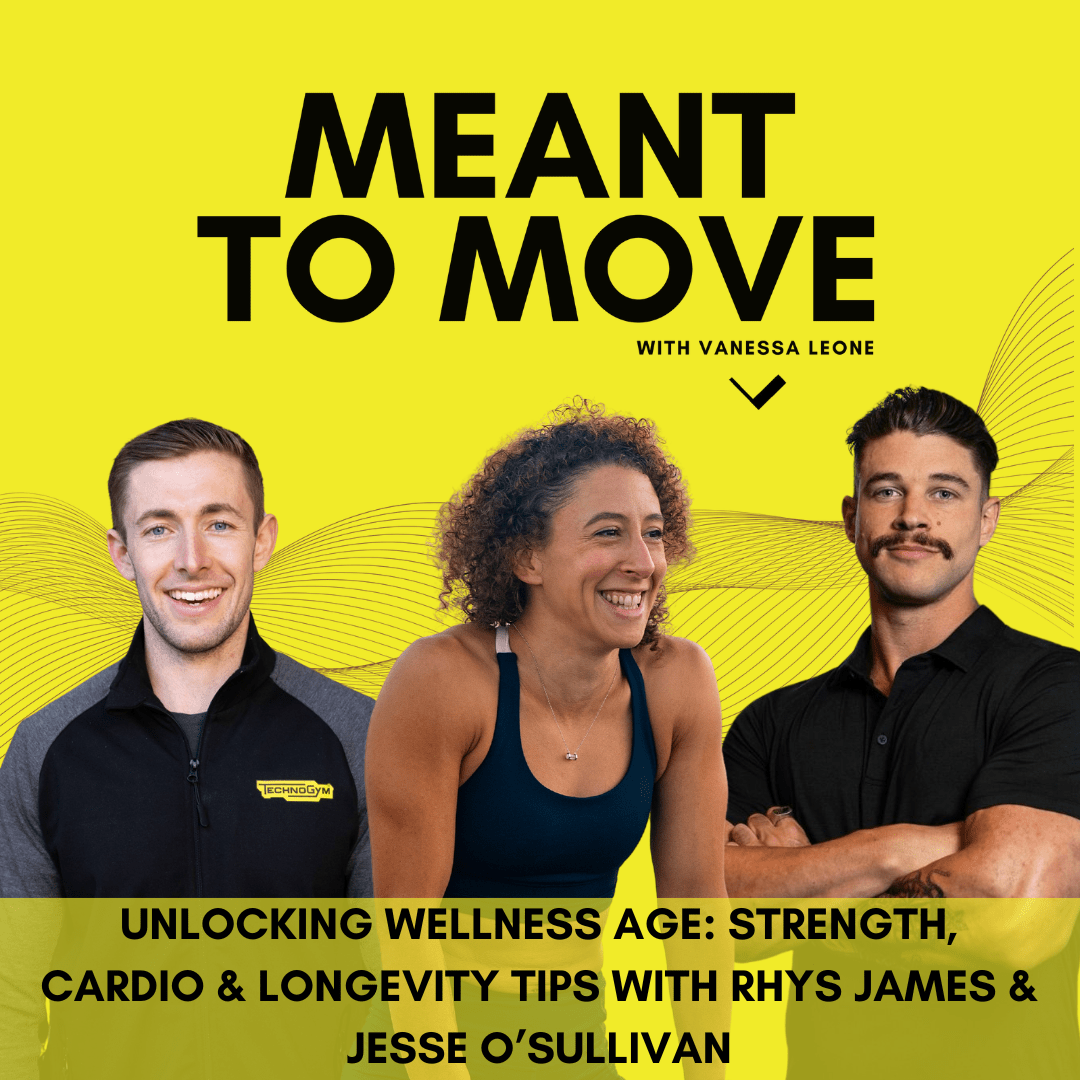
Meant to Move Episode #26
Summary:
In this podcast episode, Vanessa Leone, Rhys James, and Jesse O’Sullivan discuss various aspects of health and fitness, focusing on the importance of strength, cardio, and body composition. They introduce Techno Gym’s Checkup, a new innovation for measuring wellness age, which includes tests for strength, cardio, mobility, balance, and cognitive function. The conversation highlights the significance of maintaining a healthy lifestyle, understanding the metrics behind fitness tests, and the impact of factors like hydration and inflammation on overall health. The episode emphasizes the value of testing and tracking progress for improved health and longevity
Transcript
Vanessa Leone (00:01.229)
Hello, we’re back with Rhys and Jesse. Hey team, how are ya?
Jesse O’Sullivan (00:06.965)
Very good, how are you?
Vanessa Leone (00:09.015)
Pretty good Rhys.
Rhys James (00:10.485)
Yeah, awesome, thanks, Ness.
Vanessa Leone (00:12.345)
I am so glad to have you back on. These boys, I’m very lucky to work with these boys. And while I don’t get to see Jesse so often, it’s nice to see your face on here. Our first episode that we did together went really well. We talked about measurements, but it was pretty broad. We went through a lot and some of the discussion that we had, I think, really opened up,
some tangents and some rabbit holes. And today is the rabbit hole day. Today is the day where we can dive. And I know that Rhys is absolutely dying to answer this first question. Absolutely dying. Because last time we didn’t talk about a really cool new innovation from Techno Gym. It’s called Checkup, which is essentially a test machine.
It is the test machine, but I will let you talk about it and our conversation from here will stem, I think this would be a good starting point for all of our tangents. So Rhys, what are we talking about?
Rhys James (01:22.998)
Yeah, very excited to talk about a concept and a potential new measurement tool that we’ve created here at Technogym Gym called Wellness Age through the use of our new checkup. And yes, after the last podcast, Ness, was, yeah, I was kicking myself because I forgot to talk about it. And I genuinely do believe it’s quite a cool new way to track and monitor or at least help predict longevity.
more so around the health span as opposed to the lifespan area because yeah, there’s quite a comprehensive metric that you can use which is determined by different areas which underpin wellness, I guess.
Vanessa Leone (02:05.187)
Hmm. Couple of words in there. I’m going to shoot across to you, Jesse, quick fire. When you hear the word health span and lifespan, when we’re talking about measurements specifically, what comes up for you when you hear that?
Jesse O’Sullivan (02:23.435)
The way I would describe it would be how long you live, moving well, being happy, being able get through your activities of daily living with minimal discomfort, limitations. Because there’s a difference between living long and living healthy for a long time. It’s like the saying, you want to die young as late as possible.
Vanessa Leone (02:53.657)
I like that. Nice. It’s really interesting that we’re talking about this and we’re going to talk about these pillars that you mentioned that Checkip measures. I saw on SBS, because I’m an old person and I like watching SBS, that there is going to be over 60,000 Australians over the age of 80 still living and that number is just going to continue to spiral upwards as of this year.
What it’s done is it creates a huge amount of strain on people in between. So people living in their middle age have kids, maybe teenagers, but then they’re also caring for their parents, for these kind of older adults who we’re talking about here, and you’re talking about longevity, who may not necessarily be so healthy into this, you know, 80 year old range. So I think this is super, super relevant.
Now, before we go into the tests, if you guys had to sum up, you know, that was a really nice sum up by Jesse. What does that kind of, you know, older population, what does that mean for you guys? What do we want to watch out for as we get into that older age?
Rhys James (04:13.59)
Yeah, I jump in there. I heard this the other day actually when talking to a client and essentially when you, you’re getting older, you almost want to add your, add more life to your years, not years to your life. So there are some fundamental components to wellness age. And I think that applies definitely to those who are aging and those key ones, which we spoke briefly on last time was strength and cardio. So
Those are the two main elements in my opinion, which would underpin longevity because they have a lot of application beyond just moving well or even just feeling good in terms of the physiological elements. Strength and cardio definitely are some of key ones.
Vanessa Leone (05:00.697)
Okay, let’s rabbit hole. Let’s go. I’m ready. So what are the tests that we need to look out for? you know, got a couple of, we’re all in our thirties. I’m on the older end. won’t say no. We’ve got a couple on the younger end, if we’re, if we’re, if we’re at different stages of our life, do the, different tests of strength mean different things? Sorry. Let’s, let’s start with that.
Rhys James (05:04.844)
Okay.
Jesse O’Sullivan (05:31.337)
definitely say yes they definitely mean different things when you look at like you know for example with my coaching I work predominantly with blokes between the age of 25 and 50 and the tests that I would do for their strength would be vastly different if I was working with a bloke that was 70 and I guess that’s where the types of tests that we have kind of at our disposal is important to align with who you’re working with there’s no point
I mean, I think I was reading in a forum yesterday, this guy was complaining about he couldn’t leg press 500 kilos anymore. And he was worried about that. And I was like, why are you worried about leg pressing?
that much when there’s no practical application to it. There’s no functional benefit to a leg, a really heavy leg press, especially if it’s causing you pain and discomfort. So aligning the test to what they actually want to get out of life. Obviously, when I work with younger blokes, it’s like they want to get strong and they want to get, you know, muscular and masculine and all that kind of stuff. And yeah, that they kind of don’t mean style of training. Whereas someone who’s a little bit older,
Vanessa Leone (06:33.699)
Hit the PBs, hit the PRs, right?
Jesse O’Sullivan (06:41.235)
is just going to want functionality, like pure functionality. So, you know, for example, a leg press wouldn’t be the best assessment for, well, it could be a good assessment, but it’s not the best. There’s definitely some better ones for older individuals.
Vanessa Leone (06:52.963)
That’s really cool. So, guy doing 500kg leg press. Props. Very strong.
What would a leg press measure? Let’s go into this. What does a leg press measure?
Jesse O’Sullivan (07:15.855)
Um, well, to get into like the nitty gritty, it’s a, it’s a, from memory, it’s a closed chain exercise, which just means, you know, stability is controlled. It’s from point A to point B. Um, in terms of how we move throughout our days, it’s not really, it doesn’t correlate very well to how we move out of the day. But at the end of the day, it’s how much force your quads can produce quads and glutes, I guess, uh, can produce, uh, to move that machine, but then put that person under a barbell and.
Jesse O’Sullivan (07:45.353)
depending on their functionality. It might not be anywhere near the same.
Vanessa Leone (07:49.977)
Good point. Rhys.
Rhys James (07:52.935)
Yeah, I guess as Jesse said, as you age, strength declines, which could be caused mainly by muscle mass loss, just with ageing, unless you’re maintaining that base, but also the neural strength. So while strength will decline, one other element I think is, which is really important for ageing is actually power, which is predominantly neural. So the neural element of strength is key.
And I think that’s why nowadays you see a lot of research out there around hand grips. It isn’t necessarily the grip strength itself. You if you have massive forearms, doesn’t mean you’re going to live longer. It’s more your body’s ability to neurologically apply strength, which has a crossover effect all over the body. You know, that then has application into trips and falls. If you can almost absorb your weight, it’s going to…
reduce the impact that that injury could have on you, which could be reduced mobility, which means then that leads to maybe some mental issues because you haven’t got the movement that you’ve potentially once had and you’re now desk bound at work or you’re sitting on the couch because you’ve broken your hip. So yeah, I think the neurological side of strength is the key thing here, which is very important to test, which also then comes with power testing as well.
Vanessa Leone (09:19.615)
Hmm. Okay. What’s power? yeah, go.
Jesse O’Sullivan (09:21.461)
Can I cut in for a second? Reece, can you define power, please? Because I think that’s something that everyone mistakes is what power is.
Rhys James (09:32.524)
Yeah, so if you go into like the biomechanical, physiological side of it, it’s looking at the relationship between force and velocity. So how much force you can produce, but also the speed of which you move in it. So for example, if you put a really heavy weight on a barbell and you can maybe do one rep, you’re not really going to be moving very quickly. Whereas if you put a lightweight and you move as fast as you can, you’re probably going to come off the floor because, you know, the weight’s too light.
So either end of the spectrum there, power’s not going to be optimal because on the one side when you’ve got a heavy load, there’s not enough speed or velocity. On the flip side, when there’s too much speed and not enough weight, you haven’t got the desired load to elicit that peak power. So essentially it’s the balance between your force and velocity.
Vanessa Leone (10:23.469)
This is super important.I think thanks, Jesse, for asking that question. You can, you can now be the cohost now. But I, I love this part because you know, you’re talking about a leg press initially, you’re talking about, know, maybe like a back squat or a front squat and you know, people in gyms will traditionally know those movements and we have loaded them. We have used them for strength tests, but power is not something that is well tested.
Jesse O’Sullivan (10:30.165)
Ha! I don’t know about that.
Vanessa Leone (10:52.151)
outside of athletic populations. And the types of power testing that I did during my exercise science degree were completely unavailable to most populations outside of coming into the university lab really, or being in a proper strength and conditioning gym. But now we can test power a little bit more accessibly. And this is part of what you’re talking about in terms of Checkup, isn’t that right, Rhys?
Rhys James (11:21.976)
Yeah, definitely. And I think there’s a study that we looked at when analyzing and doing all the research for the Checkup. And actually, I think it said power declines 3.5 % a year, irrespective of muscle mass decline, which that was from Journal of Sport Medicine, I believe. I’ll have to get the references in the bio of the podcast for you there, but that was quite a big one that stood out for me.
Vanessa Leone (11:45.859)
That’s huge.
Vanessa Leone (11:49.921)
And so is that just in observing populations who aren’t training for power? Yeah. Okay. Cool.
Rhys James (11:56.524)
Yes. Yeah. So if they maintain their muscle mass, power still declined, which tells you that that neural side of the strength is, is the factor that’s causing the decline, not just the structural muscle mass.
Vanessa Leone (12:07.007)
Hmm. Okay, cool. So what does a power test look like then?
Rhys James (12:13.48)
Power test could be anything like we talked last on the last podcast about actually, you know, different types of strength tests, but you could test power through an isometric rate of force development test, which basically you’re not actually moving. You’re exerting a force against a fixed speed, but it looks how quickly you apply that force. So how much force, but the time of which you get to that peak force. So that’s one way you can test it. Another way that we do
here at TechnoGym with some of our BioStrength Rev machines is we can actually use a resistance type called isokinetic, which essentially means constant speed. But what the test does is you have six reps. The first rep is going to be at a slower speed. The second is going to be a bit quicker. Then the next one’s a bit quicker, all the way through to the fastest rep, which is the last rep. And as we spoke about earlier, we now know that
strength sorry that power is about force and velocity so if the speeds of those isokinetic resistances change through each rep we’re able to exert a different amount of force for each rep so that test essentially allows you to do six reps at different speeds which means you’ll see a force profile which mimics the power curve which you you can probably google that and check it out and how that looks because I’m not gonna
pretend to draw that on the screen if you’re listening here just with audio only. But essentially, yeah, so that’ll then give us your peak power, but it will also give us the load of which you would hit peak power for that specific exercise. So then you’ve got that prescription element as well, which is quite cool.
Vanessa Leone (14:01.889)
Now Jesse, as someone who I would say practically applies quite a lot of what we’re talking about here, have you done many power tests with your clients before?
Jesse O’Sullivan (14:12.331)
Um, yeah, I would say it’s not always the number one thing that my clients are working towards. So obviously strength is, you know, with the demographic that I’m working with is a lot more prominent, um, situations where I’ll get someone working with power as if they were to, you know, enter a fitness competition of, you know, when you’re looking at like CrossFit style workouts and things like that, that’s where I’ll assess power because a lot of cases with those workouts, they’re based around speed and weight.
So whether it’s high rocks and you’re trying to push a sled or it’s, you know, as many, what do you call it, like clean and snatch in a certain amount of timeframe or whatever it might be, like that’s where I would assess with power. But then inversely, like I have worked with some elderly populations, more so back when I was studying and in my placements and like to kind of…
look at like a backyard test, I guess you would call it like a very primitive test. For elderly people is more like the squat test, like how fast you can squat or like the timed up and go kind of test. So either one of those tests, like they multifaceted, like looking at power from a more body weight.
focused situation because most of these people they probably can’t actually You know, well depends on their strength, but they probably can’t even actually move additional load. So doing these body weight based power assessments are quite useful. So as I said before at the time dot and go and the Stand test those kind of ones and even that the Checkup has the cardio assessment. That’s kind of similar with the squat test That’s a different parameter though
Vanessa Leone (15:55.075)
Yep, we’ll get there.
Jesse O’Sullivan (15:55.637)
But these tests are really good more so for elderly people or people who are completely untrained because it’s easy, accessible, as well as it looks at things like, well, I guess there’s an aspect of cardio, but there’s also stability and balance and obviously strength there as well. And it’s all about how fast they can move, which is then once again,
Vanessa Leone (16:16.425)
That’s cool. I like that and as someone who, funnily enough I didn’t do this on purpose but I actually yesterday played with a 1RM strength test for myself. I don’t know if you saw my absolute fail. I decided to, yeah he’s nodding yes, I put a 16 kilo weight vest on myself and you guys can do the maths, I weigh 51 kilos so that’s fun and decided to
try a one RM pistol squat. yeah, it was pretty funny. I’m not going to lie. So my very first rep, I don’t know why I decided to do it on a step. Yeah. took it. I took it down. The nicest way to say it. and the reason why I bring this up is because you’re talking about, this is where our tests start to intersect between power, stability, mobility, and.
Rhys James (16:56.27)
It’s like you took a tumble there.
Vanessa Leone (17:13.453)
When you’re looking at something that’s very specific, you know, like a strength or a power test, the reason why they use them in science is because they can be very specific and it does measure something. But for a general population, that also means it’s harder to test it usually because you need a specific machine. But the beauty of strength testing is that you can make a strength test out of anything. It’s just, you have to make sure that you measure it in the right way and don’t measure your pistol squat.
with a weight vest on a bench when you haven’t done it before is what I’m trying to say. It’s definitely a better protocol. And the second time I did it, I was on the floor on my hard surface and I think I kind of managed a rep mostly. I would say it’s about an 85, 90 % rep. And I was pretty happy with that in terms of, you know, strength. I would suppose that’s definitely much more strength. It took me a long time to get out of that bottom position. That’s not power there.
but I think that what I love about, you know, when we look at a strength test, there’s like, there’s already, we’ve already talked about so many different types of tests and why they’re important. It’s really cool.
Rhys James (18:24.94)
Yeah, it’s easy to get lost, isn’t it? There’s a lot of different tests and we spent the first 18 minutes talking about strength and power, yet most people don’t have access to most of these, the equipment that we’re talking about. So, you know, something simple, hold an isometric position, get someone to time it. That’s quite a nice little strength test, which is, you know, has got a good crossover there to most of the stuff that we’re talking about for sure. Yeah, you know, we spoke last time we got
Off on a massive tangent there talking about all the different tests. And it’s quite hard, I guess, for practitioners and coaches and trainers to actually pick a test that they need to do to get the desired data that they want. So yeah, I would say just pick a number of tests that you feel comfortable delivering for your demographic and your members and build your own data around that as well. If you haven’t got access to some of the cool piece of equipment and software solutions that fortunately we have.
Vanessa Leone (19:29.495)
Yeah. I will say the beautiful thing about Techno Gym Checkup is the fact that the tests that we’re performing, even though most of them need to be on a specific piece of equipment, they’re much more accessible than they ever used to be. But there is that line where you want to have a little bit of that scientific validity, that background, that research to know that you’re kind of on the right track, but then also have the flexibility to create a test.
around what’s really specific and measurable for your client as well, or for the people in front of you. And I think that you both describe that really well. So as we move on to, let’s go cardio, because you mentioned that before as well. As we move on to cardio, I think this is a huge other tangent that we’re going to talk about here. What comes up to mind for you, Jesse?
Jesse O’Sullivan (20:18.891)
I guess with any testing it’s if you want to be a valid test it needs to be repeatable and you need to control as many variables as you can. So if you and when you’re doing say pre testing and post testing there’s no point doing two different tests because even within those tests there’s gonna be too many variables that you know let’s say you did a VO2 max test on a bike versus a VO2 max test with a run.
Like the two variables are completely different and are not going to be very, you can’t really compare the two, it’s like apples and oranges. So with cardio, I think it comes down to picking the right test for what your goals are and in what way do you want to improve your cardiovascular fitness?
Vanessa Leone (21:03.247)
Mm, I like it. What are the tests that we’re looking at on Checkup Rhys?
Rhys James (21:08.62)
Yeah, so when we’re talking cardio, the ultimate metric we’re looking at is your VO2 max, which essentially is your body’s ability, max ability to take in, transport and use oxygen. So that’s looking at your respiratory, your vascular, and then your muscular system and how they interact. So that’s the metric that we’re talking about here when we’re talking about the cardio test. Now, there’s almost three ways you can test this on the checkup.
One is actually performing a maximal VO2 max test on a Tetanjun piece of equipment. We’ve also then got submaximal tests. You’re laughing there.
Vanessa Leone (21:44.601)
That was me making a face. That was me making a face for maximal testing everybody.
Rhys James (21:49.646)
Yeah, so that’ll probably take a good maybe 14 minutes to hit your Max VO2 on either like a ramp test or a step test, where essentially every bit of time, minute or whatever the protocol is, it will increase the intensity of which you might run, cycle or walk on an incline. And the idea there is aiming to get you to your max. So by the end, you should feel completely cooked.
and your heart rate is probably near in its max. So yeah, that’s the maximal one. That’s probably the most valid because it’s actually taking you to max. If you take a step back and you’ve got a client who may not be able to hit their max for safety reasons, we do have the submaximal tests as well, which basically predict the VO2 where off your heart rate and where you finish. So that is a safer bet than taking them to max.
So that means we can start to analyse VO2 max on maybe those older populations who is not safe to get to their peak. And the third way is through a protocol called the squat test, which essentially looks at your heart rate recovery. So the protocol involves completing a number of squats within a set timeframe, and then
looks at how quickly your heart rate recovers back to more towards the rest and then that is a metric which we can then predict VO2 from. So that’s a quicker test. It’s essentially, it’s easier to administer if you haven’t got enough time, it only takes three minutes, but it’s pretty accurate as well. There’s a lot of research on that as well.
Jesse O’Sullivan (23:36.907)
I think it could be really valuable to talk about what VO2 is as well. Because I’ve even watched some, I you would call it successful podcasts, where they have a health expert talking about things about cardiovascular health or obesity and things like that. And they couldn’t even describe what VO2 max was. So I think it’s something that not a lot of people actually…
know what it actually is. Everyone knows, or not everyone, some people might know, yeah it’s a measurement of your cardiac health, but what actually is it? So I guess Rhys do you want to dive into that or do me to go? Yeah so VO2 max is essentially
Vanessa Leone (24:11.489)
it, Jesse. You’re ready on it. You’re ready on it. You’re ready on it.
Go for it mate.
Jesse O’Sullivan (24:19.199)
how efficient your muscles are at drawing in the oxygen to use for exercise. So obviously, I mean, I’ve probably got these percentages wrong, but I think it’s around 23 % of the air we breathe in is oxygen. And then we usually breathe out around 21 to 20%. I might be one or 2 % off of that, but roughly around there. So we don’t use all the oxygen that we breathe in. So our lungs aren’t the limiting factor, like, unless you’ve got some kind of lung condition.
or maybe if you’re vaping heaps or something like that. But VO2 is a measure of how well your muscles can utilize the oxygen that’s in your blood. So that transfer of the, I guess, gases between CO2 and oxygen is what your VO2 max is. So that’s what you’re trying to improve.
Vanessa Leone (25:08.131)
And it’s also completely different utilization when you’re working at, you know, where we’re at right now, we’re just chilling out, we’re breathing, our body’s able to utilize the oxygen pretty efficiently in our body. But when you’re working hard or really, really, really hard, if your body is not trained for that, you’re not going to have efficiency. And that’s really what it’s looking at when we’re doing a max test, right? And for anyone who’s ever done a max test, and I know you both have, and
I have as well. They’re not nice. They’re really not nice. like, if you had to make a case guys about, you know, why you would do one, what’s your case that you’re making for it?
Rhys James (26:00.142)
Well, I guess it’s finding out the best predictor of longevity. So if you’ve got high VO2, you’re more likely to have a greater health span. So I think that’s quite an important one.
Vanessa Leone (26:12.205)
Nice, Jesse.
Jesse O’Sullivan (26:14.367)
I mean, yeah, it really comes down to like, depends on what population you’re looking at, but whether you’re looking at athletes and it’s going to improve their performance in sports, whatever that sport might be. or you’re looking at the weekend warrior that’s doing their first marathon, or you’re looking at someone who is, you know, high risk of cardiovascular disease or something along those lines. It’s like, regardless of which category you’re in, VO two max is a very valuable measure.
Vanessa Leone (26:47.159)
No, you’re right. You’re right. Because it comes across all of them. I would say in terms of who wants to do a VO2 max. I don’t know if anyone actually wants to do a VO2 max. We all have like this memory of high school when, you know, they force you to do the beep test. And that’s, that’s a, that’s that’s a VO2 max test essentially without measuring your heart rate. It’s kind of a, a different type of predictor, but it’s, it’s the same thing. And for someone who’s, I think I’ve done about seven or eight lab
max tests before in my life, where they hook you up to the whole apparatus and they’re measuring the oxygen in and out. I’m honestly really glad that I did that for a couple of reasons. And number one is that I don’t think that many people actually get the opportunity to really actually push to your maximum. And mentally,
and emotionally and, know, whatever else comes up for you. That’s a really big achievement. Like that’s, that’s pretty big for the resilience piece. It’s pretty big for you knowing fundamentally that you are able to push yourself that hard. And so when people ask me like, why would I do the test? Like that’s why you do the test. Your reasons, the scientific reasons are all there. But I think that we forget that these tests, strength, cardio, these are ultimately super challenging tests.
that they, like, that’s the added benefit of having testing is the fuck they make you feel so good, you know what I mean? Like that’s huge.
Rhys James (28:30.156)
Yeah, definitely overcoming adversity there. That’s a way to summarize that, Ness. And 100%, like when you’re training and you have to hit, you have to know the intensity zones in order to adapt quicker. So yeah, I guess I’d agree with you there.
Vanessa Leone (28:48.035)
Love it.
Jesse O’Sullivan (28:48.393)
And at the end of the day, it’s what gets measured gets improved. So like if you do have a goal for whatever realm you’re training in, then you wanna measure that outcome and you wanna have a standardized measure that you can come back and repeat that test to actually get an accurate score.
Vanessa Leone (29:04.665)
Mm, yeah, yeah, very valid. Love that. So in terms of Checkup for Techno Gym, we’ve covered two out of six pillars, were we right? What other four are we looking at when it comes to like longevity and wellness?
Rhys James (29:16.045)
Yes.
Rhys James (29:22.018)
Yeah, so, so far we’ve spoken about two of the key pillars that are the fundamentals, which, like you said, strength and cardio. The other fundamental is body, which most people are, you know, they’re well aware of body composition and some of the metrics that you can get from different BIA scanners or Dexascans. But essentially the body composition element of the wellness age looks at quite a variety of different components, but the main three will be
your muscle mass, your hydration, and I’ll come back to you on the other one whilst I remember it.
Vanessa Leone (29:59.831)
Yeah. Your body fat percentage. Yeah.
Rhys James (30:01.612)
Yes, nice. Thanks, Ness. So yeah, you can cut that. So they’re the three metrics that we’ve now changed the algorithm to predict it, to predict your body score from, because muscle mass is key, as we spoke about strength. Obviously, having a high percentage body fat can lead to other issues and diseases. And then your hydration is very key as well for cell functioning. So they’re the three key ones. But of course, you get other metrics off the back of that, which probably won’t go down that rabbit hole.
Yes, so the body is the other fundamental element of your wellness age there.
Vanessa Leone (30:38.477)
Very cool. Okay. Jesse, as someone who has manipulated those three elements very interestingly throughout what you’ve done personally for your training, how do you like, what are your thoughts that come up with that?
Jesse O’Sullivan (30:51.999)
Um, yeah, like at the end of the day, there’s a, there’s a healthy range for everything. And even when you’re looking at body composition, you can take yourself into unhealthy ranges, even below, uh, certain body fat percentages. So it’s important to recognize like where the healthy ranges and like, I’m not even 99 % sure the, the Checkup actually takes that into consideration. It’s not just like, I’ll get your body fat as low as possible. It actually asks for it to be in a range.
And like, that range changes depending on your demographic. So male, female, and what age group you’re in. I mean, I specialize in men’s health. So I know that men’s health stuff really, really well. so yeah, that’s anywhere between like 12 to 18 % body fat. And even for myself, when I’ve manipulated myself well below that 12%, you feel it, you really feel it. But then…
when you’re above that 16%, guess what? You also feel it like, and probably even worse. So there’s always that kind of happy place you wanna be with your body fat percentage. And then I guess another realm that I researched or kind of used myself as a test dummy for recently was to prep for a marathon at the same time as increasing my body weight.
What I learned from this was actually my VO2, as much as my cardiovascular fitness was improving, my VO2 max stayed the same because my body mass also increased. So as much as I was more efficient at pumping the oxygen around my body and utilizing that oxygen, I had more muscle mass. I had more mass to utilize it. So therefore total efficiency was net zero.
So as much as I was going for these long runs and all that kind of stuff, my VO2 max stayed the same, even though I felt much more capable of doing these runs. But at the end of the day, my VO2 max was exactly the same because it ties, because it’s, VO2 max is like the measurement is millilitres per kilo of body weight. So if you’re increasing your body weight, it’s going to change that millilitres per kilo. So that was a more interesting aspect that I found out myself recently.
Vanessa Leone (33:06.889)
cool. That’s a really great like representation, I suppose of the intersection again of like these tests and how they start to paint a picture about your overall health. think that’s really clever. I mean, for me, with this body comp stuff, I’m not a coach, as you know, who focuses on transformation or who really even looks too much at the numbers of weight and those kinds of things. What I find really fascinating from
the use of technology in these types of scanners and tests is how much more information you can get, like you said, about your hydration and your cellular health. And that to me was like mind blowing. That was really, really cool because I heard a crazy, crazy stat about athletes that about, I was like 30 or 40 % of athletes are actually pre-diabetic. And it’s because yes, they have all this muscle mass.
But their nutrition, like they’re eating really like high sugar, high carb foods to fuel themselves, to fuel their performance. So when they stop training like an athlete, it really puts them at risk. And if they don’t really clean up their diet, if they don’t continue these healthy habits, a lot of them actually enter into a diabetic realm. I wanted to bring that up because
Like metrics tell a story. It’s not just like, like you said, Jesse, you can be on the really low end of body fat percentage and you could be very unhealthy. You could be sick. and your cellular health, your, your hydration could be not in a great, in a great place, but you know what? You’re all standing on a stage and you look fantastic. And so I, I love these tests because it just tells us so much more about what’s really happening behind the scenes.
Rhys James (35:06.402)
Yeah, there’s an interesting one that we’re now able to analyse, which is called phase angle, which is something new to me. So I’m by no means an expert, but from my understanding, it looks at your cell integrity and the balance of water, essentially intra and extracellular water. So in and out of the cell, which if you’re dehydrated, obviously that’s going to be impacted. But also if maybe you’re
muscle mass is declining quicker than it should be, that’s going to impact the score as well.
Vanessa Leone (35:39.019)
inflammation impacts the score as well, which I found fascinating.
Rhys James (35:42.042)
Mm. Yeah, so inflammation, which nowadays, a lot of people are chronically inflamed through stress. And that will massively impact your phase angle for sure it will drop. So a higher phase angle is better. And we saw someone the other day completing a Checkup, they had amazing muscle mass. They their body fat was great as well. She actually was hydrated. However, the phase angle was low. And I asked why she said,
I went out last night, I drank a lot of alcohol, which obviously causes a lot of inflammation. So that’s why. Okay. And it’s a, it’s a metric that is going to change more acutely than maybe your muscle mass will. So yeah, keep an eye out for that as a metric. It’s called phase angle.
Jesse O’Sullivan (36:29.355)
I think also to touch into the hydration side and the inflammation. When you’re looking at intracellular, extracellular, intracellular, you want hydration inside the cell. You want it to be…
you know, imagine like oil inside of a car. So you want to make sure you’re drinking enough water. But then if you’ve got a lot of that water outside of the cell, that’s a sign of that inflammation. And to kind of put it into perspective, even around body composition and body weight is that inflammation is contributing to your body weight. So, you know, that’s what’s useful about this tool about the Checkup and
more in depth measurements of rather than just focusing on body weight, actually looks into the parameters within body weight. So it looks at muscle mass, it looks at skeletal mass, looks at fat mass, looks at water mass. And those kind of measurements, you know, for example, during my contest prep, my peak week, I lost about three kilos. So for those who don’t know, peak week is like the week that you stand on stage. And over 26 weeks, I lost like nine kilos.
managed to maintain a lot of muscle mass through that as well, which is, know, that’s why it took so long. but in that last week, I lost about three kilos just because I put my feet up and I stopped training so hard and I, you know, started sleeping better and all that, all these, you know, recovery protocols that I was using that week, as well as also tracking my food, my, my water and salt and electrolyte intake and things like that. So.
just realizing that just that water wastage was enough, or that extra cellular water was enough to drop my scale weight by three kilos. And so when you see your fluctuations from day to day, it really doesn’t mean anything.
Vanessa Leone (38:18.167)
Yeah, yeah, it’s a great point. I think a lot of people could get fixated on the number. like I said, these tests are designed for the purpose of that overall picture, not really just a rabbit hole into one. And the reason why we rabbit hole is to explain it a little bit more, but then bring it back to that next big picture. And those are the three big ones. And obviously they’ve taken the majority of the time and I’m glad that we’ve spent the time to go through them because
These are the ones that we see all the time.
What would you say, Rhys, is the next one for you on that checkup, on that test, the different pillars that you want to bring up?
Rhys James (39:02.818)
Yeah, well, you mentioned that I’m very competitive and my poorest score is mobility. So the mobility score is looking at four different measures of mobility, basically working top down. So you look at your shoulders, your neck, your hips and your ankles. And yeah, it’s got cameras. So what it’ll do, it’ll measure the degrees and the range at each joint, which overall then gives you a score for mobility.
And it’s worth probably mentioning about the score, what the score means as well. So a score on the Checkup is essentially out of 100. If you have 50 out of 100, that means you are bang on average for your cluster. So your cluster is based on your age, plus or minus five years and your gender. So me having 50 out of 100 for mobility means I’m average for my age and gender. So.
Yeah, the mobility score is made up of those four tests.
Vanessa Leone (40:04.025)
Mm, yes. Right, Jesse.
Jesse O’Sullivan (40:10.531)
Yeah, I would definitely say, I mean mobility is really important, especially when it comes to like the functionality of being able to get through your day, like without limitation. But it’s also, I don’t know, it depends on the demographic that you’re assessing. It always depends. It’s like the coach’s magic word, it depends. Because I would also say that balance is extremely, extremely important. Because either day, if you don’t have balance, you don’t have strength.
If you don’t have balance, you don’t have functionality at all. As I was talking at the very start about the strength testing with the leg press versus something else like a back squat or something that will be more functional, is that balance is a key part of all of it. It feeds into strength.
Vanessa Leone (40:56.045)
Yep. That was my, that was my pistol squat. I was way off balance with that weight vest on.
Jesse O’Sullivan (41:02.131)
Yeah, so I mean, that’s where we look at those tests and like is testing balance as well. If anything, I mean, you take a foot off the ground and you’ve got even less than half of the balance that you had before in terms of the surface area on the ground, all that kind of stuff. And so that would almost be more of a balance test with load than a strength test. Whereas like, I don’t know.
we can debate for ages about how strength testing should be done and whether you want to have like variables of balance in there.
Vanessa Leone (41:35.203)
Yeah. All components of mobility in there as well. Right. So I think you raised a really good point because I think this is, you know, in coaching circles or in strength and conditioning, this is the debate. But when you put it into real life, the reason why checkup has segmented it is because it does make it easy to view. And what we are trying to, to show you here is the nuance.
Of the story that it’s painting for you. So like you said, Rhys, have average mobility. So not bad, not good. It just is right. And that’s a useful place for you to know right now. And it may not change anything in your training right now, knowing that, but you know, touchwood, this doesn’t happen. If you were to have an injury, that’s when you’d need to monitor and see if that has affected your mobility because now.
what Jesse is saying is relevant. If you have to go through your day and you have limitations, well, that’s, that’s what’s going to cause you pain and suffering in the long-term. that’s when tests like mobility become more important or that you value them a little bit more because they’re going to tell you a bigger part of the picture of what you’re experiencing right now.
Rhys James (42:53.678)
And that’s important actually because the scores, your wellness age, as you age, the relative components change. So as I age, maybe my balance becomes relatively more important for my wellness age. Likewise, mobility becomes more important. So it is an adaptive metric, hence why I think we’re talking about it today. But the other one there, Ness, as well is the cognitive side, which excites you.
Vanessa Leone (43:21.881)
Those cognitive tests, okay. I quite enjoy this Checkup machine and anything that gamifies the test is always a winner in my book. And so these cognitive tests on Checkup, man, they are hard. They are tough. And I think it shows perfectly the type of ADHD that I have because I think I can’t remember which one. It was either memory or attention. One of them’s terrible. One of them’s really good.
Rhys James (43:49.422)
Well, can’t remember, you?
Vanessa Leone (43:50.943)
Exactly. It’s probably memory.
Jesse O’Sullivan (43:54.793)
What I’ve actually found with those tests, obviously, yeah, we’ve got the attention span test, then you your brain speed test, and then all reaction time test, and then you get memory test. And what I’ve found is those that either have diagnosed or even undiagnosed ADHD, it’s like, you would think their attention would be the one they struggle most with, but it’s actually…
almost the opposite because the test itself is being able to focus on more things, more than one thing at the same time. And that’s like an ADHD is, you know, perfect environment is they’re focusing on too many things. So in this thing where you got to focus on two different variables, it’s like, it’s actually, you know, I’ve found just from the number of tests I’ve done with people at seminars and things like that is that those with diagnosed ADHD is it seems to be that they’re
Attention span is really good for this test, but then their memory is shocking and it’s like that short-term memory is is exactly why You know ADHD has its strengths and weaknesses
Vanessa Leone (44:52.825)
I’m like Dory, yep. But these tests are cool, they’re very interesting and Rhys could you tell us a little bit more actually about the tests?
Rhys James (45:06.572)
Yeah, so it’s the one element in the Checkup that we actually haven’t developed ourselves. So we partnered with, I believe it’s Brain HQ out of the US who are experts in cognitive training. And as we know, as we age, cognitive fitness, let’s say declines. Actually now, I think it’s 82 % of people based on a survey in 2023 believe that mental and emotional health are just as important as physical. it’s, know, as you know, there’s more research coming out now around
dementia and like Parkinson’s and the cognitive decline being linked to diet as well as like they’re talking about type three diabetes is definitely becoming more prominent as well as obviously stress is going up. So I think being able to track and measure your cognitive health and being aware of that, like Jesse said, if you can’t measure it, you can’t improve it. It will impact just your general health and impact sport performance, stress, sleep.
Recovery, know, if you’re not tracking or at least aware of these Yeah
Vanessa Leone (46:13.491)
Have either of you done any cognitive testing prior to using it on the Checkup?
Jesse O’Sullivan (46:19.719)
not the clinical style that the Checkup does. Like I’ve done, you know, the rule of reaction time test and I’ve done like, you know, your memory, flip a card, you know, remember where the spot was. Like I’ve done those kind of very, very base level tests, but these tests were really cool to see like a clinical, like almost game. And then also like what Rhys mentioned before with being aware of these scores, but also like
when you’ve got a measurement, say your reaction time or your memory.
And there’s a variable that’s changed. whether you are more stressed or whether your sleep has been terrible or whether you’ve drunk alcohol, all these, I mean, was at a conference and you know, the ones that had a beer or two, their, their scores were terrible. And it’s like a massive indication. And you know, even I went out to a mine to take this out and the guys that just came off night shift, like they were, I scores were terrible, really bad. And it just highlights like, you know, the variables that most people forget in lifestyle, how that impacts just
your decision making, as you mentioned before, your mental health, your reaction to stimulus emotionally. I think it’s one of the most, I really like that that is one of the variables and it also highlights the areas of lifestyle that are often ignored.
Rhys James (47:40.216)
Yeah, like agility training, you know, that’s the only element I think that I’ve trained mind because obviously you’ve got the mental perceptual element of agility training as well as the change of direction. And actually, if you think about most of the ways we train, it’s very, apart from going to play football or soccer, as you call it here, it’s very closed, closed skill as opposed to open. Yeah, most of the things that we do day to day, you know, like having to stop.
at a sudden stop at a red light or react to a ball being thrown at you. We’re not really doing many open skills in training, especially in group as well. So I think the application for practitioners or trainers or group fitness instructors is include more play, include more games in your warmups after your main session, because then you’re training the agility element, you’re changing the reaction time, the brain speed, even building community as well, which
actually probably is another element that should be in the checkup, the social side. How many followers you got on Instagram?
Vanessa Leone (48:44.601)
Don’t know how you’d measure that though.
You make a great point and I’ll highlight it with a practical story. Quite literally yesterday, driving through a school zone, I’m going under the speed limit and a child on a bike pulls out right in front of me. That’s, that’s what we’re talking about. The ability to recognize that from my periphery. So you can see it, have that, you know, that wide perception you can take in your surroundings and you can react to it really quickly. Child was fine.
the, I stopped luckily. He, his tire just kind of clipped like my tire, but he didn’t bounce off or anything like that. He stayed on the bike. I had a freaking heart attack, but that’s where it’s important. Like that’s where it’s so important. And you know, that was a lucky one because nothing bad happened. I was just after the initial Friday, but I was frustrated at the child because he wasn’t wearing a helmet and not looking where he was going.
But that’s why you need it because that could have gone a whole other way as well, right?
Rhys James (49:58.584)
Yeah, I guess I think we need to do a lot more of that, a lot more mental training and applying that through groups because it’s fun. We’re all adults. When you start playing a game with adults, they start to smile. They don’t feel like they’re exercising, which is the most common barrier. People actually don’t like the feeling of exercise. So playing games means that they’re distracted, which means maybe they’re going to have a bit more fun and adhere to an exercise program for longer, which
improves all the other six components then of check of the wellness age. So play more.
Vanessa Leone (50:31.353)
So finishing on wellness age after all of this, we’ve done six tests. What happens?
Rhys James (50:40.044)
Yeah, so once you’ve done your six tests, you will have the most accurate wellness age prediction because if you have all six, it’s got more validity based on the calculation. You can get a wellness age after doing three, as long as you do one of the fundamentals, strength, cardio or body. However, let’s say we’ve done all the six tests, you then get a wellness age, which a wellness age is different to your chronological age because it’s more of a measure of your physical
fitness or your functional health as opposed to your actual clock age. So it’s a better representation of longevity or health span as opposed to your lifespan. And then if you’ve got a good score, ideally your wellness age should be below your chronological age. So that’s the overall aim. What’s yours, Jesse? The minute? Probably quite low.
Jesse O’Sullivan (51:35.627)
I’m fairly sure there’s some data in that it’s not mine, so I can’t really reference it. I’m going to use that excuse at least. But I actually think it’s 23. And considering I’m 28, that’s five years off my chronological age, which I’m very happy with, even if it is some other people’s data. So I can’t say it’s super accurate. It’s not a very valid assessment. I’ll have to do all of them. Yeah. Yeah.
Vanessa Leone (51:54.467)
You need to get back and do some of your own tests mate, yeah. In terms of wellness age, what are your thoughts about it? Jesse.
Jesse O’Sullivan (52:05.771)
I think it’s extremely useful as a, almost like an education tool. If I said, hey, your VO2 max is 45 millilitres per kilo of body weight, you’re gonna be like, what does that mean? If I said, you know, your…
One RM predict predicted one RM back squat is 100 kilos. You’re like, that sounds cool. But the translation doesn’t actually make much sense to most people. It’s like where as I said before, old mate was using 500 kilo leg press as his metric to whether he was strong or not. And it’s like, well, that’s beyond strong like that’s and but then it was measuring stability or rest of it. But this wellness age provides an understandable number. Everyone knows, hey, if I’m 30,
I better be 30 or below because if I’m 40 and like biologically then I know something’s wrong and I’ve got to improve that. So I think it’s a great education tool, a great way to kind of open people’s eyes with a very simple measurement that everyone understands.
Vanessa Leone (53:10.615)
I really liked that description. think that that’s really smart. Very, very cool. I agree with you wholeheartedly because I think the problem with testing is it’s scary. It sounds scary. It is scary. puts people into positions of, you know, those feelings of judgment and shame and it can bring up some potential bad memories for people. So something that’s more accessible, that doesn’t feel so clinical, that is…
easy to do that actually produces something that you can use as well I think is so, important. Last question to finish, if someone has heard this, both of you, and they’re like, oh I want to start doing some tests or I want to do a Checkup, like where are you wanting to steer them to be able to start this process? Rhys, you’re up.
Rhys James (54:05.666)
Yeah, well, we’re fortunate enough to have access to a checkup here in Sydney in our showroom in Rushcutters Bay. So maybe we can put something in the description or the comments or something to the pod so you can book in a Checkup. Come along and we’ll test you out. Otherwise, we do have quite a few gyms around and corporate locations as well, not just gyms, using the Checkup. So again, maybe…
feel free to connect with me. I can connect you with the nearest facility for you to go and try it out.
Vanessa Leone (54:40.237)
Love that. Thank you.
Jesse O’Sullivan (54:42.333)
And for Queensland, like we’ve got coming up very soon is the Queensland showroom. So we’re going to have a Checkup up there. So that’s in Newstead in Brisbane.
I don’t know the exact opening date, but it’s coming very soon. So yeah, I guess we pop something in the description to stay in touch with me if you are in Queensland, Brisbane based, Gold Coast, that kind of stuff. And yeah, as we said, we’ve got a number of gyms up here that are also rolling out gyms, clinics, like residential places and things like that that are getting the Checkup. And I swear I’m gonna buy one one day. Like they’re that good that I’ll have one one day.
Vanessa Leone (55:23.085)
I agree. Yeah. Just like, yes, why not? That would be an excellent way to just finish the home gym. I love it. I think that if anyone wants to start on a testing journey, the first thing they need to ask themselves is why and what they want to test. That I think is probably the biggest one.
You can refer back to our first conversation and Jesse, you talk a lot about like other things to measure like sleep and bloods and all of this kind of stuff. Have a listen to both because I think that they offer really interesting perspectives about tests and, and, and what’s happening in our body in terms of health and longevity. I thank you both for your excellent chat today. Again, thank you. And I have to get you again in season two.
Jesse O’Sullivan (56:14.773)
Season two, I love it.
Rhys James (56:15.042)
I might add one more thing quick. So once you’ve done your testing, quite often people don’t know where to go from there. The cool thing with the Checkup is we use AI to basically build your program around what you need to improve on. So it’s got the prescription element as well, which I think is super cool.
Vanessa Leone (56:35.203)
That’s the next podcast.
Rhys James (56:37.145)
there we go, round three.
Vanessa Leone (56:39.929)
Amazing. Thanks guys. I will chat to you soon.
Rhys James (56:43.672)
Cheers.
Jesse O’Sullivan (56:43.807)
Thank you very much Vanessa.
 Vanessa Leone Movement Therapist