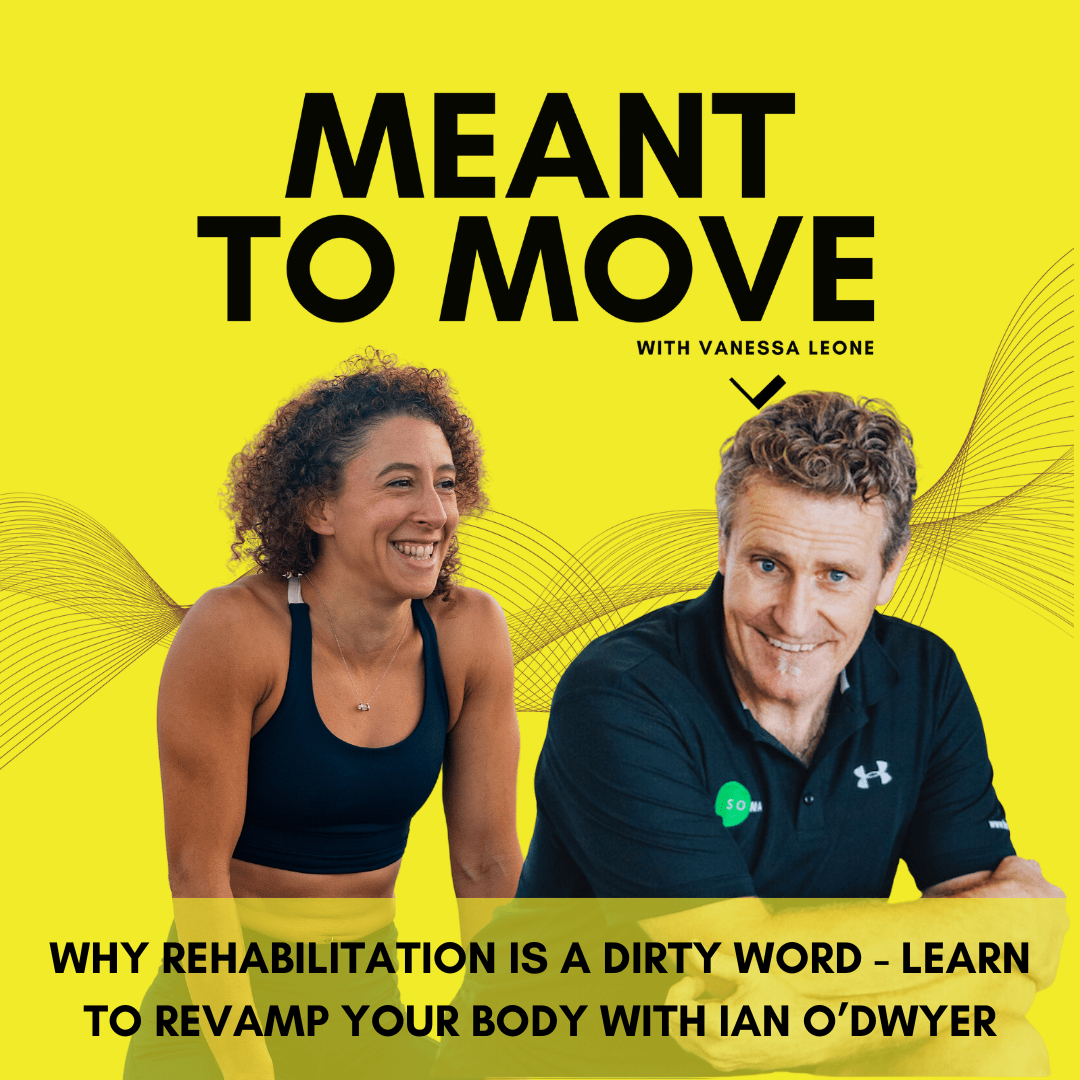
Meant to Move Episode #27 with Ian O’Dwyer
Summary:
In this episode Vanessa and OD, discuss the concept of rehabilitation in the fitness industry. They explore the negative connotations associated with the term “rehab” and propose using “reconditioning” or “preconditioning” instead. OD shares personal experiences with injury and recovery, emphasizing the importance of mental and emotional aspects in the healing process. They also discuss various tools and techniques, such as vibration therapy and foam rolling, to aid recovery. The conversation highlights the need for a holistic approach to rehabilitation, incorporating both physical and emotional support
Transcript:
Vanessa Leone (00:00.77)
Hello, and we’re back. Ihave OD, Yoda in the house. He came on and I said, the first thing he said is, I miss you, OD.
OD (00:13.64)
Yeah, I’m not sure what being in the house is a great thing for you, Ness, or a not so great thing. But anyway, we’ll just see how today rolls.
Vanessa Leone (00:23.006)
Look, we are… This is the season for everybody, isn’t it? It’s the, you know, if you’re in the Southern Hemisphere, we’re in winter. Winter months seem hard. You know, the days are short, but the days are long at the same time, do you know what I mean? It’s one of those weird things, isn’t it? It’s a strange little paradox that we’ve got going there. So I have a interesting topic that I…
I’m literally just completely throwing it out at him today because I was thinking about it over this last month or so. And I wanted to talk about rehab. And I’m not talking about actually, you know what I’m talking about just the word rehab because I think that like a lot of fitness industry words, we’ve kind of killed it and maimed it and made it sound horrible.
When I say the word rehab, what comes up for you?
OD (01:22.536)
Boring, bad shit, don’t want to do it. I’m over it already. It’s not gonna work. I’ve heard it all before. See you later.
Vanessa Leone (01:36.718)
Yep. That’s it. End of the podcast. Let’s go. Yeah. Yeah. Yeah. For sure. And this is exactly, exactly what I wanted to talk about because I think it’s, it’s a dirty word almost now, right? It’s, it has so much baggage associated with it. And I think we need to, to repurpose what, first of all, we can
let’s define what we think is actually rehab. And then let’s talk about how it needs to be repurposed, right? Because I think that this is a space where it’s completely underrated in the fitness industry. People go to allied health professionals for rehab. They get injured, will go see a physio, they’ll go see an osteo, et cetera.
That’s a big space. It’s a big space. So I don’t know, where would you like to start with this, OD?
OD (02:38.014)
Well, as a person who has spent 20 years of his sporting career rehabbing and doing, I was your dream client. I was the client who did everything to the letter. You know, same old, same old, same old, same old. And the worst part was I got on that cycle of injury, rehab,
introduction back into training and then playing injury, rehab, introductory. So it was the same cycle. And, you know, once you’ve got that injury for the year, you go for the season, you basically had it for the season. So hence, Ness, why, as you know, my background, I got very, very curious about the way we’re conditioning clients, conditioning people.
but it’s what do you want to call them? The way we’re conditioning them isn’t matching how we’re trying to reintroduce them into the sport, into the exercise, into the challenge. So rehabilitation for me, it’s not about the physical, it’s about the mental, emotional. Those words are tainted because we’re seeing more and more back pain. We’re seeing more and more science and then we’re seeing more and more tools.
And then we’re seeing more and more experts and we’re seeing less and less results. So the word rehab really, it’s a space that needs to be revamped. And I know from our perspective, from Feel Soma’s perspective, we call it reconditioning.
And in fact, we’ve gone one step forward further and called it preconditioning because at the end of the day, every time I do something under stress or load, I go and do a handstand session with Vanessa Leone. At the end of the session, I’ve blown fuses, my shoulders, my spine, my hands, I’ve blown fuses. My system, my tissues need to reset. So what am I gonna do that’s gonna allow them to reset?
What do I need to do? Well, I need to do some breathing. I need to do some fluid movement that’s gonna allow the fluid to now be absorbed back into the tissues, because we know that nerve, muscle, bone, fascia, skin are primarily water. I would need to bring back in some enjoyment, because the enjoyment’s gonna help the healing process and help the resetting of the fuses more quickly.
So it’s interesting this, it’s, know, where do you start with rehab or where do you finish with it? I don’t know
Vanessa Leone (05:44.728)
That was a nice, profound little moment there. I quite like that. Here’s a, if you want some enjoyment, here’s where my brain went when you said the word revamp. Number one, how much better is that word for rehab, by the way? Let’s start a new thing to call all rehab, revamp. I also just imagined, you know, those glittery vampires from like Twilight, don’t know why that’s imagine if we could like revamp ourselves and
become more indestructible, become more resilient, become more, you know, just that kind of better version of ourselves. And I think that, I think you’re on the money when you’re using words like reconditioning or preconditioning because rehab isn’t a, here’s the start and there’s the end. Because quite often for myself, my own experience, when I see a client, even if they’ve just come with me,
come to me with an acute injury. Let’s take a really easy one. I have sprained my ankle. I’ll say it’s easy, you know, I fell over, I sprained my ankle. I’ve got to wait for some swelling to go down and then we’re going to follow this process. And that’s the process of allied health. But what happens when we work with movement therapy or Feel Soma in your case, is that we go through what I like to call this kind of
onioning. And that first layer is like, okay, you sprained your ankle. Cool. Here’s the rehab or revamp or reconditioning that’s going to get your ankle a little bit closer to what it was like before you sprained your ankle. But it’s going to be different now because you sprained your ankle. So there’s scar tissue and there’s trauma and there’s a whole bunch of other things there. But what about for the six, 12, however many weeks that you weren’t able to walk properly. Now we’ve got a whole body.
that’s out of balance, out of whack, out of its normal condition, because correct, because you just spent 12 weeks guarding your injury. Also, what led to that injury? Because if that’s just you rolling your ankle, why is that happening? Like we need to investigate this. This isn’t something that should be happening. and so once you take away that first layer, even for something
OD (07:48.548)
out of synchronization.
Vanessa Leone (08:12.386)
And I don’t want to call it simple, some, you know, traditionally, if you look at it from that allied health perspective, there’s a six week, you know, rehab process for an ankle sprain, but already we’ve, you and I have just taken off two layers and we go, this is complicated.
OD (08:29.662)
Yeah, it is complicated. And it’s kind of funny, right? Because as soon as you damage something, healing starts.
So if healing’s starting as soon as you damage something, how do I fast track the healing? Well, through our experiences, once upon a time we used to R.I.C.E we used to rest, ice, compress, elevate. Well, I would certainly still compress. I would certainly still elevate. I certainly wouldn’t use ice, and I haven’t used ice for 30 years.
And the research is telling us not to and has been for 10 years and yet we’ve still seen sporting stars using ice on hamstrings, calves, knees, ankles, whatever. So it’s interesting because realistically the ice was used to take away the pain, not necessarily take away the inflammation. So we need inflammation to heal, not excessive, but we do need inflammation. So…
If we damage an ankle, let’s just use the ankle because it’s a common area. As soon as we roll an ankle, what happens? Well, from an integrated approach, the hips say, hang on, ankle’s damaged, we’re not gonna move as much. It has a conversation with the brain. So it limits how much the hips can move, which means it protects the ankle for a period of time. So do I want someone to move on that ankle that has been damaged? Well, like it or not, people have to get to the toilet.
OD (10:10.472)
So whether you’re on crutches or not on crutches, they’ve got to move, right? And if you’re in outback Australia and didn’t have a moon boot, pretty sure you’d probably move minimalistic, but you’d still move. So there’s a lot to be said about, you know, minimalistic movements with damaged tissue from the very get-go because we need to pump fluid. So if we had vibration, we could potentially use that, you know, whether it’s cycloid vibration or whole body vibration.
Vanessa Leone (10:11.096)
They’ve gotta move.
OD (10:40.778)
Um, whether we had, you know, percussion guns, we could go to the lymphatic areas above the back of the knee, the crease, the groin, um, just to help the fluid flow, which is going to help get rid of the waste toxins in the products. So there’s lots of things really Ness that, you know, from that very get go that we can do that fast forwards the healing. And you and I have both seen, you know, I’ve, I had a, ruckman at one stage who was 108 kgs. Um,
rolled his ankle, it was twice the size of his normal ankle on the Thursday night and 10 days later played, know, strapped obviously, but he was doing all the movement. He was doing everything, no ice and played and played very, very well that day. Now, does that injury go away? No, he’s got to maintain that now for the next X amount of weeks, maybe for the season. And especially being as big as he was, obviously he had to be done through the season, but.
got through the season very successful. So it’s, the ankle’s only one area. We’re not talking about spinal damage. We’re not talking about complicated stuff. We’re talking about common sense things. So it’s interesting. It’s once again, it’s getting back to, we changed the name because there’s an emotional anchor to the name and that emotional anchor will impede your healing if it’s a negative vibration. Someone says the word,
rehab to me, as I said, I had 20 years of rehabbing and, you know, brings up all sorts of emotional responses. But I can tell you right now, if I go and twinge something, I’ll go and do some simple movements that I’ve created and I’ll go and use the roller or the ball or the percussion gun or whatever and straight away my body feels better. May not be able to go back to full performance, but certainly go back to at least probably 75%.
So it’s interesting this, we start talking about these things, you know, the industry has invested a lot of money in education, a lot of money in research and science, a lot of money in tools, and our industry has been very driven by tool-based solutions, and a lot of times those things haven’t really been effective.
Vanessa Leone (13:03.778)
I would also say that that kind of research stops at a certain level and doesn’t permeate through. It’s kind of like people just know the surface of it. Like you said, most people know about R.I.C.E but they have no idea that that’s now been proven to be incorrect. And it’s like, well, why does it take so long?
When the science is there, it’s telling us that this isn’t the best methodology to utilize after an acute injury. Why does it take so long for that to proliferate back through when supposedly we do have the best tech and the best access to research? I find it really interesting why we kind of, I don’t know, like just randomly pick out whatever kind of facts that we want. Like people…
OD (13:55.261)
There’s too much money invested in prior research. It takes 17 and a half years for research to come into a textbook and to go out of a textbook. 17 and a half years. Like that’s a lifetime for us in our industry, So, you know, I had a lady contact me today about wanting to have a chat about fascia. She said, you know, people are starting to talk about fascia. And I thought, wow.
2025, we were talking about it in 2007. So, you know, it’s interesting, isn’t it, Ness? We’re talking about things that are what we feel common. Rehabilitation, for instance. And, you know, for some people, I’ve got people who’ve come in here. And the weirdest thing I’ve seen is they’re 50 years of age and never had an injury and they are emotionally, mentally spent because they think their life’s over.
How am going to get back from this? How am going to do my Pilates class? How am going to walk the hills, the mountains? How am going to play golf? am I… Hang on, whoa, whoa. This will be something we’ll get over pretty quickly. And if you do your exercises or what you do your program, away we go. But this is just something that now becomes a ritual that you’ll do every day. Might take you seven minutes. If you haven’t got seven minutes, well, you won’t get back and play golf. If you haven’t got seven minutes, you won’t go and climb the mountain.
But you’ve got to be committed because your tissues now need this to reset, to recondition, to become revamped. That’s a really nice way to put it. We’re revamping the house, we’re revamping the car, and now we’re revamping the
Vanessa Leone (15:37.996)
Yeah, I think it’s going to stick, OD I like it. I’ve got two tangents that I want to go down that you’ve mentioned. One was talking… Well, it’s early.
OD (15:46.279)
Anything.
OD (15:50.366)
So you can You’ve only got two hands is what you’re really saying
Vanessa Leone (15:55.15)
I’m just having a party over here if you’re watching. yeah, so one is you mentioned foam rollers, percussive, full body vibration. I love that stuff. I don’t think many people know what’s going on there. I want to talk about that. But before we kind of go science, come back to the elephant in the room that no allied or very few allied health professionals address when we have an injury.
And you said it is the mental and emotional despair, pain, frustration, fear, the huge cacophony of mixed emotions that we get when something like an injury happens, particularly when it takes you away from the things that you love doing the most. Like, can we just pause on that? Like that’s huge.
OD (16:48.542)
Yeah. It’s massive. It’s massive. I’ll give it to you from my perspective so that maybe some of our listeners can jump on the wagon with me and rekindle some of their gut feeling, their emotional feelings. You know, as most people growing up in Victoria, you wanted to play AFL at the highest level or VFL back in my day.
I got an opportunity to go down to one of the clubs, obviously didn’t make it, went and played VFA which is the next level down which is now VFL. Five games in, had a cracking start to the season, broke my leg. Now, you go, okay, you’ve got one eye, you’re playing in the toughest league outside of VFL.
You’ve got players coming in from Collingwood, Richmond, Geelong, various clubs to try and get a second chance to get back into the VFL. And I’m just a country footballer. I’m just a young bloke down there who hasn’t made his name yet. So emotionally, where am I sitting at? I’m in a situation where that I now start to worry about what happens with my future.
Will I be accepted? Will I be as good? Will I get a kick? Will I get a game? Will I own a contract? You know, will I ever play footy again? I mean, this is the stuff. This is the emotional stuff that no, no person, and I was fortunate back in the time, back in the day, there was a guy called Jeff Oxley and, or two guys, Jeff Oxley and David Shannon, who were the physios down at Geelong at the time, most beautiful guys. And Jeff’s still a great friend of mine.
And, you know, they cared. Yes, they actually cared. They cared about the players. They cared about because they could see we were just country boys, right? Now, without them mentioning the word emotion, they would say, look, it’s going to be OK. We’ll just do this. We’ll just do this. There’ll be some stuff there. But that reassurance, like I didn’t have what my sons had with me. I think I can share experiences with them. I didn’t have anyone to go to.
as many other people didn’t or don’t. It’s a matter of you just do what you do and hope that what you’re doing is gonna get you to the other end. But what people don’t get is that mental emotional aspect impedes your healing. It impedes how you feel, it impedes how you move, so it impedes how you live. So you can imagine I broke a leg five games in, I’m in the cast from hip.
to toes on crutches for 12 weeks. At the six week mark, they cut the cast and put it from the knee down. And even then you’re thinking, okay, yeah, you’re going to the footy, you’re watching your mates run around, you’re just, and I’m doing the exercises, I’m doing what they tell me to do. And it’s one of those things where you sort of go, hmm, okay.
That’s not working. So where am I at? What’s going to go on here? So it’s just one of those things, mate, that the mental emotional thing is just huge that no one addresses. if you can’t, look, I’ve got kids who come into me now and, you know, they’ve rolled an ankle and they’re back playing, you know, and I’ll give you an example. My son, four years ago, tore the ATFL off the bone ruptured it, Thursday night.
Right? Looking to play his first game of VFL. And so you can imagine what he is. He’s shattered and he’s in a scenario where the physio, who was amazing, says to him, I’m gonna tape it, send you back out. Anyway, tapes it three times, three different ways. The third time, worked. No pain.
So he said, I want you to go back now and I want you to work with your dad tomorrow on the whole body vibration plate. And I want you to work with that. And then what’s going to happen, we’re going to go and you’ll be fine to play Saturday. Which he did. Not ideal, but he did. Now, fortunately of all the ligaments you could rupture, that was the one that you probably didn’t need. And we could mimic a type of taping that would let him to play.
But the healing he had, the reassurance that he had, the love that he had in that one day before he played was gold.
Vanessa Leone (21:47.314)
Mm. It’s so undervalued as well. It’s so undervalued. And I think that there’s a very fine line also between that interplay of you’ve got your emotion, you have a physical something. But I’ll share what happened to me a few years ago, you kind of triggered this memory, was
You that you’ve got those two, but then it’s also like your internal health is so closely linked to both of those things. You throw out one of those things and then you’ve got like this cycle of stuff that can happen. And so for me, Miss Bendy over here, putting away a giant inflatable paddleboard, of course.
I get my foot stuck under it, my knee twists, decides to dislocate itself for the eighth time. It’s great fun. So it was quite painful. This one was one of the worst ones that I did. And my knee cap’s sitting out. And so I just kind of, I knew the protocol, just kind of gently push it back to where it was meant to be sitting.
Yeah. And, uh, I kind of sat with it for a little while. It was very ginger to do anything. And then because I’d done it so many times, OD uh, it barely even swelled up. So it was me going, oh, I dislocated my knee after a couple of days. Nothing. It was so minimal. Right? But.
OD (23:22.607)
Are you serious?
Vanessa Leone (23:31.406)
You know, I started, I was very careful, very ginger, kept movement on it, didn’t take anti-inflamm, didn’t ice it, got some massage in and around it, kept the blood flow, all of those good things that we’re talking about. Unfortunately for me, my thyroid condition, Hashimoto’s, was not under control, even though I was taking required medication and things like that. So my nervous system decided to completely go into overdrive and it was on high alert.
And so it decided to attack an injury that I’d actually never ever felt ever in my entire body. So a week after my dislocation, the bottom of the same side foot, my toes, like right under the toes and the pad of my foot started itching and burning and swelling. And I was like, what’s happening here? Like, what is this?
And it got worse and it was on like two toes. And then after a few days, it was on all my toes. And then two days after that, it started going into my other foot. And then my other foot started getting exactly the same thing and toes burning, neural pain swelling. And I’m like, what is happening? Like, what is this? A week in a bit after I did the initial dislocation, I remember it vividly, I was writhing in pain.
in bed, I had my feet elevated because I couldn’t put anything on them. Anything on them was just, it was so painful. My partner, like Michael’s freaking out going like, what’s like, what’s happening? What, like, what do do? Doctors obviously aren’t really entirely sure. go blood test, two types of scans on my feet. Blood test shows my thyroid’s out of whack. Scans show that I have a plantar plate tear in each of my foot.
in each foot. Now, ex-gymnast, ex-dancer, I used to jump around a lot. I actually never had, have ever had a problem with my feet. And this was a super interesting thing. So this dislocation, and it took weeks for anyone to figure this out, mind you. No doctor figured it out. It was a physio friend of mine who was very, very good. And a physio friend of, girlfriend of mine both said that I had this kind of complex pain disorder that popped up.
Basically my nervous system and my immune system attacked this injury that just lived there. Like plantar plate tears don’t heal physically because it’s inside the capsule. It’s, it’s just old damage. And I never had an issue with that. And I couldn’t walk for months, months. And I remember seeing the endocrinologist and I said to him,
If I get my thyroid sorted, do you think that this will help my foot?” And he was the most unsympathetic, let alone unempathetic, like, person I’ve ever met in my life. And he was, the whole consultation was just so rigid and so cold and just like, no, not even any pity. Do you know what I mean? Like it was just horrible. When I was just really lucky that I had great support from Michael
great support from these physios who were just trying to figure out how the hell to get this. Yeah. Like what’s happened. And, and that I think is the perfect illustration is that we all, all of us, we had to figure out how, do we rehab this? Like what’s going on? There’s inflammation there for an injury that I’ve never had to rehab, so to speak ever in my entire life. It’s never going to go away. So how, how do we deal with this? And
So many people have, you know, what you’d call an unexplained issue or something like, like this. And that’s not rehab. Like I had to, like I had to figure things out. Like my entire life was completely altered for months and months. I had poor clients of mine. Luckily I was working down the road from where I lived. had clients coming to pick me up in the morning from my house and drop me off because I couldn’t drive. I was still doing PT sessions, but I was just sitting there on the floor.
because I couldn’t, I literally couldn’t do anything. My clients are incredible about it. Um, but.
OD (28:01.084)
And that’s the difference though when, it’s interesting isn’t it, you talk about relations, because you’re really talking about relationships now. Your clients were prepared to go and get you and for you to go out and that’s a relationship there. And what we’re really talking about is the relationship between ourselves. Now I had a very, you know, straightforward, which I thought it was straightforward, a broken leg, which it obviously wasn’t. And then you had this, this,
unique injury that’s happened from no real trauma as we could see, there was hidden traumas. So, you know, it’s the whole thing of I had to trust someone else because I didn’t trust me, because didn’t know much about the whole thing, as nor were you. And then fortunately, I had people who were supporting me professionally, you had people who weren’t supporting you professionally.
So as you say, know, mine was probably what we would typically say a traditional rehab program. Yours was far from a traditional rehab program.
Vanessa Leone (29:15.084)
It’s wild though, right? And like, this is what happens to everyday people. And this is not something that’s talked about in the fitness industry. It’s all like, reps and sets and do this exercise and you’re going to have a great butt and blah, blah. It’s like, no, this is not real life.
OD (29:33.406)
And it’s interesting about rehab. The research shows, and we’ve discussed this before, about 400 to 600 reps for the synapses of the brain to learn the movement again, to activate the muscle, to remember the movement pattern. Or you can do it through play with 10 to 20 reps.
Well, you know, we talk about boring and we talk about repetitious and we talk about, you know, and I get building stamina and I get building strength and I get all that. But just imagine if we could do it through play, through enjoyment, through fun, through three dimensional motion, through things that look like life. And in a manner in which then you can start to add some challenges which are going to bring the endurance that’s needed in the tissue.
with bicep tear or calf strain or whatever. But it’s just, yeah, rehab is an interesting term. There’s an interesting perspective on it. Because I can tell you right now, I’m seeing people doing stuff that I was doing 40 years ago when I was injured.
still to this day. And it didn’t work 40 years ago and it’s not working now. So it’s just a matter of, for anyone listening to this, it’s a matter of understanding that, you you can’t break the body into segments. And I’ll redefine that. You can.
Vanessa Leone (30:49.07)
That’s outdated. Yeah, by the way.
OD (31:15.08)
But you have to look at the whole body first before you can define that there’s something that’s potentially not sequencing properly, activating properly, moving properly or whatever. Because, you know, what we do Ness is very different from what typically everyone else does. We bring people into an environment that they’re safe and they’re confident in and they’re going to move in. They’re not going to…
just do repetitive stuff and they’re not gonna sit and they’re not gonna be in a certain position for the whole session. Me, I do a little bit of body work as well as the movement side of things, then we’ll build some stability back into it. So the time they move, but the time they leave, they’re smiling, they feel better, generally they feel better. And there are clients, trust us, as we all know, there’s clients you do stuff for and you just go, that just doesn’t make sense, but there’s…
Generally those clients who leave who are still not quite where they should be, in your view, there’s generally underlying emotional and mental stress that’s going on that they don’t want to share and I don’t need to know.
Vanessa Leone (32:23.566)
And it’s also just really hard for anyone to share that level of detail about what’s happening in their world and, and all of the things that can influence how well your body recovers from something or how well it’s not recovering from something which was part of the issue as to why it happened in the first place. And so this is where I think that I really
that circle back really nicely, actually, where your talk about reconditioning and preconditioning is perfect because it becomes this constant circle of what am I doing in my body that needs help and assistance to be able to recover and to grow? And then what can I push in my body that I have developed enough stamina control ability to push a little bit further? And so I quite like the symbiosis of that really.
OD (33:20.518)
And Ness, think this is one thing I believe I’m probably getting better at now is that, you you’ve done these episodes, these podcasts and listening to the podcasts, the information that’s been on there has been fantastic. And the guys you’re getting are people who aren’t just informers, they’re practitioners, they’re coaches, they’re people who actually are living in the real world. So I’m going to take this back one step further, as you said, whether it’s called preconditioning or not.
This is recovery. This is how, you know, we had a conversation some episode ago on what is recovery, right? Recovery is priming the tissue, priming it so it doesn’t break, priming it so it doesn’t, so it doesn’t falsely sequence, priming it so it can adapt under force, under load, pressure, you know, in an odd position. So,
And priming can happen through foam rollers, can happen through some fascial mobilizers, can happen through some stability exercises, whether that be with bands, sticks, body weight or whatever. And then you’ve got your restorative side. So post-session, you would say, right, what can we do post-session? So this isn’t rehab, this is all part of a program. So every session we do should incorporate some type of
priming some type of preparation some type of Making the client do something that’s going to look like what their challenges are going to be if they’re to be handstand as well I’ve certainly hope they’ve got you know fascial mobilization through their hands their shoulders their elbows And through their hips because their hips have to move as well when you’re a handstand and by the way, so their feet So it’s kind of interesting right? It’s
We’re going back to the episode where we spoke or episodes where we’ve spoken all the way through about fascia, where we’ve spoken about neural connection, about movement patterns, about fluid response. If we get things correct, what that’s gonna mean is we don’t have the need for rehab. You’re gonna break bones, you’re gonna fall over, you’re gonna trip, those sorts of things. The bones are a completely different thing to rehab, to…
tissues like fascia, neural nerve, muscles and that sort of stuff. The bones, the fascia that wrap around it, once you’ve got your bones strong, then the tissue, what you can do with tissues after that is really, really cool. Really, really quite powerful. But it’s just a matter of understanding that if we come back to what we know, and it’s funny, this little beautiful
Australian uniform in the back there a client of mine presented to me when she won the 2010 Lucerne Double Scull world championships She went through you know all sorts of things and we got her to the Olympics and I sort of staff and she was a girl from Bendigo just a beautiful girl Hannah Hall every and she’s still involved with the AIS and she’s involved I think with the heptathlon or decathlon team still and she’s saying now they still don’t do much
priming It’s still not doing much restoration. So here we are 20 years down the track and not much has changed. Yet, you know, words certainly hasn’t changed and athletes, can assure you, no one wants to do rehab. A corporate doesn’t want to do rehab because it’s not cool. So just imagine if we stuck in some, some simple little things in their programs that could create
the ability for them to create better fluid flow, improve their decision making, allow them to adapt into odd position positions with force, could allow them to perform optimally, could allow them to feel good and allow them to enjoy it. Wow. That’d be a nice little recipe.
Vanessa Leone (37:37.24)
So far fetched. What is this?
OD (37:39.006)
If it was in a tablet, was in the tablet. I’m not Big Pharma, but they’d be after me
Vanessa Leone (37:44.298)
Everyone had buy it.
Vanessa Leone (37:48.366)
100%. So let’s come back then to someone who’s listening who wants to employ some of the things that we’re talking about.
At home, I have two different types, of course I do, of percussive guns or vibration tools. Now, you’re the best person talk about this. When people are like, I’ve got a massage gun, but maybe they do have a massage gun or maybe they actually have something else, what’s the difference that we’re looking at there, OD
OD (38:21.278)
Okay, so when we talk about vibration, vibration’s a really, really powerful way to help tissue heal. Now, whole body vibration power plates are when the plate goes up and down, it only goes up and down on low at about one to two mils, so really, really small, but it goes up quite quickly, up and down quite quickly. So it goes up and down, side to side, and backwards and forwards. So we call that multi-directional vibration, and the cells…
love it. The brain loves it. Anything that’s multi-directional, any sort of stimulus, the body, the fascia, the brain loves it. And then you have, but with whole body vibration, you can actually create force. So you can stimulate not just vibration frequency, but also you can stimulate, you can increase the amount of force you want. So you could have, you know, one to two Gs, you can have three to four Gs, you can have five Gs, six Gs of force.
Six times your body weight, five times your body weight is a lot of force. But for most athletes, you’ve got to able to produce that because when they’re playing sport, for instance, if they change direction, they’re running in a straight line and they change direction to handball or to throw, could be anything up to 15 Gs of force in that direction or change. So tissues are under a lot of load. So whole body vibration creates a frequency.
multi-directional frequency which tissues and the cells love. Cycloid vibration, once again is a multi-directional vibration, very, very no force at all, very, very low. So you see a lot of times you’ll see cycloid vibration. There’s a company in Australia called Niagara and they do amazing stuff, not only for humans, they’re in Brisbane, but also in the equine system. Then we have our typical, I haven’t got a gun here, but you might have a peanut.
and it’s a vibration peanut, whites come on. Now it’s one dimensional, it only goes in one direction. Now the really cool thing about that or a percussive gun, once again, there’s two types of percussive guns, there’s big gun and there’s a smaller gun. The beautiful thing about vibration balls or the percussion gun is that it’s great to stimulate fluid flow. So for…
OD (40:46.366)
priming or preparing the tissue to get fluid into the tissue is really important. So, you know, if I was an athlete, if I was a person going for a 10K fun run, I’d stimulate the soles of the feet, I’d stimulate about a hand’s width above the crease at the back of the knee, I’d stimulate the creases of my groins, I’d stimulate either side of my belly button, I’d come up and down my sternum under the bony sections. Any of those areas are gonna be great areas to stimulate because it’s gonna stimulate fluid flow.
and it’s going to help the tissues now become hydrated and lubricated, which means they’re gonna move better and the body’s gonna respond better. Vibration, percussion are very, very, very good tools. It’s just understanding, know, multi-directional vibration is the ant’s pants. Percussion, vibration, balls are great for fluid flow and, you know, they’ve all got great uses.
Great for fluid flow, so they’re for priming the tissue, but they’re also great for restoring the tissue.
Vanessa Leone (41:47.924)
Mm-hmm. I’m gonna put the side note in here. I wholeheartedly miss having access to full body vibration powerplate tool. my god, the recovery on that is… there’s nothing better. There is nothing better. Having had it for years and then not having access to it, I miss it and that is like my number one.
a priority to one day get back into. So hence why I have the percussion and a different tool. I will say this. Go, go Eddie.
OD (42:18.354)
Yeah, yeah. And that’s the thing. And that’s the thing. It’s not, you know, in a perfect world. It’s great to have.
you know, whole body vibration in a perfect world. Now they’re expensive. The side to side plates you see that, you know, for 500 bucks, do they cut it? No. They’re one dimensional. And in fact, they draw a lot of force into your lower back. So you need to be careful of those sort of plates. So power plates, potentially the only plate that now creates whole body vibration. So they are expensive as you know, but they are amazing. But even getting fluid to move through the percussion
or vibration balls. Super, super, super, super important. Super important. I’ll give you, it was quite funny. I’ve known Niagara for many, many years now. And it was interesting because when I was in China in 2019, they had an epidemic that where the flesh eating diseases were coming through on people’s arms and legs and they couldn’t stop them. And the only way they could actually get the flesh to grow back was by using
Niagara has this pad. It’s a vibration pad. has a hard roll on one end and it’s a soft pad that sort of goes down about the width of your back and it’s about probably 18 inches long, 450 mil long. And they putting them in the beds of the people and the flesh was growing back like you wouldn’t believe. fluid flow, know, cells love that cycloid vibration.
Vanessa Leone (43:51.288)
Patients, yeah.
Isn’t that incredible?
OD (44:02.941)
Gentle but just very very powerful. So it just shows you and you’ll know like if I’m using a small gun on The bone I don’t use big guns on the bone I use big guns on the muscular areas But if I use a small gun on the bone, I’ll generally use it sideways But as soon as you use it on the bone around the collarbones up around, you know, know, occipital base of the cranium base of the head. Use around those areas how you feel after that. I use it up in my face up my sinuses
And just on the side, just on the leg, and the tissues just feel amazing. Absolutely.
Vanessa Leone (44:36.462)
Mm-hmm, yeah. personally I can’t stand the force much of the big gun that we have. It’s also one of probably, I think, the most initial old models of when they first came out and it sounds like fricking, like it sounds like an aeroplane’s landing. Yeah, that one personally for me, Bendy humans in the room, watch out because
changes a lot, but I got one recently that has a super low setting and a nice, kind of more flat, more round interface head and different types of facets rather than the real kind of pointy or angular interfaces. And makes a huge amount of difference, like a huge amount of difference. And that one I love, like that one has been
super useful, I use it quite a lot more because I yeah sometimes I’ll see a massage gun and for some of my bendy clients I’m like, put that away. That one’s too big and scary for you, you don’t need that one.
OD (45:44.062)
Yeah, yeah.
OD (45:48.71)
And it’s interesting, the technology’s come so far. I now you’ve got infrared lights that are on the gun. Now you’ve got various speeds. As you said, you’ve got various array of nozzles now that are much more comfortable to use. So yeah, they’ve come a long, long way. Really, really, really way. So they’re powerful.
Vanessa Leone (46:06.198)
I think, and I think that’s also like, for me, and we’ve talked about this, know, foam rolling is a great tool. It’s stimulating set very similar components in the body that we’re talking about when we’re looking at percussion or that one dimensional vibration, but it hurts more. And it’s much more targeted and specific and
And a lot of people have a resistance to that. And also you’ve got to get in kind of all kinds of weird and wonderful positions to use your foam roller. It’s not necessarily accessible for everybody. So I think it’s great that these kind of smaller tools have perpetuated because it does make that kind of recovery so much more accessible for everybody.
OD (46:54.014)
And what’s interesting about that too is that, know, self myofascial release, which is what it’s typically known as from a Feel Soma perspective, we call it self myofascial engagements. In other words, we’re engaging the tissue. So they’re both, you know, 60 seconds, 90 seconds. Now we also do self osteofascial engagement, which means we work on the bone with the roller and you don’t work on it any longer than 30 seconds. Now the difference between those two, they’re both great.
One, working on the bone, less time, 30 seconds, no more, no more, maybe 20 seconds is even better. You know, four rolls, four shifts, done. What’s interesting about that is that sometimes you just have to go and use a roller on a certain location, whether it’s the lateral hip bone, whether it’s the top of the hip bone, whether it’s the back of the hip bone, whether it’s the side of the knees.
You just have to work with a roller or a ball to get that shear in the fascia to get the change and the guns and the vibration balls don’t cut that. So it’s just understanding what the tool is, what you need. And that’s why we developed, Feel Soma developed the self, the bony structure because of the fact that we knew that addressing the bone made a big difference. And people didn’t necessarily want to sit on a foam roller for 90 seconds in that pain state.
and it’s not necessarily ideal for what we want either.
Vanessa Leone (48:22.254)
Exactly. Yeah. My clients who I made foam roll early on in my career without that knowledge are like yelling at me now going like, say you hate the foam roll. It’s fine. It’s fine.
OD (48:33.534)
Don’t worry, I know what you mean. I know what you mean.
Vanessa Leone (48:38.862)
So, coming to the end of this discussion, if someone is currently engaging in a rehab protocol, I say that in inverted commas, they’ve had an injury, acute or chronic
Where, like what would you want to say to them to help them along this journey to help progress their recovery?
OD (49:07.036)
Okay, the first thing I would want to say to them if they’ve gone to an allied health professional is please ask questions. You know, it doesn’t take, it doesn’t take four to six weeks for certain muscles to get better. You know, we can change tissue very, very quickly and you’ll feel the change whether it’s a rolled ankle or a sore knee or whatever, you’ll feel the change. Now,
there might still be discomfort there, might still be limitation there, but you’ll feel how there’s been an improvement there, right? So, you my first question towards an allied health professional is, okay, so I’ve got a location that’s damaged. What are we going to do to incorporate now, not in full week’s time, to incorporate the rest of my body so that my body can support the healing process? And secondly, what are the things that I can do at home?
not just from an exercise perspective, but from a potential heat perspective, a potential compression perspective, potential tool perspective. I’ve got a percussion gun, I’ve got a roller, I’ve got whatever. Because at the end of the day, all I know is rest doesn’t fix many things.
It really doesn’t, you know, because at the end of the day, tissue needs fluid to pump and you’re not going to pump fluid through tissue unless you’ve got the tissue doing something. It doesn’t matter how small it is, it might be a breathing exercise, I don’t care. You might be lying on your bed just flexing, inverting and even inverting your foot, in other words, just turning foot in different directions backwards and forwards. But that is something that is going to empower you to heal.
So you need to ask questions from an allied health professional. If you’ve got niggles, you know, with your body, there’s a ton of different things you can do. Generally, it is a movement pattern. Generally, you won’t be breathing properly. So, you know, lay on your bed and see if you can breathe in through your nose for four seconds and then out through your nose for four seconds. And then see if you can breathe diaphragmatically into your…
abdominals, lower abdominals, because if you can’t breathe nine times out of ten, you can’t get fluid to pump around your body, you can’t get oxygen to the brain and to the tissues. So breathing is a big component of it and then, you know, we can start doing some movements and it’s funny, you know, for instance, I might have someone with an ankle problem standing up in a split stance leaning against the wall and the split stance with one foot slightly in front of the other just looks like you’re walking.
And I might just get you to rotate your hips from side to side, hanging onto the wall as I’m breathing in through my nose for four seconds and out through my nose for a few seconds. So now I’m getting triplanar motion from the ankle to the knee, to the hips, to the T-spine, to the nose. So I’m getting my whole body to reconnect. I’m giving fluid the opportunity to move. I’m stimulating a neural response and I’m creating a movement pattern now that the body recognises all within the threshold of not creating.
Vanessa Leone (52:23.894)
It’s some good advice and it’s powerful to illustrate to people how there’s always hope. There’s always someone that you’ll be able to find who can help you through the challenge that you face. And if you’re not happy with the support that you’re getting, then reach out, find someone else. I think my biggest piece of advice is find the allied health professional.
who you can ask questions to, who doesn’t gaslight you, who is happy to support you and will listen to you. Because at the end of the day, what you’re going through is relevant and important and you deserve to be heard and you deserve to be seen in a way that is impactful for you. And that is also going to make a huge impact on your recovery.
OD (53:15.742)
Absolutely, and that’s, as you say, it’s, you people don’t know, people don’t know how much you, people don’t care how much you know until I know how much you care. You know, and that’s something that’s been driven into us for years, so it’s that whole scenario now of, find someone who cares, you’ve probably got a healer, so work with them, keep them, because you’re gonna get better quicker.
Vanessa Leone (53:40.93)
Definitely. OD I feel revamped after talking to you.
OD (53:45.31)
I don’t know what I feel after that little conversation. It’s interesting, isn’t it? Because it’s something that for you and I, we’ve spent a lot of hours in not just performing it for ourselves, but actually giving it to clients. And we know what does and doesn’t, what has and what hasn’t. And what’s really important to understand is these podcasts are about
Empowering you to know and to feel that there’s other options out there. That there’s people out there who are prepared to help you and to share with you the truth about what goes on in the industry You know, I’m not employed by power plate or Niagara or Whoever to promote their products. I promote them. I talk about them. I use them because they’re great products And that’s what I love about our conversations is that
You know, rehab is, it’s something that actually, you know, can be quite depressing for people because the first thing they think of is that they’ve gone right back to the start again. Where the truth is, if you’ve just, if you’ve damaged something, you can actually get to start doing movement and get it to start healing instantly. If you give it the stuff that it needs and you can actually fast forward your progress really, really quickly.
Vanessa Leone (54:53.761)
Exactly.
Vanessa Leone (55:09.868)
Yep. Great place to end on that. Thank you again, OD I appreciate you. We love your thoughts and we’ll see you soon!
OD (55:16.478)
I’ll talk to very soon. See you guys.
 Vanessa Leone Movement Therapist